HTML · SVG · PNG · PDF
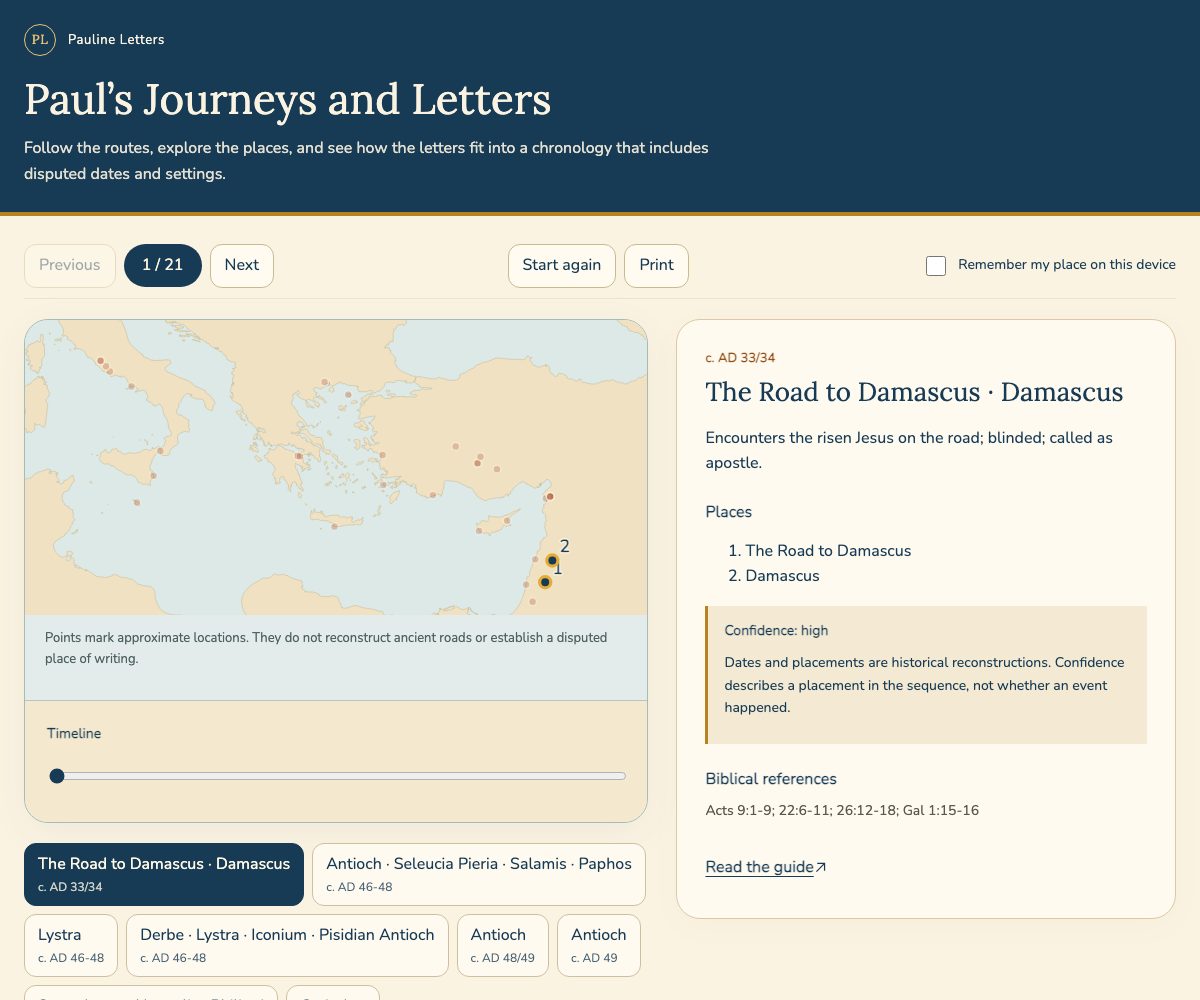
Paul’s Journeys and Letters
Follow the routes, explore the places, and see how the letters fit into a chronology that includes disputed dates and settings.
Open resourceLearn · Explore
Explore the letters. Follow the journeys. Take something worth sharing.
Encounter Christ through Scripture, history, and thoughtful learning.
Resources 68 / 68
HTML · SVG · PNG · PDF
Follow the routes, explore the places, and see how the letters fit into a chronology that includes disputed dates and settings.
Open resourceHTML · SVG · PNG · PDF
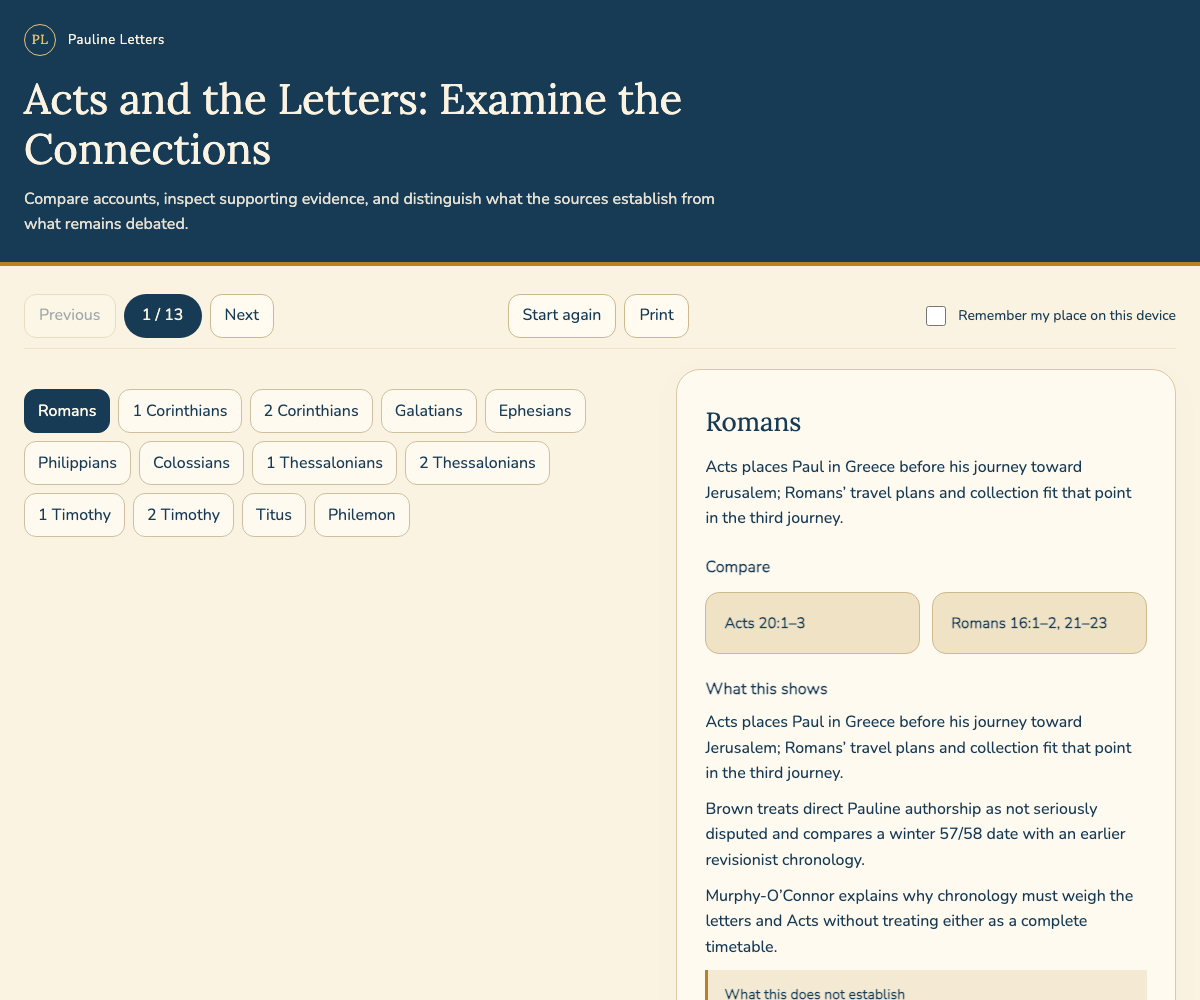
Compare accounts, inspect supporting evidence, and distinguish what the sources establish from what remains debated.
Open resourceHTML · SVG · PNG · PDF
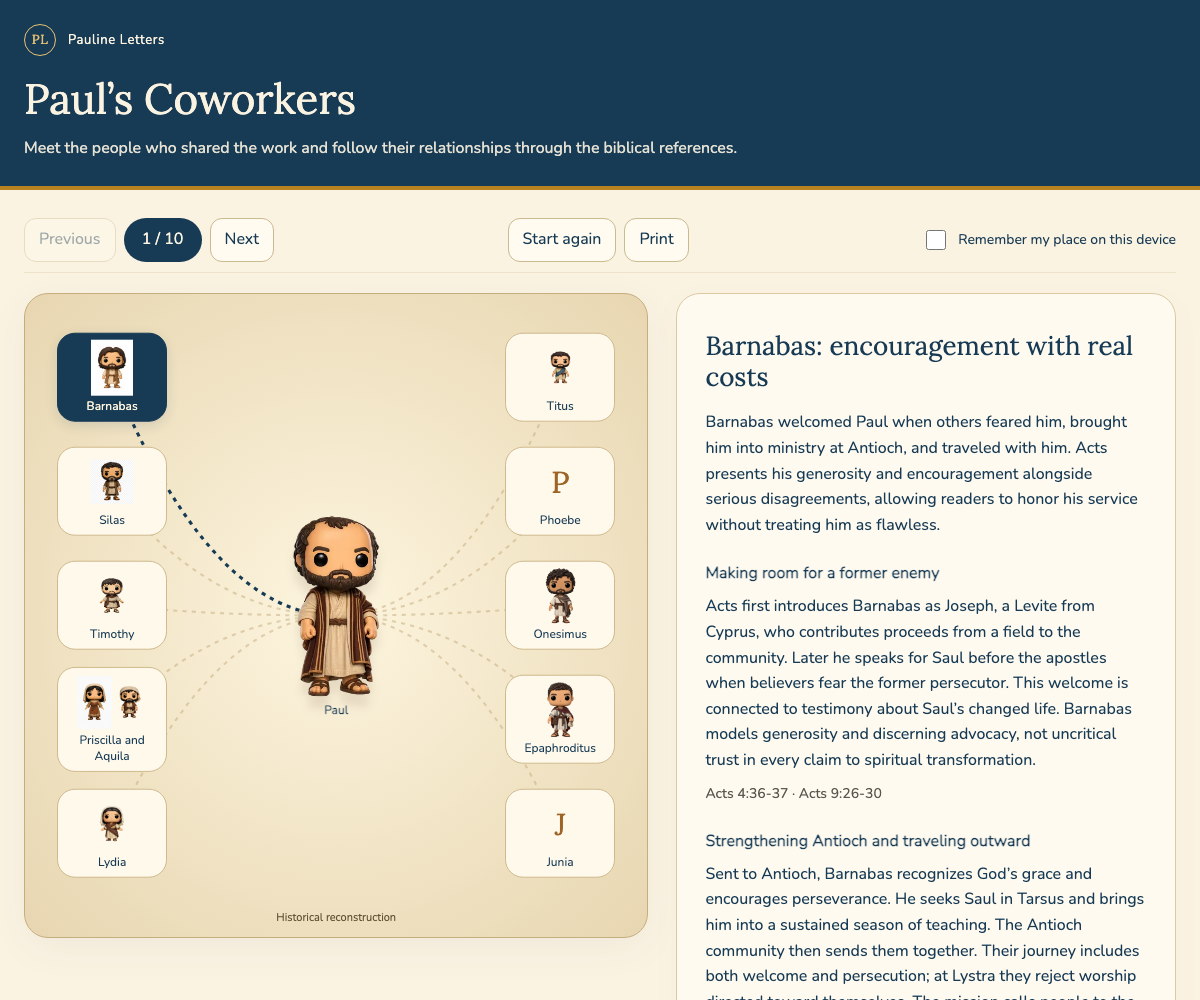
Meet the people who shared the work and follow their relationships through the biblical references.
Open resourcePNG · PDF
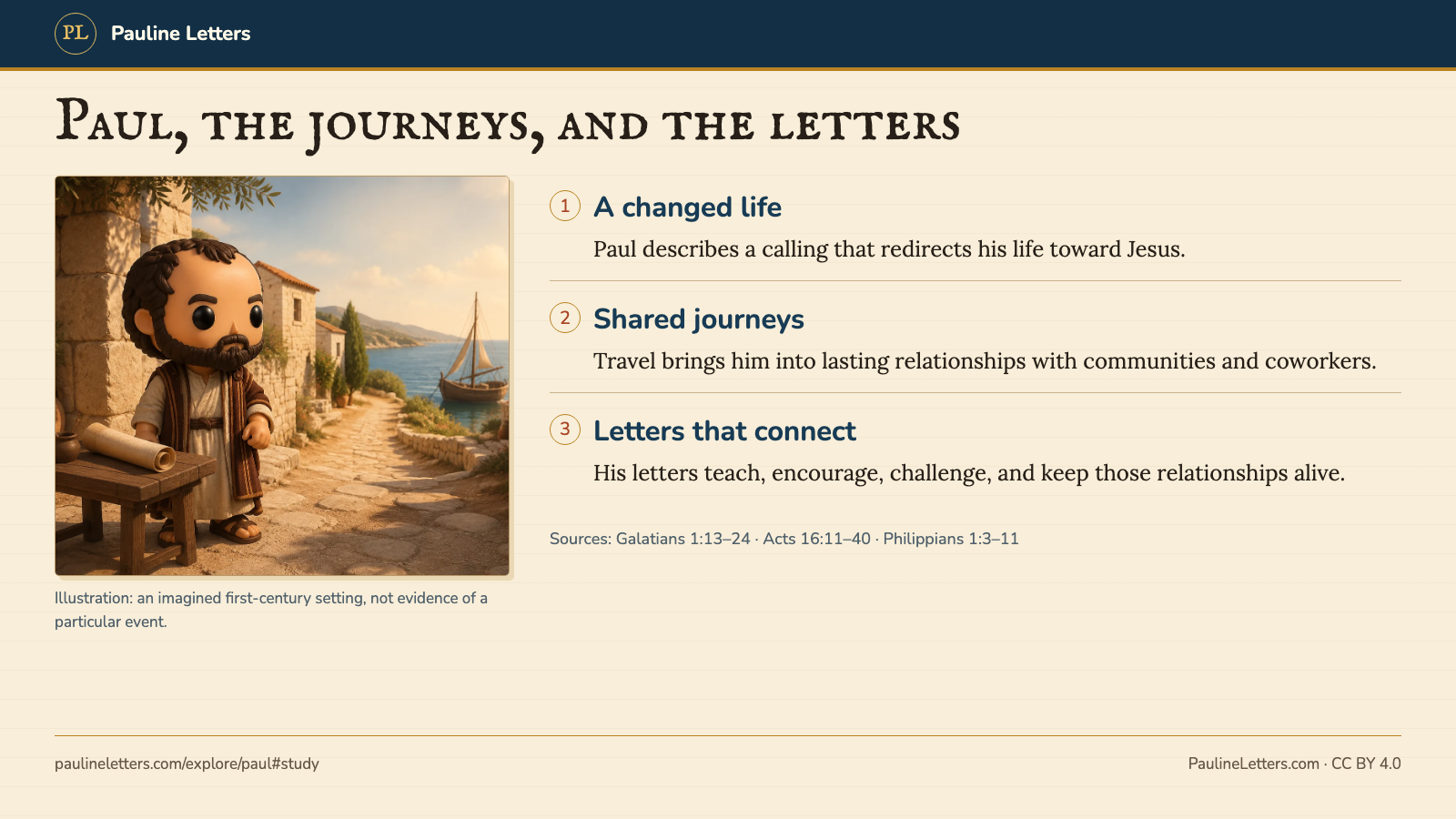
Five short readings to connect the person, the journeys, and the letters.
Open resourcePNG · PDF
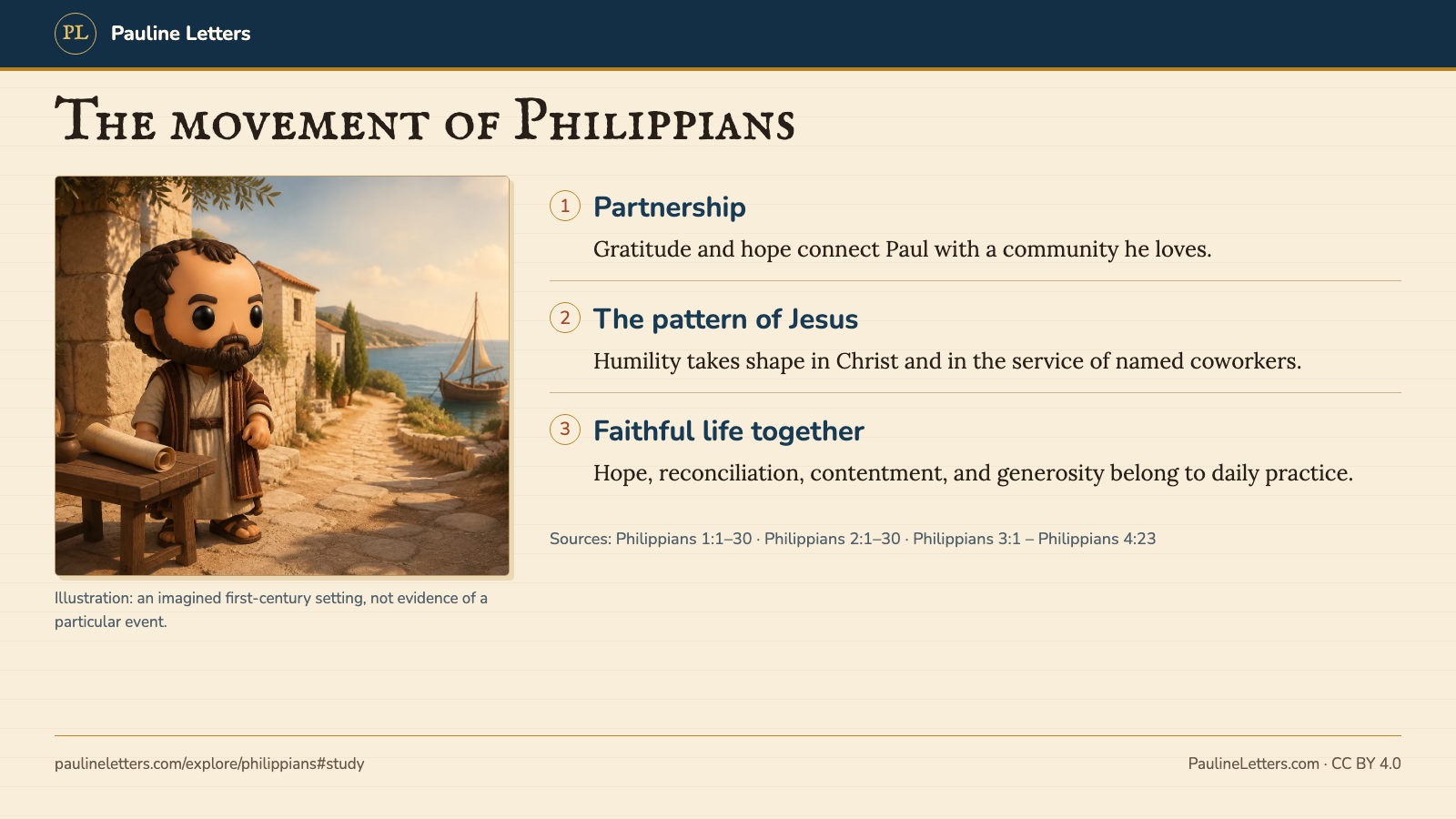
A starter study in joy, humility, and life together.
Open resourcePNG · PDF
A flexible lesson in reading journeys, relationships, and evidence together.
Open resourcePNG · SVG · PDF
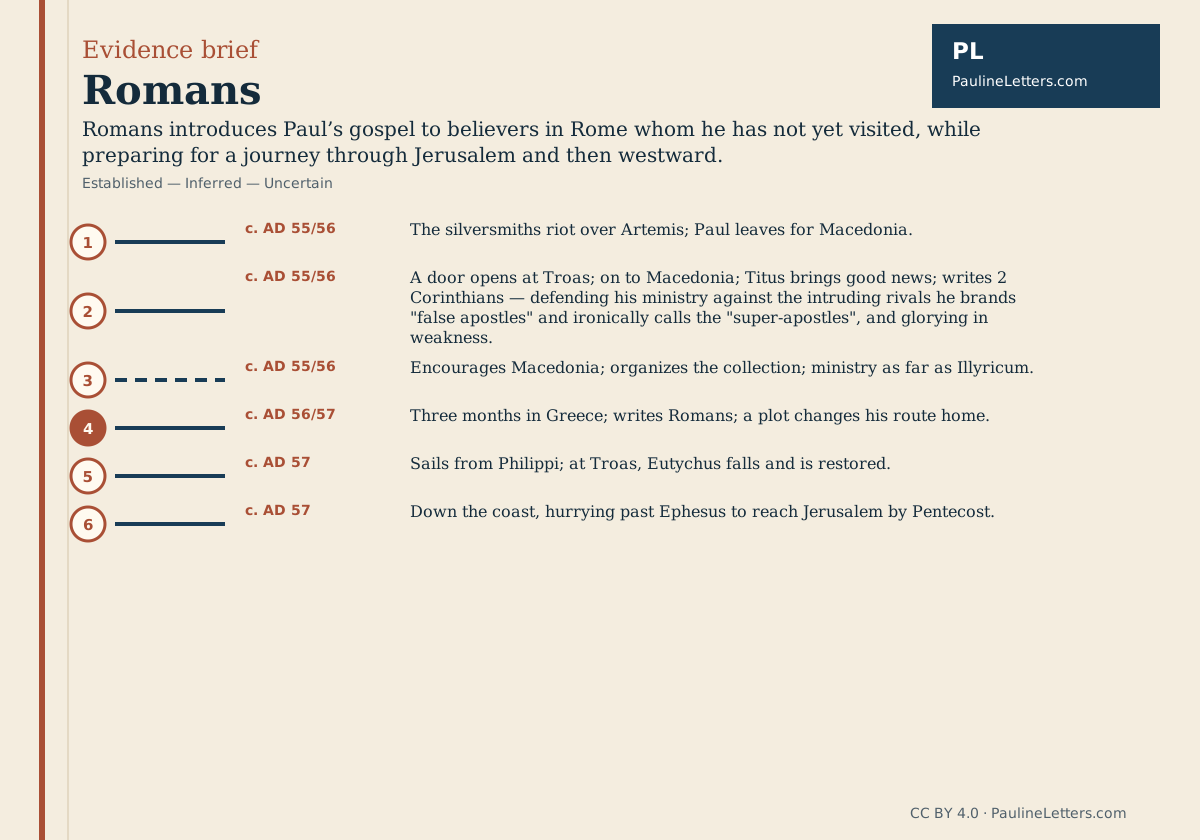
Romans introduces Paul’s gospel to believers in Rome whom he has not yet visited, while preparing for a journey through Jerusalem and then westward.
Open resourcePNG · SVG · PDF
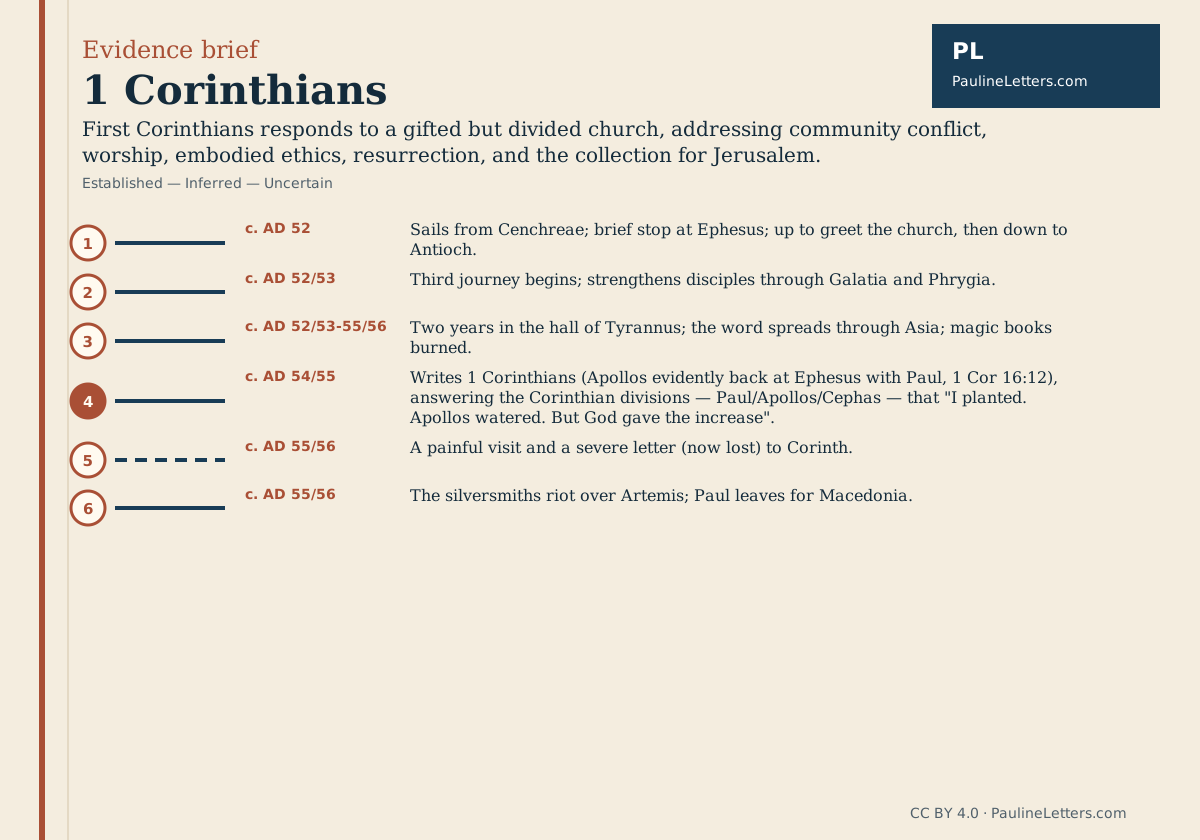
First Corinthians responds to a gifted but divided church, addressing community conflict, worship, embodied ethics, resurrection, and the collection for Jerusalem.
Open resourcePNG · SVG · PDF
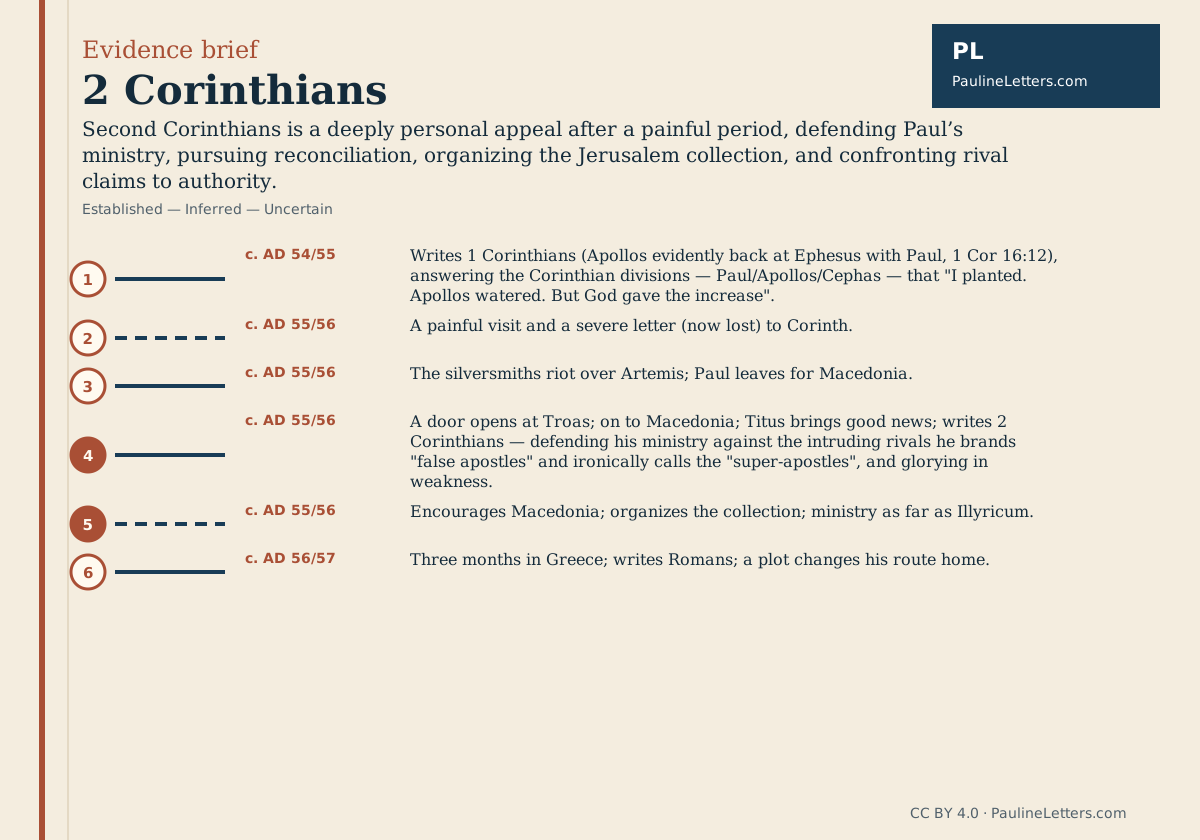
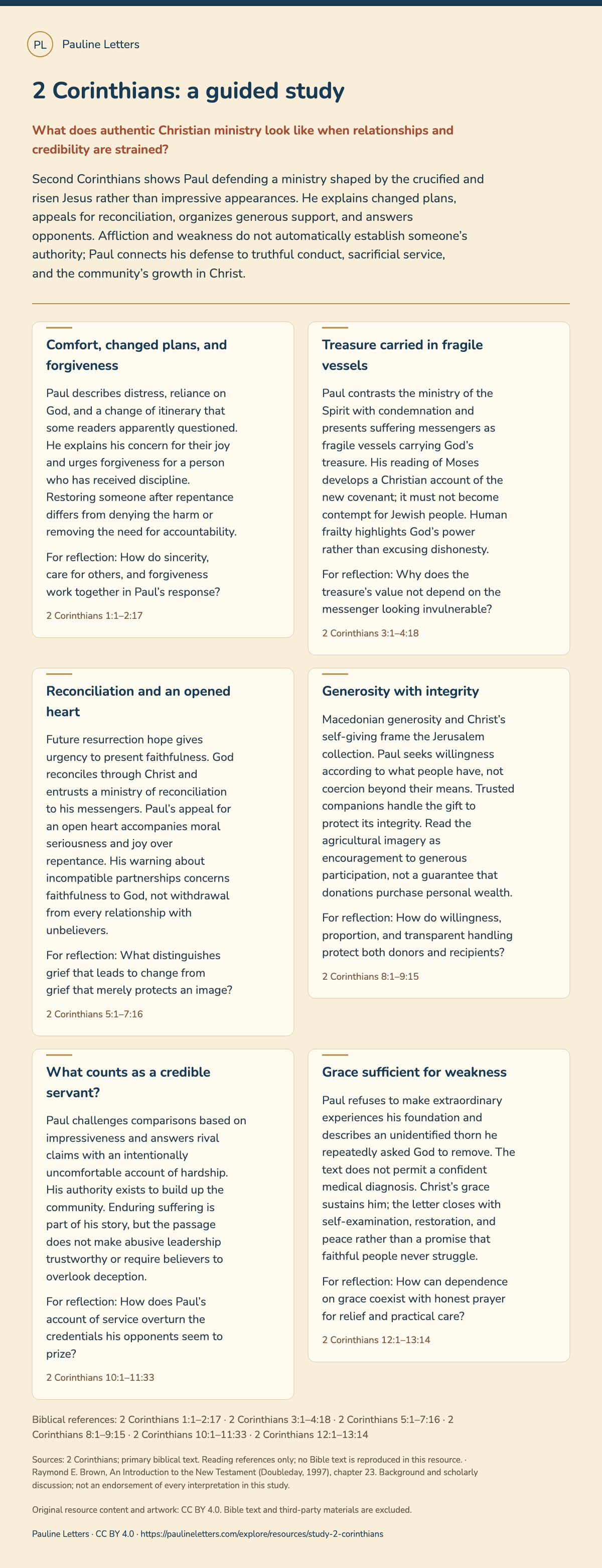
Second Corinthians is a deeply personal appeal after a painful period, defending Paul’s ministry, pursuing reconciliation, organizing the Jerusalem collection, and confronting rival claims to authority.
Open resourcePNG · SVG · PDF
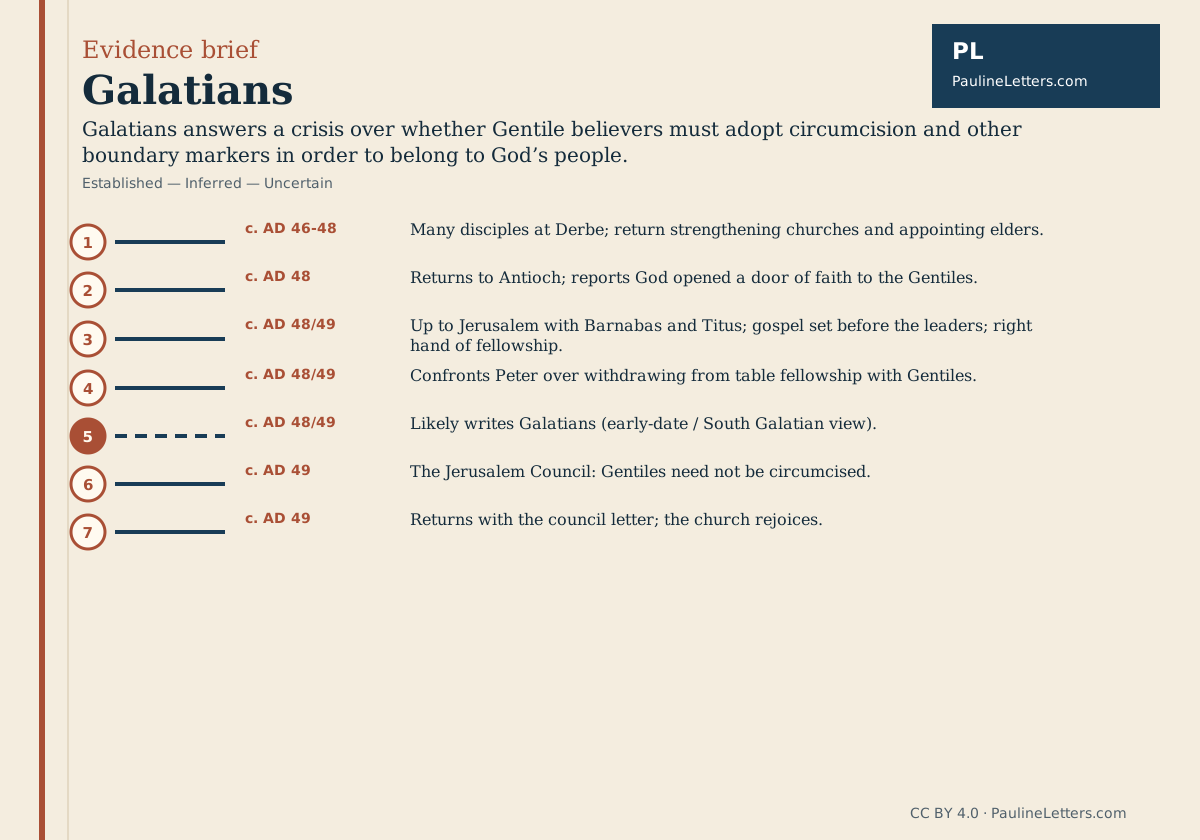
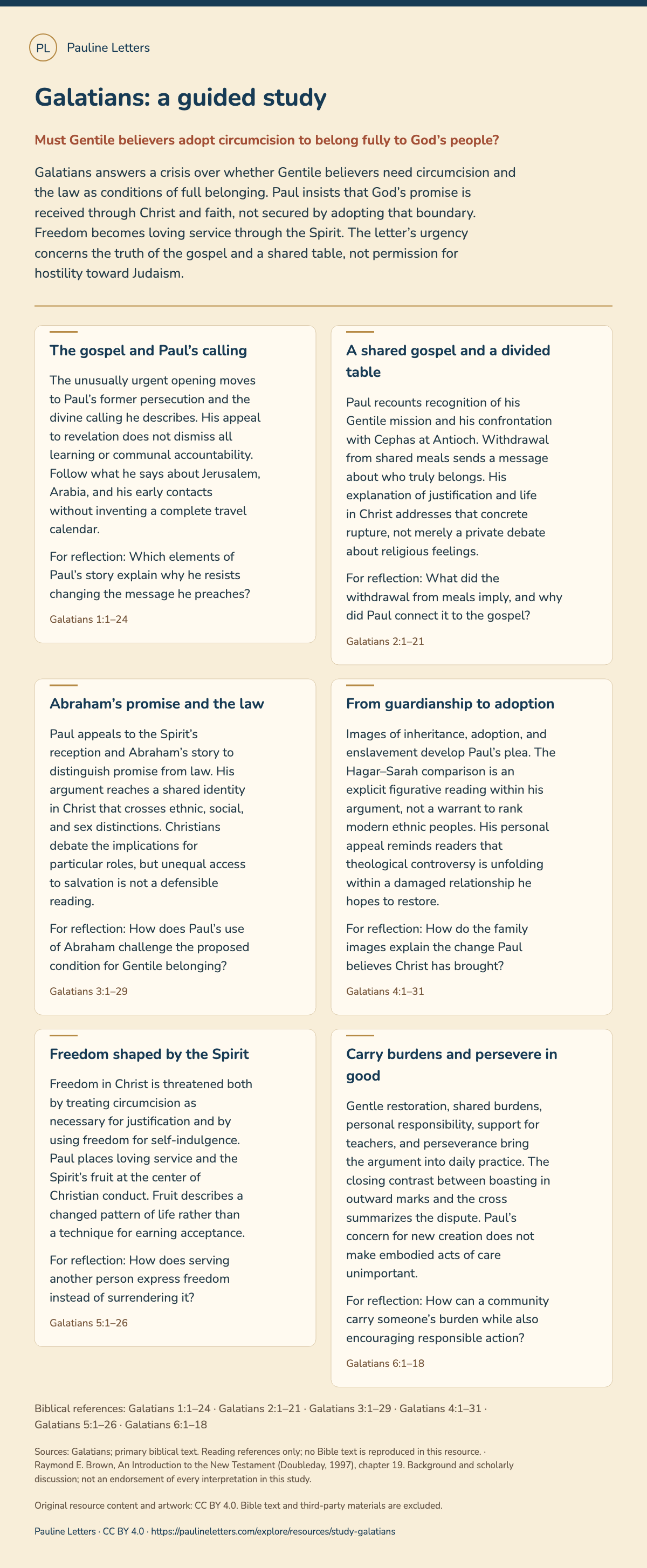
Galatians answers a crisis over whether Gentile believers must adopt circumcision and other boundary markers in order to belong to God’s people.
Open resourcePNG · SVG · PDF
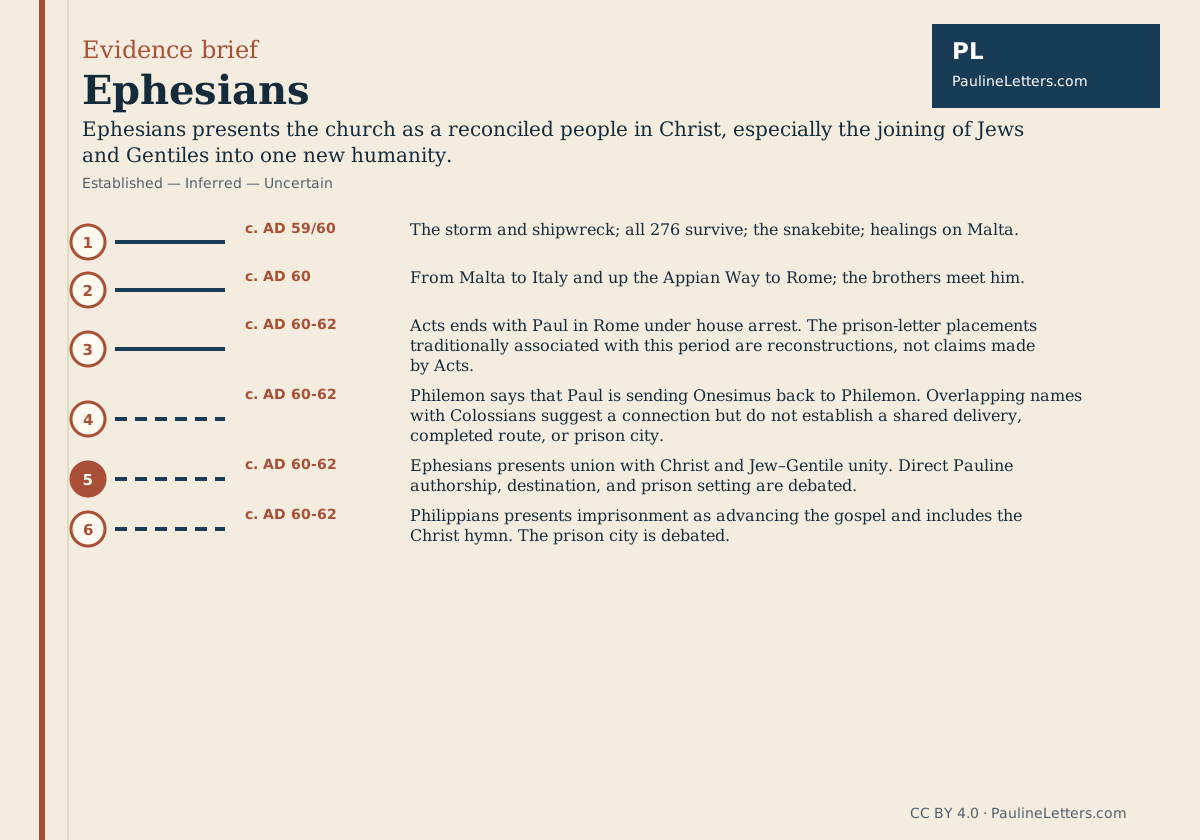
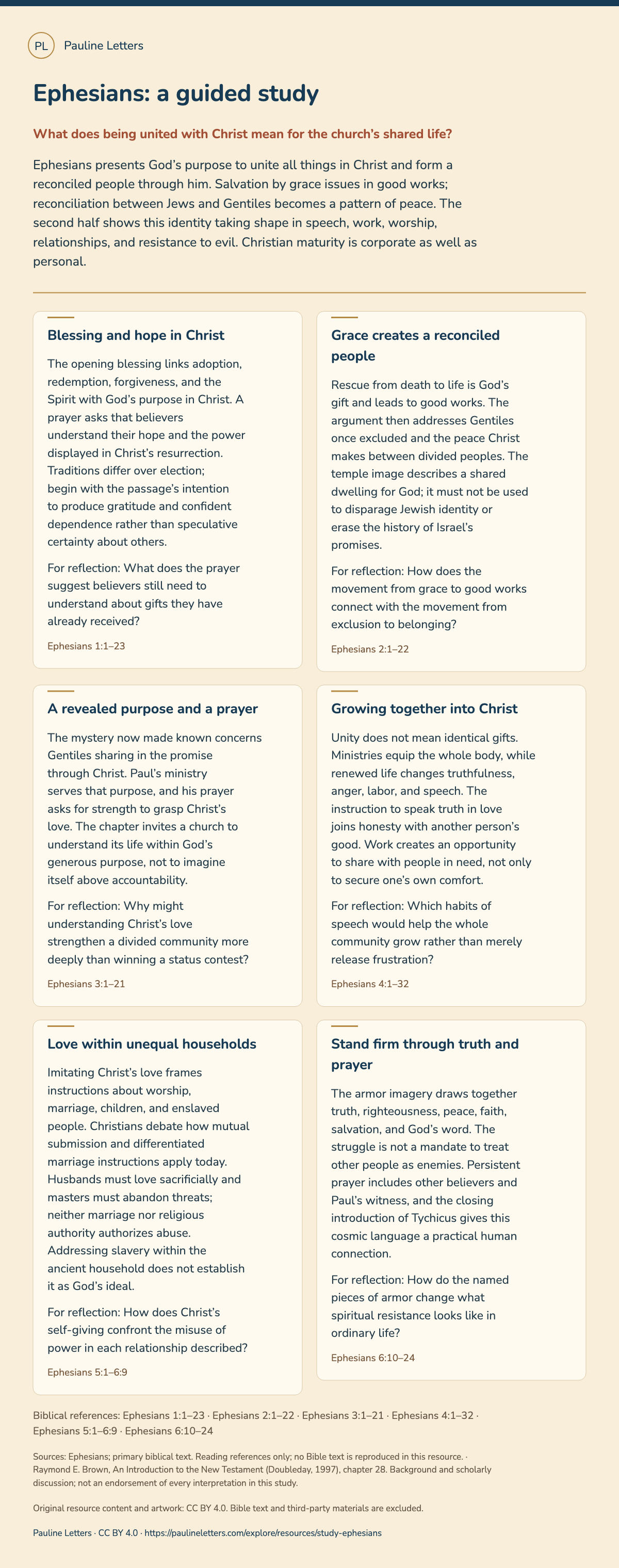
Ephesians presents the church as a reconciled people in Christ, especially the joining of Jews and Gentiles into one new humanity.
Open resourcePNG · SVG · PDF
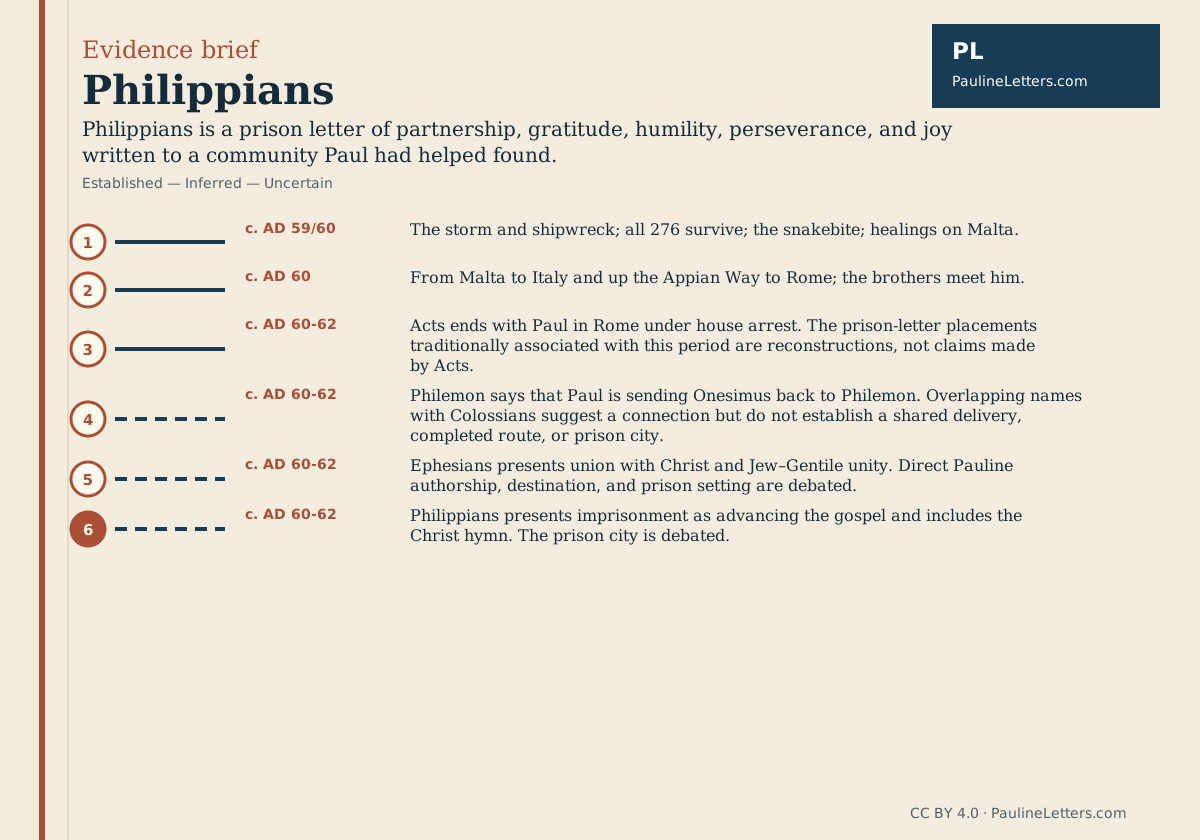
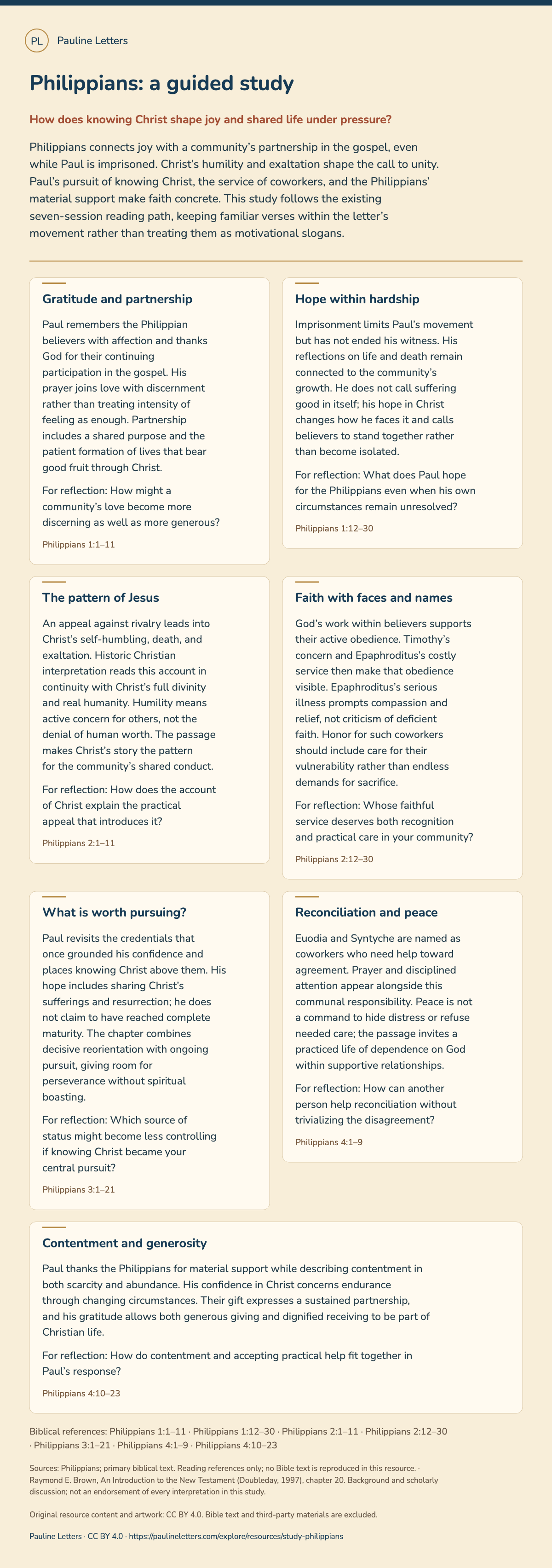
Philippians is a prison letter of partnership, gratitude, humility, perseverance, and joy written to a community Paul had helped found.
Open resourcePNG · SVG · PDF
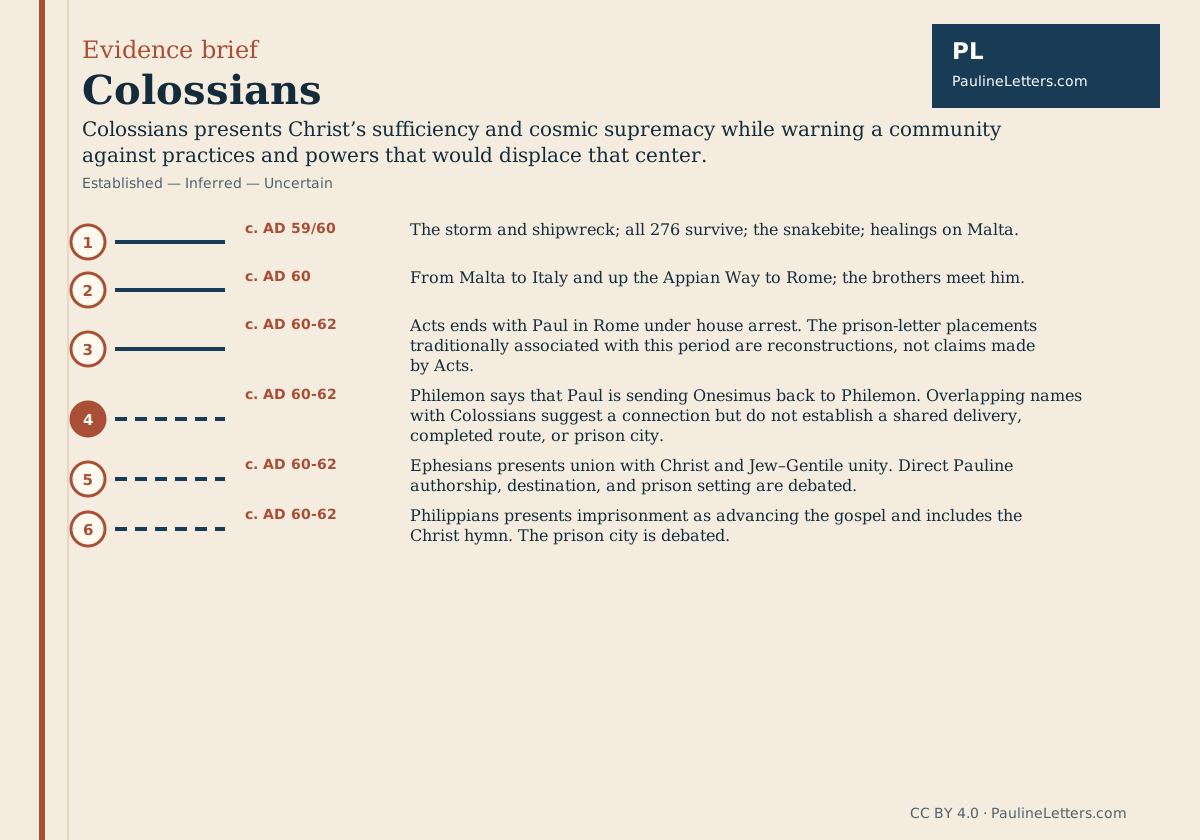
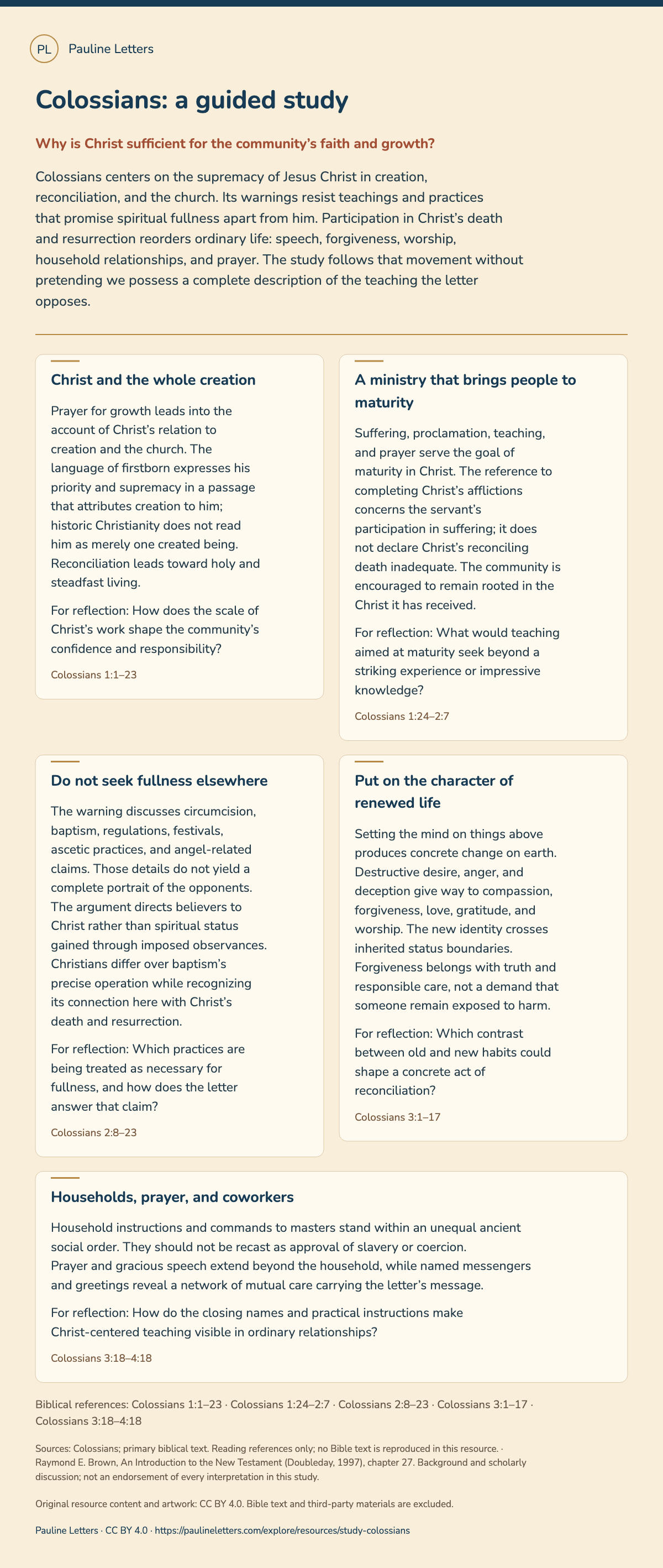
Colossians presents Christ’s sufficiency and cosmic supremacy while warning a community against practices and powers that would displace that center.
Open resourcePNG · SVG · PDF
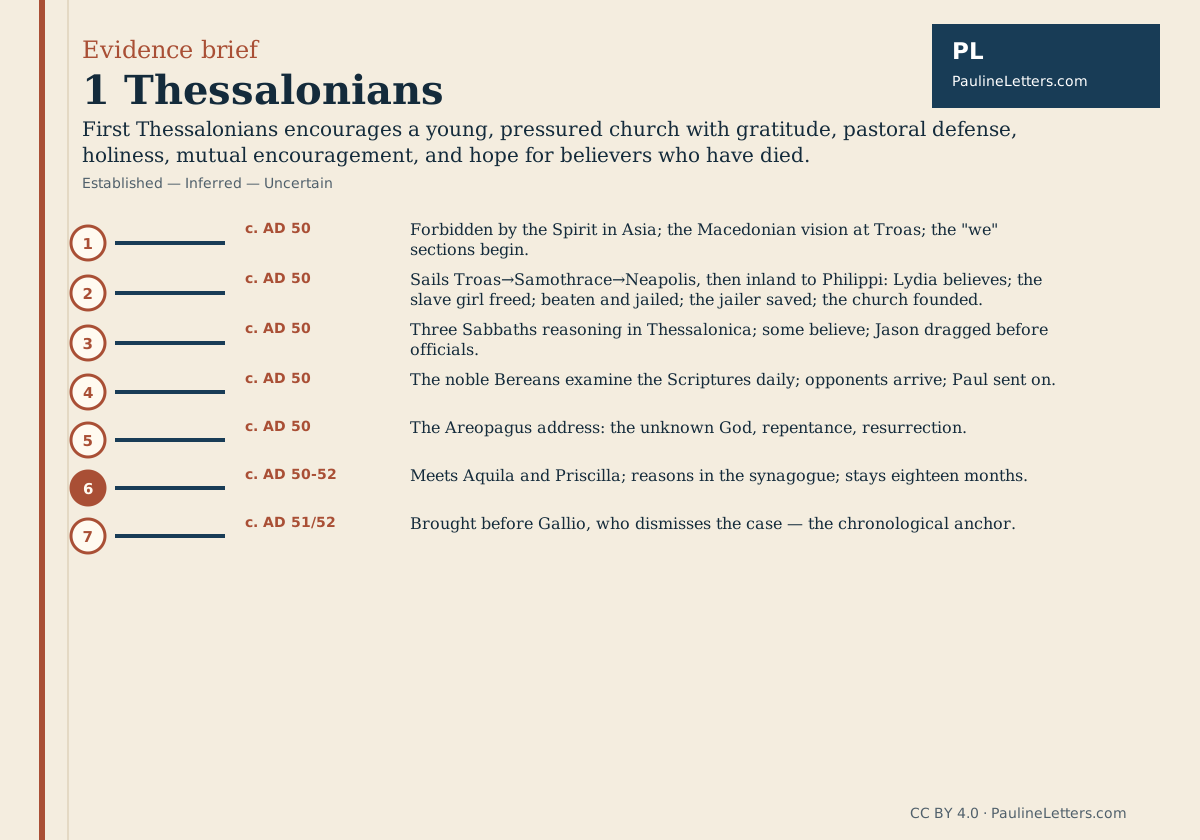
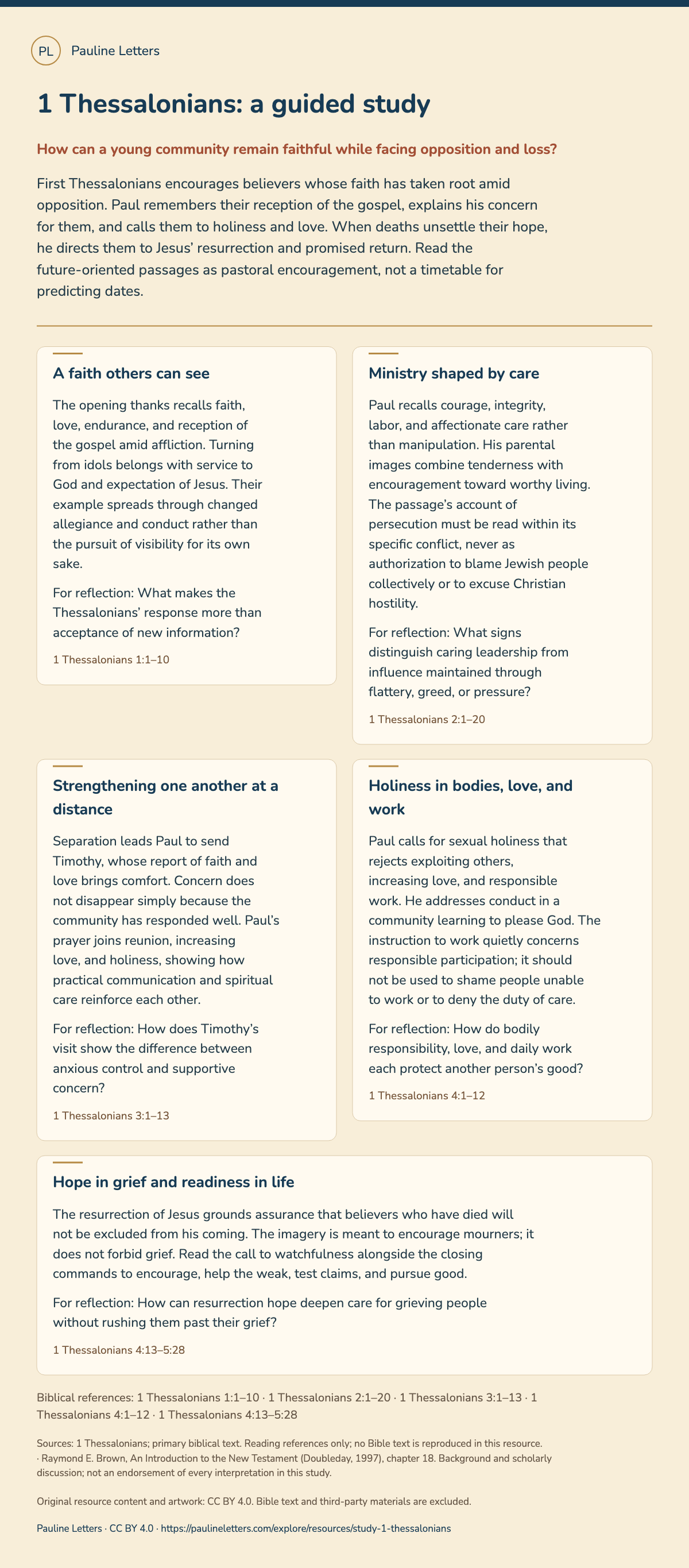
First Thessalonians encourages a young, pressured church with gratitude, pastoral defense, holiness, mutual encouragement, and hope for believers who have died.
Open resourcePNG · SVG · PDF
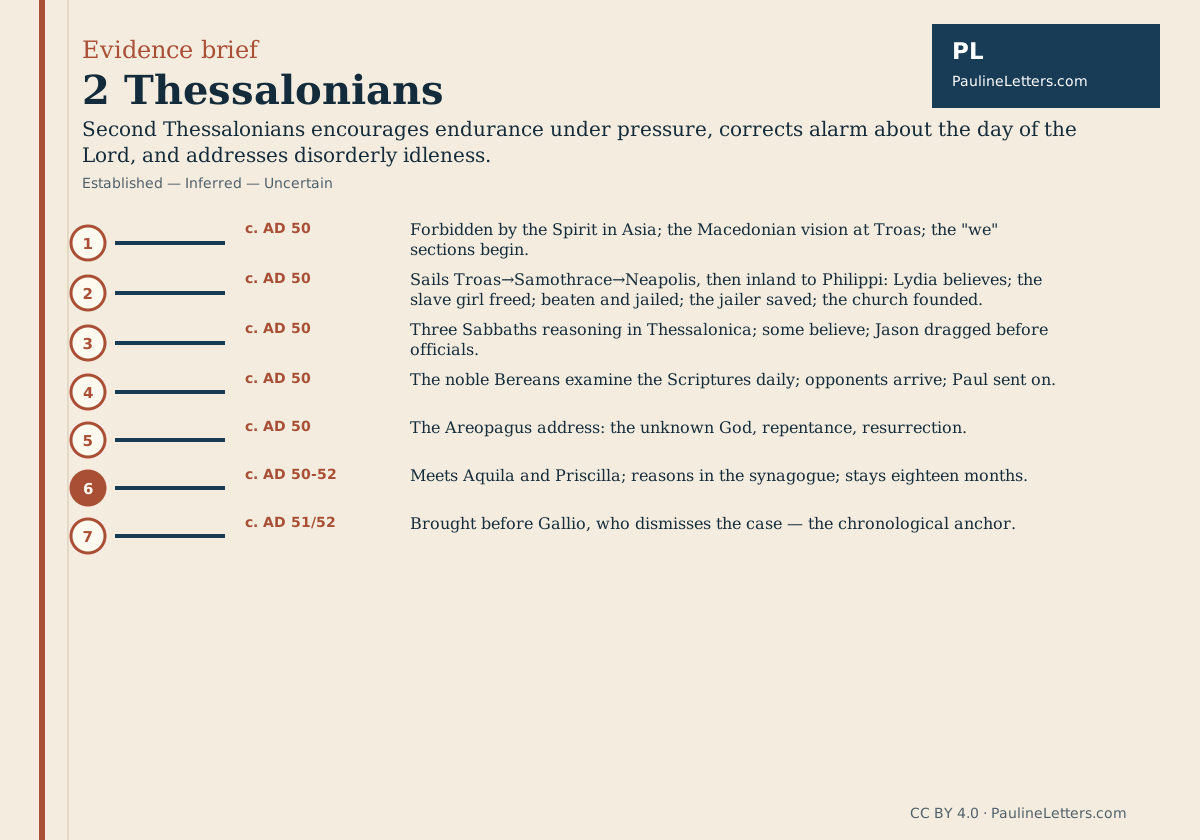
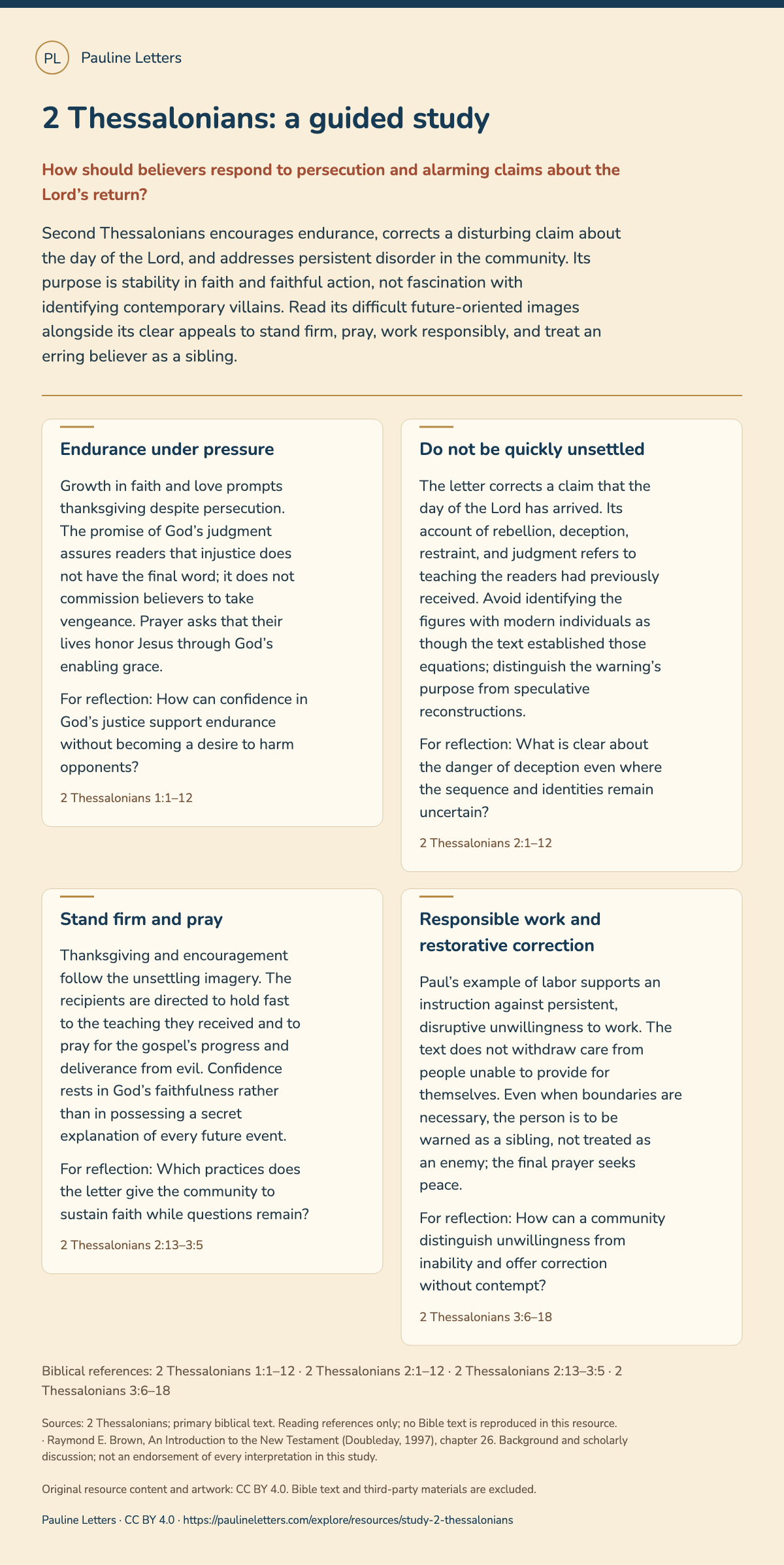
Second Thessalonians encourages endurance under pressure, corrects alarm about the day of the Lord, and addresses disorderly idleness.
Open resourcePNG · SVG · PDF
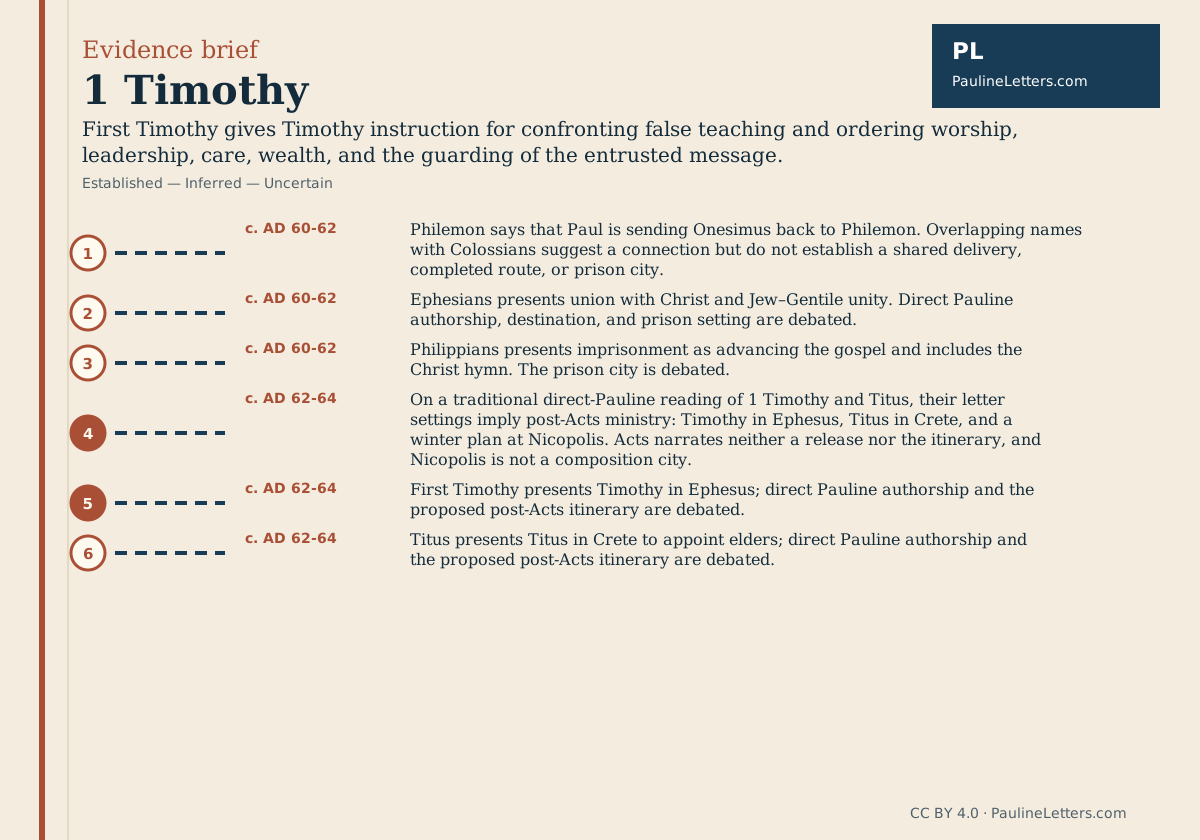
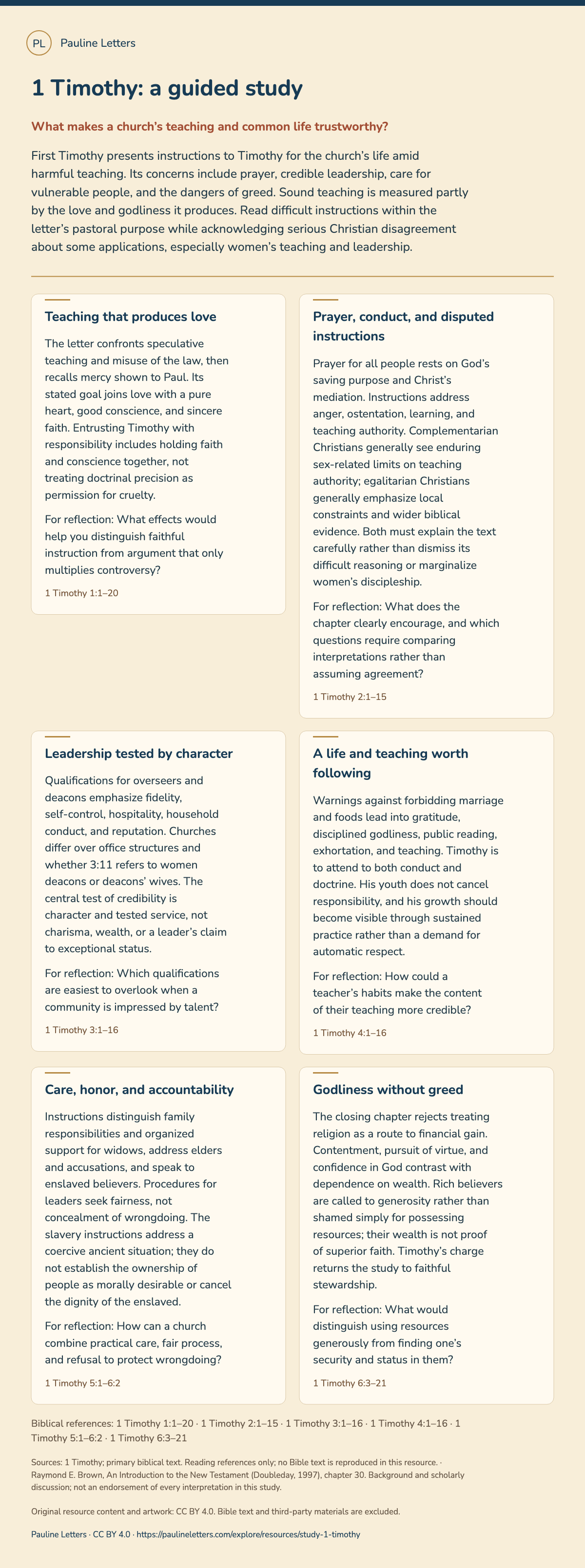
First Timothy gives Timothy instruction for confronting false teaching and ordering worship, leadership, care, wealth, and the guarding of the entrusted message.
Open resourcePNG · SVG · PDF
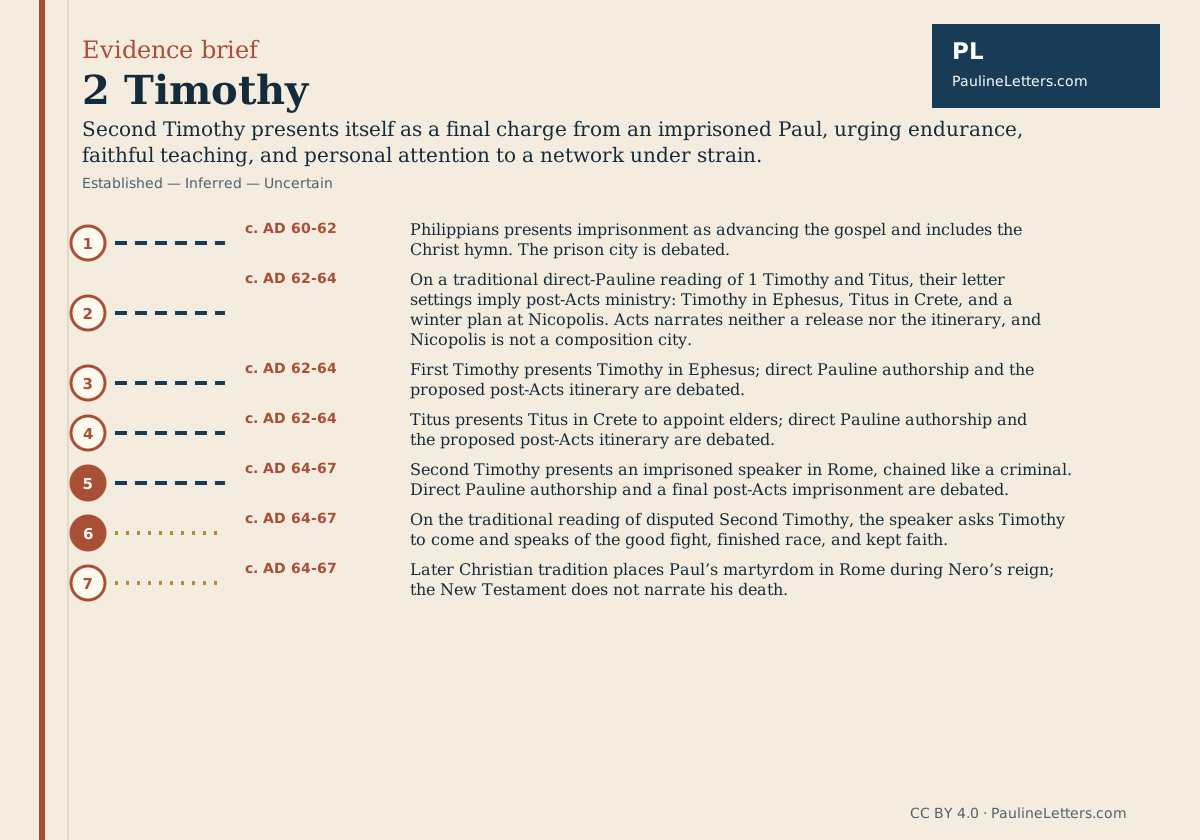
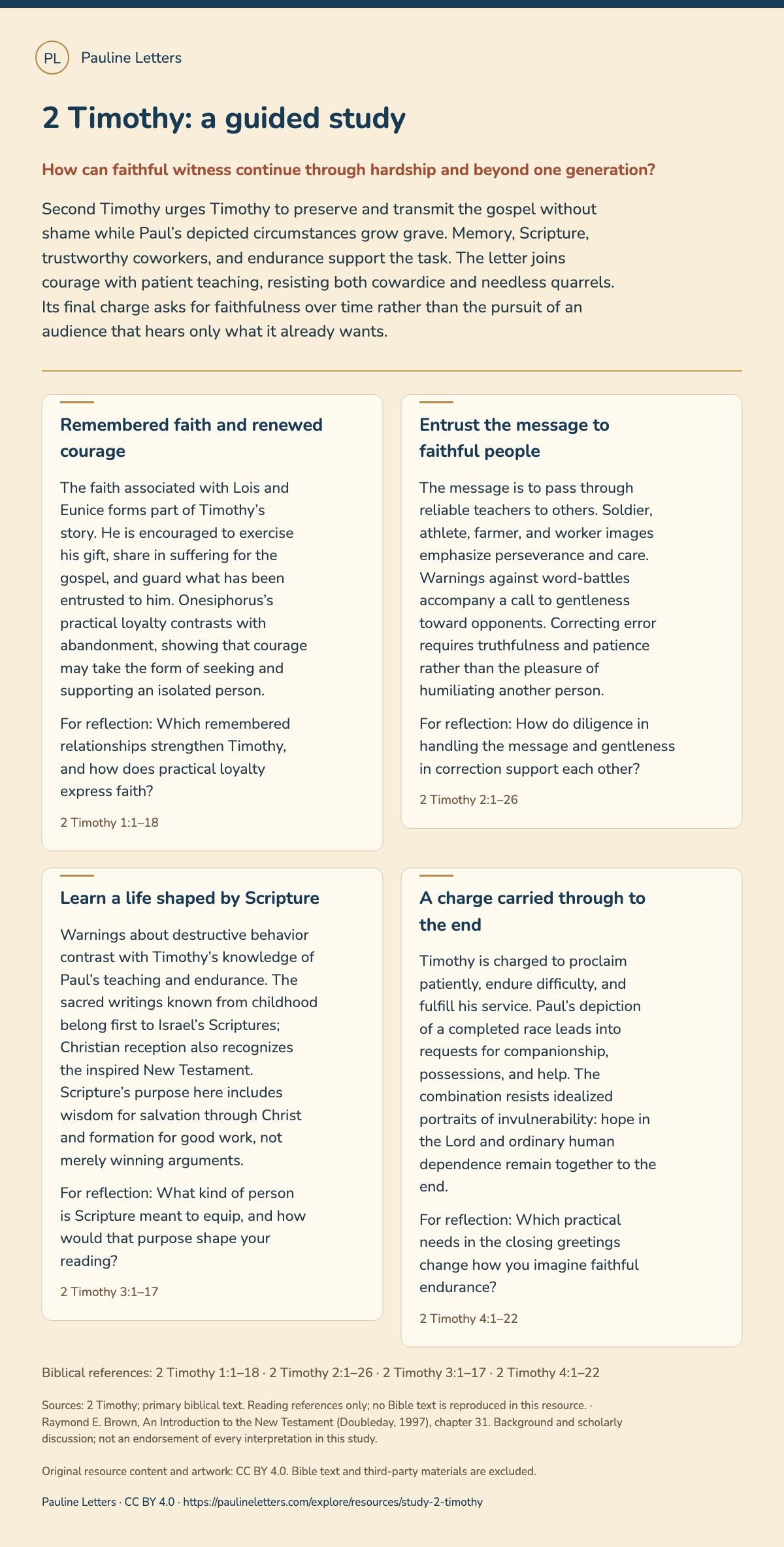
Second Timothy presents itself as a final charge from an imprisoned Paul, urging endurance, faithful teaching, and personal attention to a network under strain.
Open resourcePNG · SVG · PDF
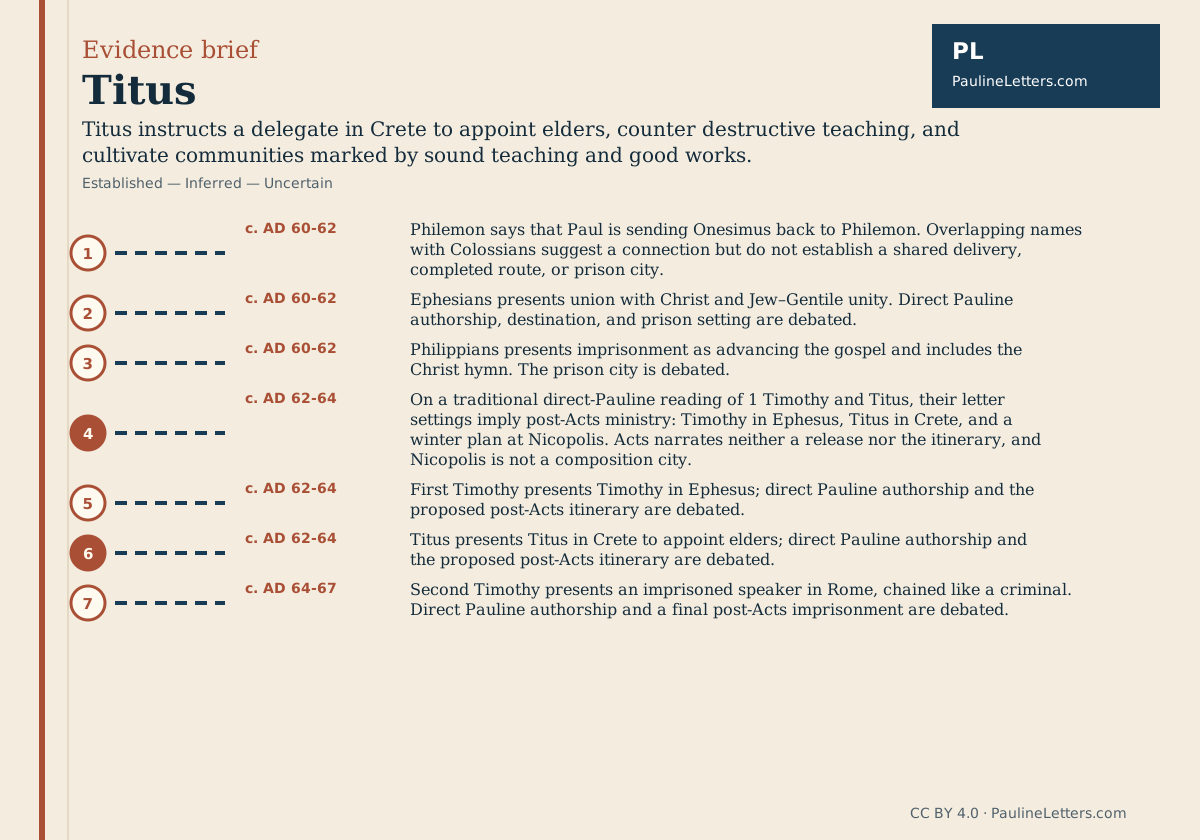
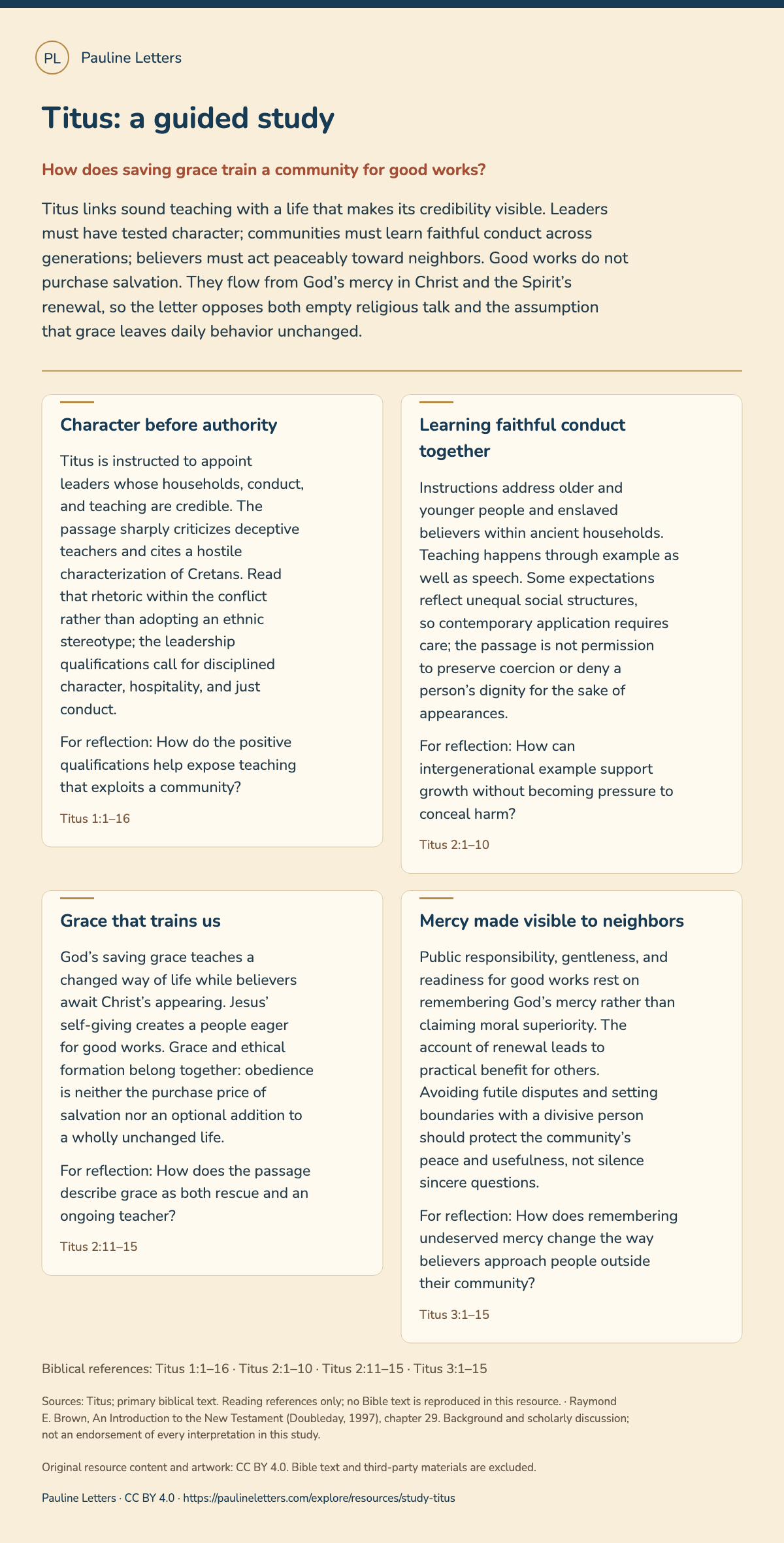
Titus instructs a delegate in Crete to appoint elders, counter destructive teaching, and cultivate communities marked by sound teaching and good works.
Open resourcePNG · SVG · PDF
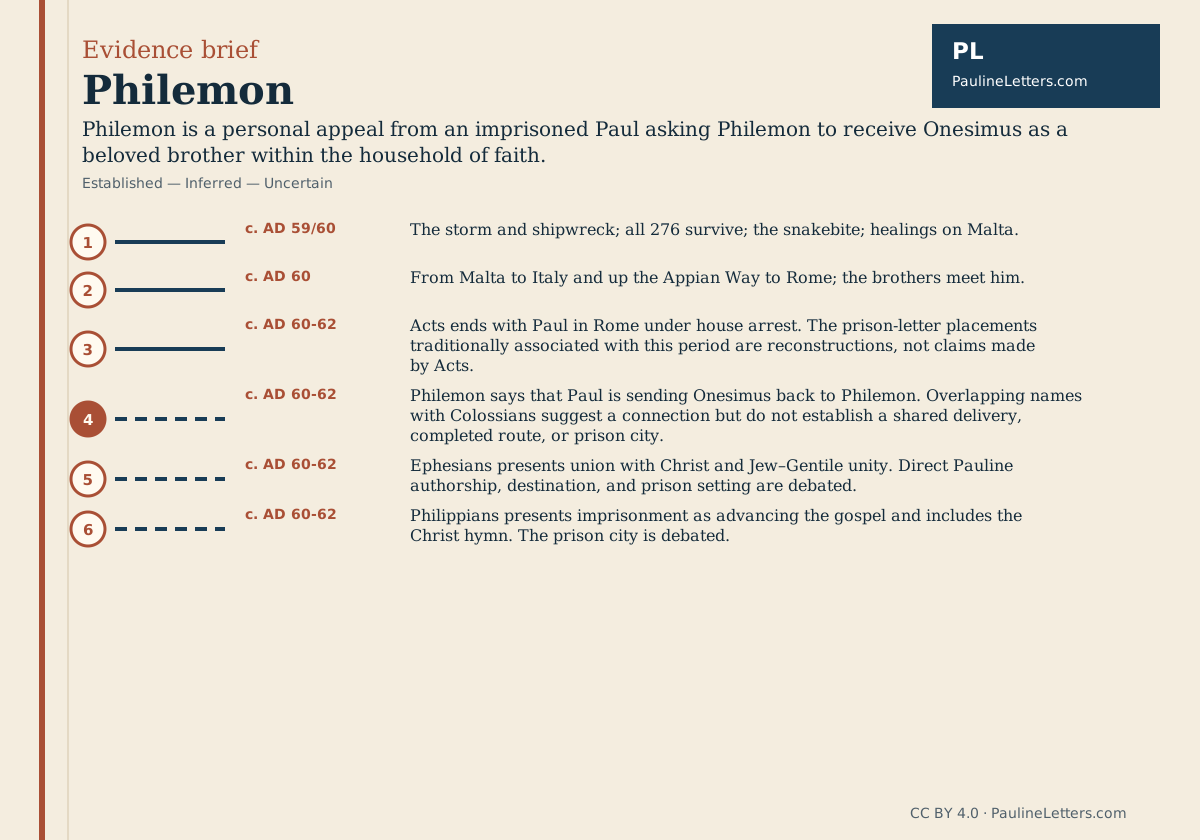
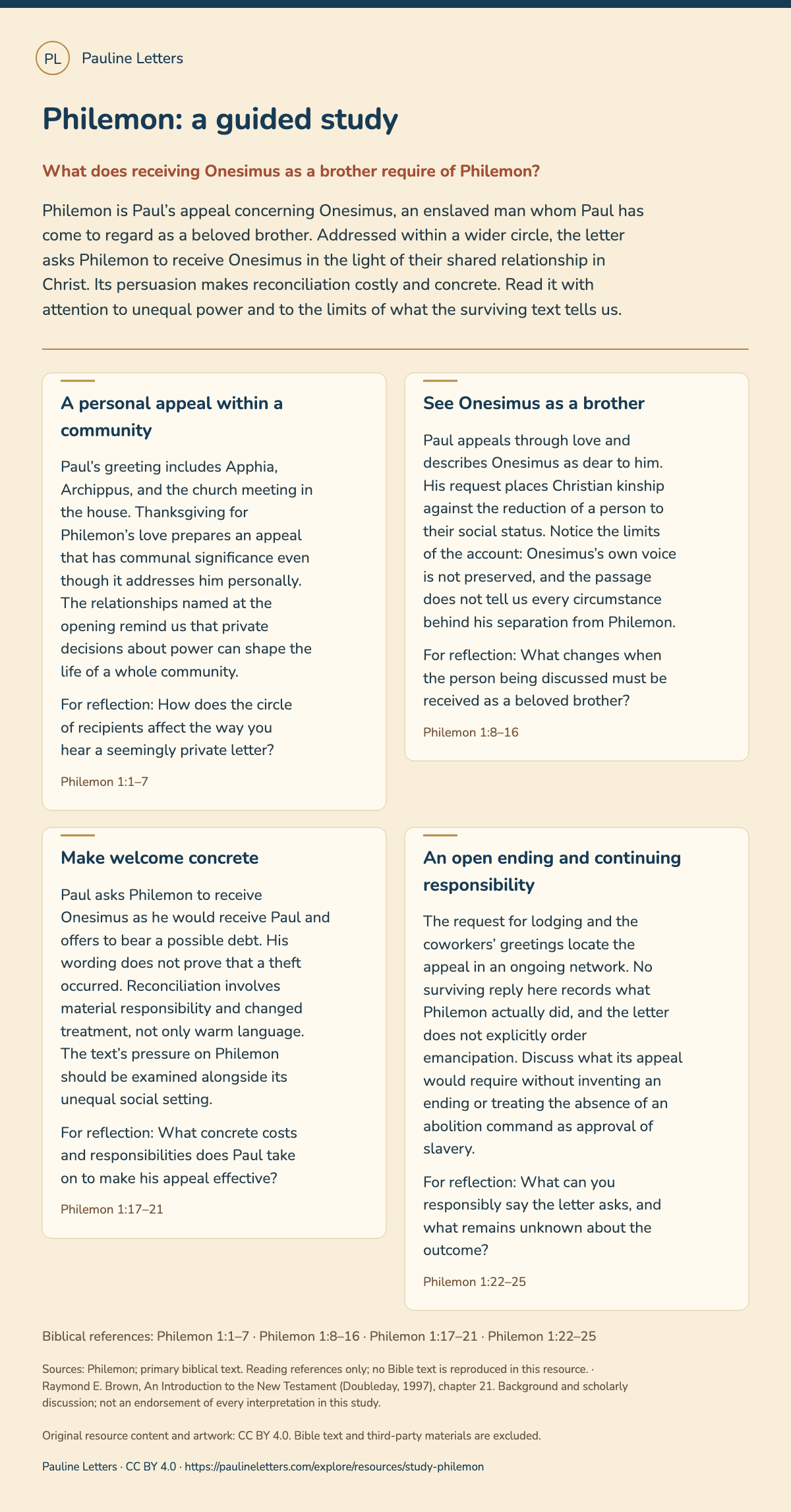
Philemon is a personal appeal from an imprisoned Paul asking Philemon to receive Onesimus as a beloved brother within the household of faith.
Open resourceSVG · PNG · PDF
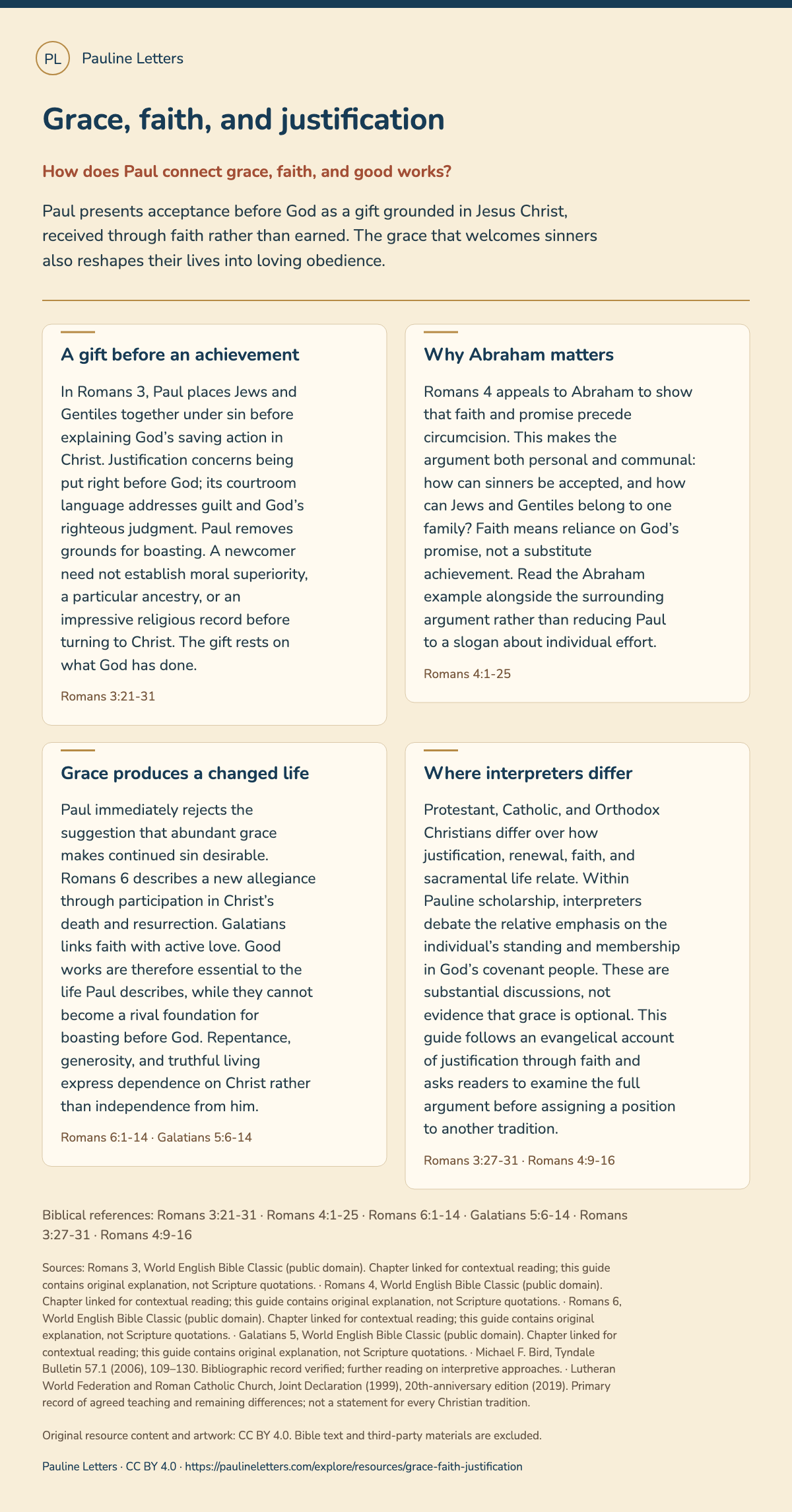
Paul presents acceptance before God as a gift grounded in Jesus Christ, received through faith rather than earned. The grace that welcomes sinners also reshapes their lives into loving obedience.
Open resourceSVG · PNG · PDF
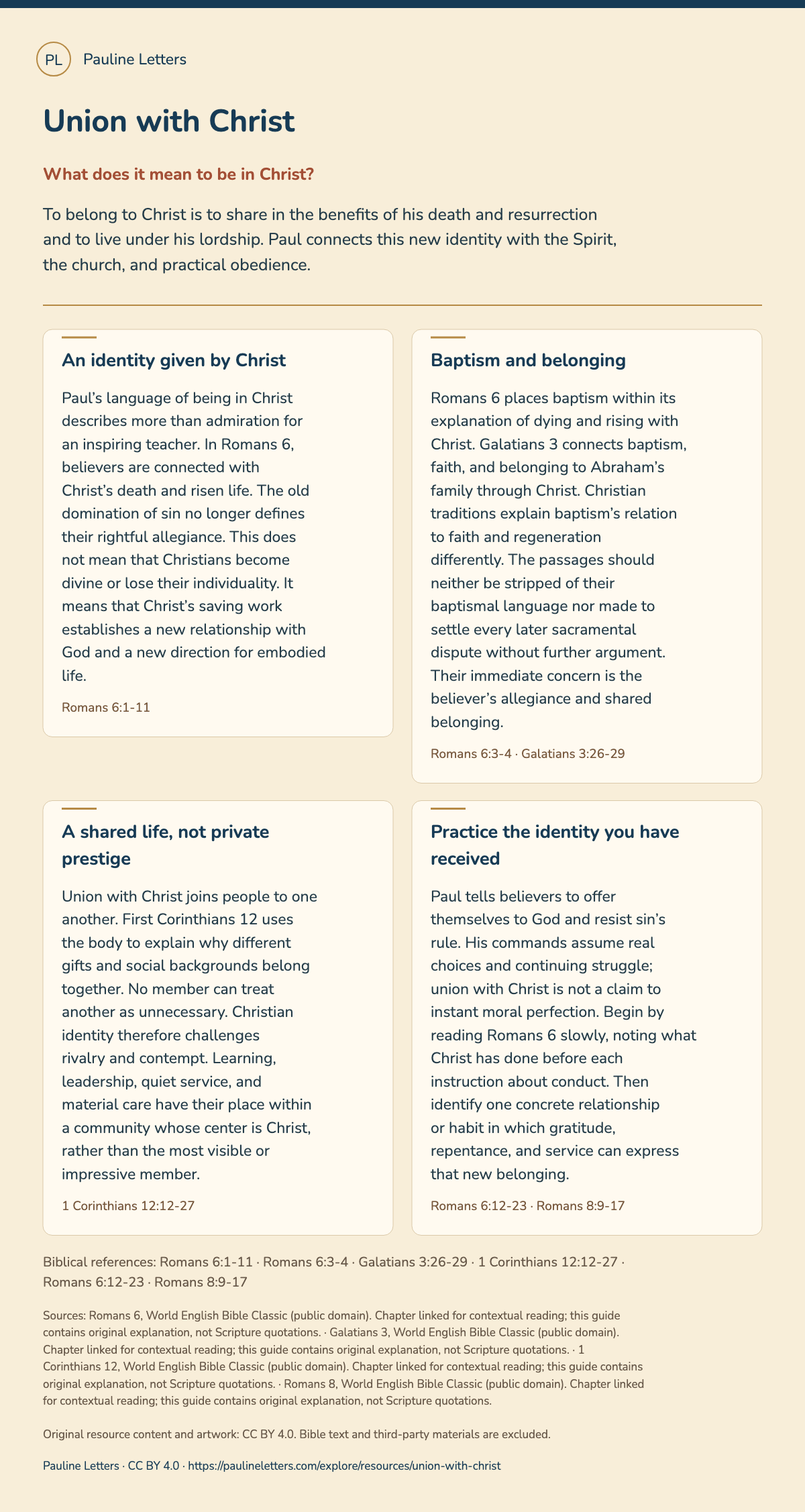
To belong to Christ is to share in the benefits of his death and resurrection and to live under his lordship. Paul connects this new identity with the Spirit, the church, and practical obedience.
Open resourceSVG · PNG · PDF
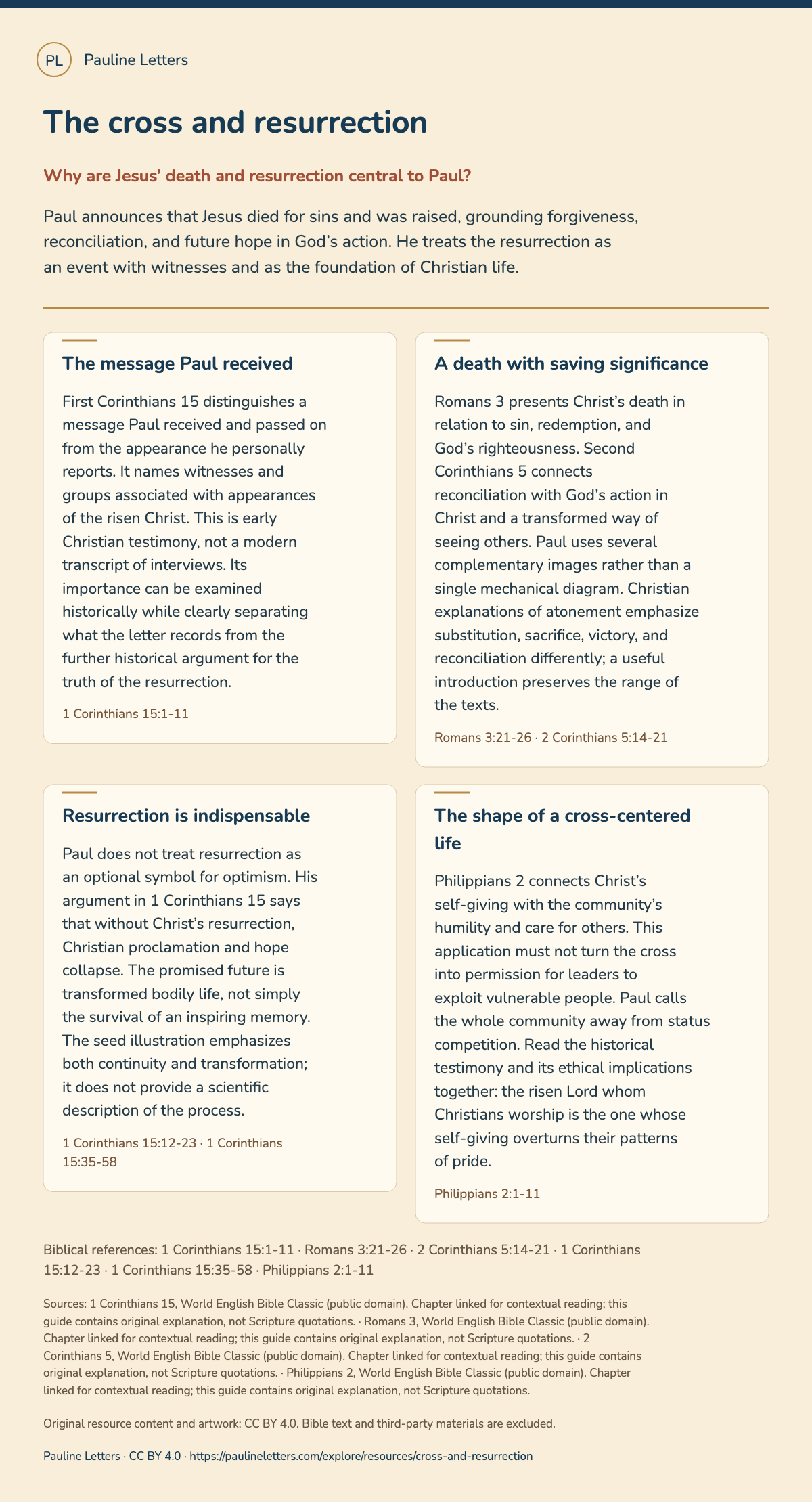
Paul announces that Jesus died for sins and was raised, grounding forgiveness, reconciliation, and future hope in God’s action. He treats the resurrection as an event with witnesses and as the foundation of Christian life.
Open resourceSVG · PNG · PDF
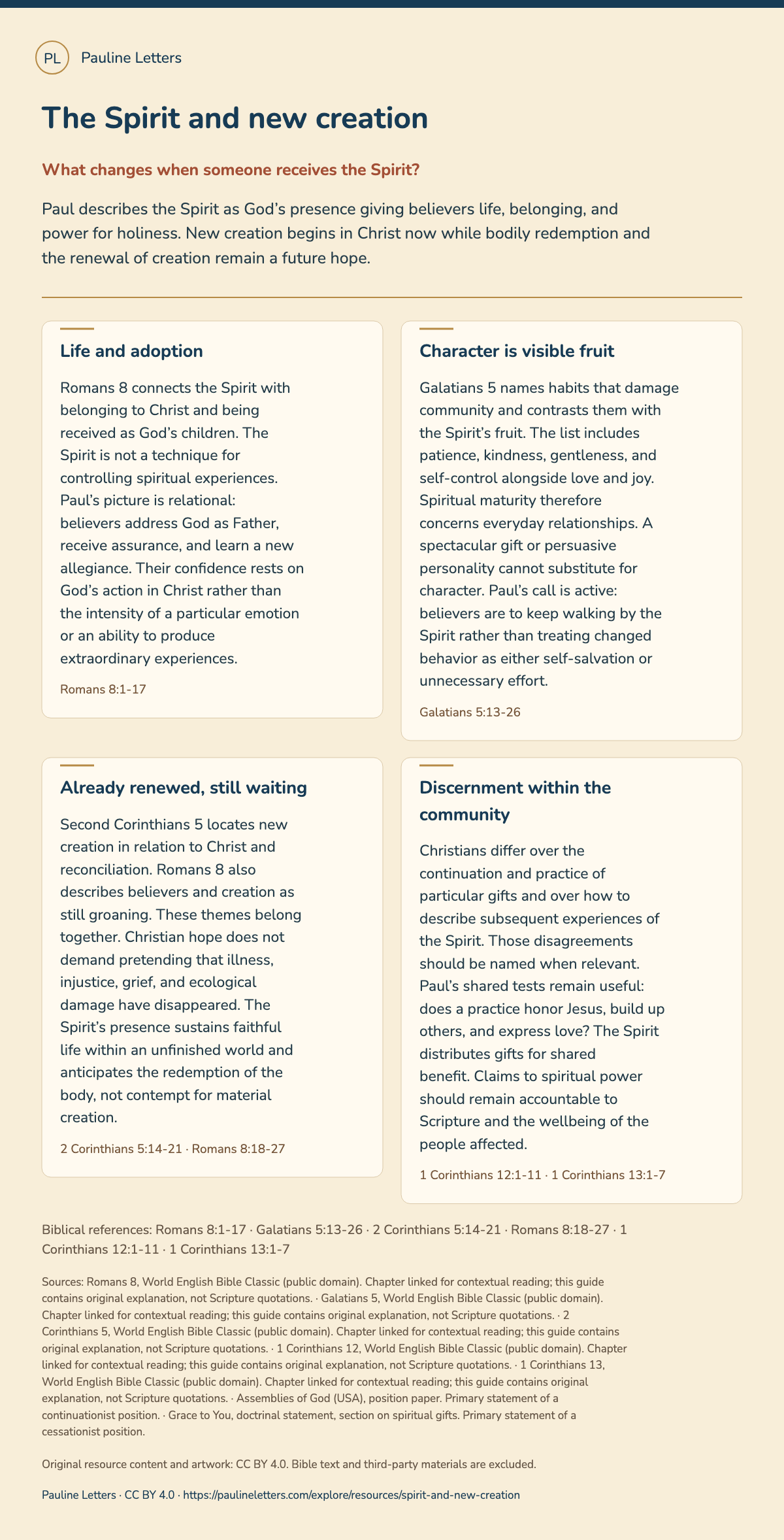
Paul describes the Spirit as God’s presence giving believers life, belonging, and power for holiness. New creation begins in Christ now while bodily redemption and the renewal of creation remain a future hope.
Open resourceSVG · PNG · PDF
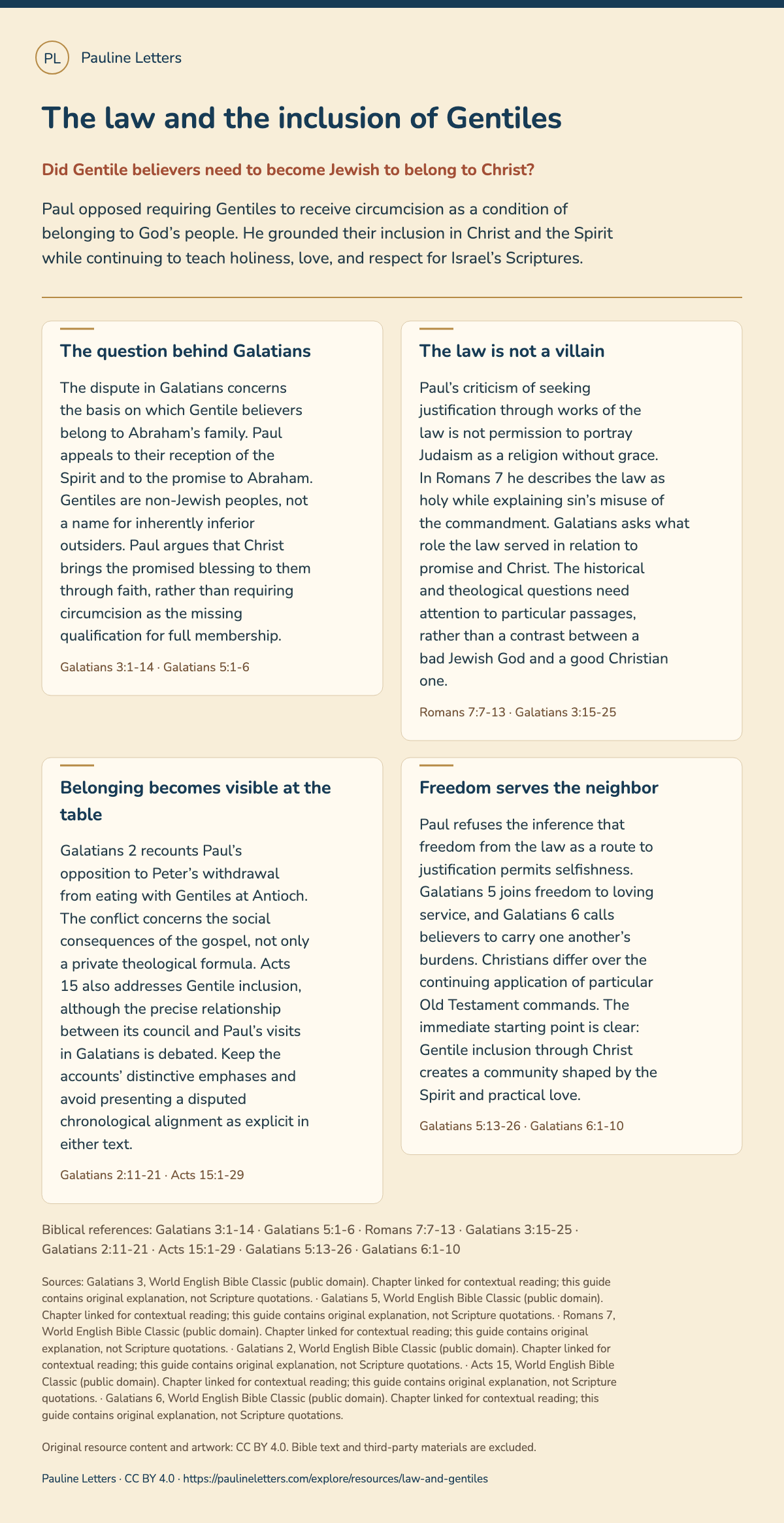
Paul opposed requiring Gentiles to receive circumcision as a condition of belonging to God’s people. He grounded their inclusion in Christ and the Spirit while continuing to teach holiness, love, and respect for Israel’s Scriptures.
Open resourceSVG · PNG · PDF
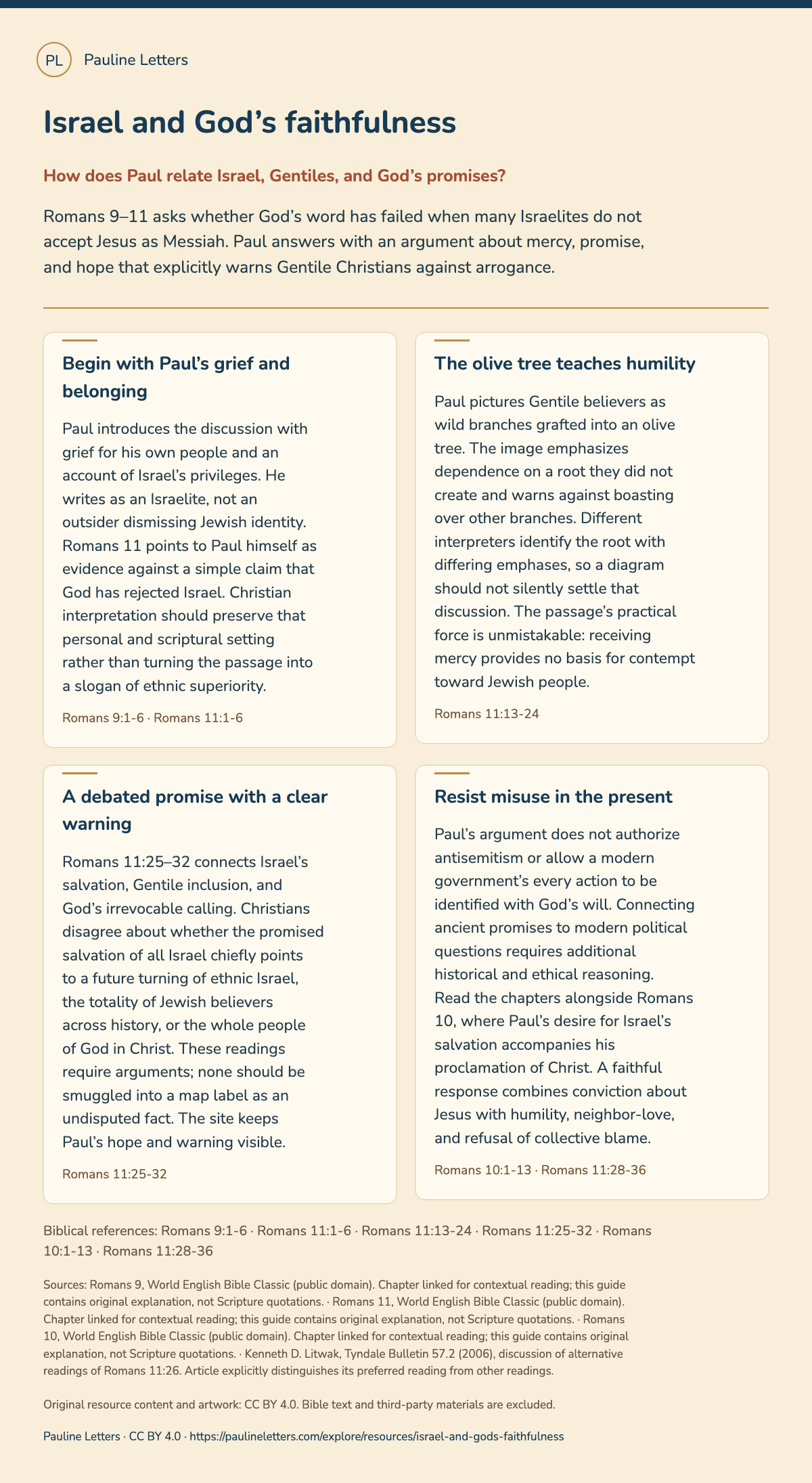
Romans 9–11 asks whether God’s word has failed when many Israelites do not accept Jesus as Messiah. Paul answers with an argument about mercy, promise, and hope that explicitly warns Gentile Christians against arrogance.
Open resourceSVG · PNG · PDF
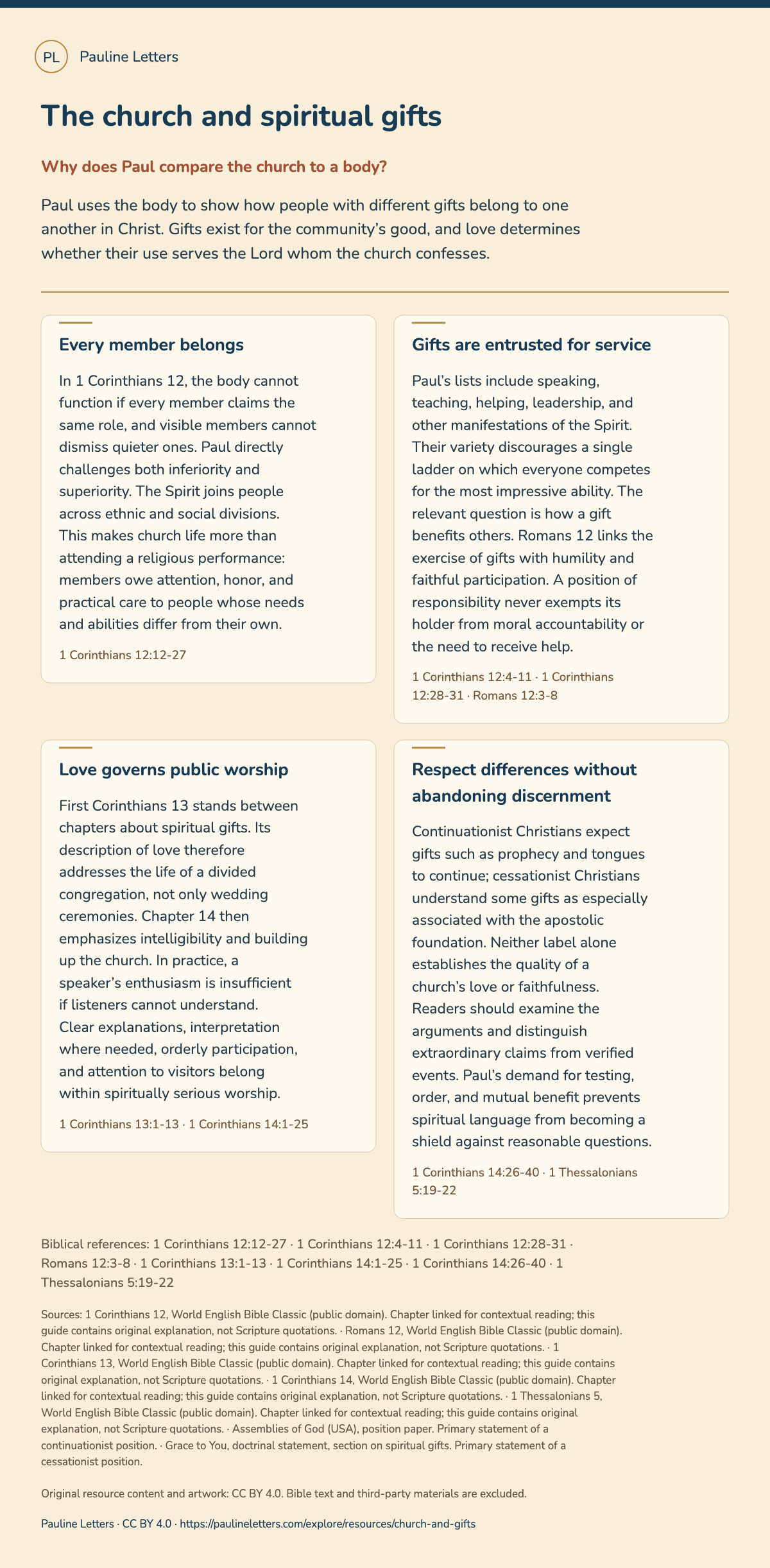
Paul uses the body to show how people with different gifts belong to one another in Christ. Gifts exist for the community’s good, and love determines whether their use serves the Lord whom the church confesses.
Open resourceSVG · PNG · PDF
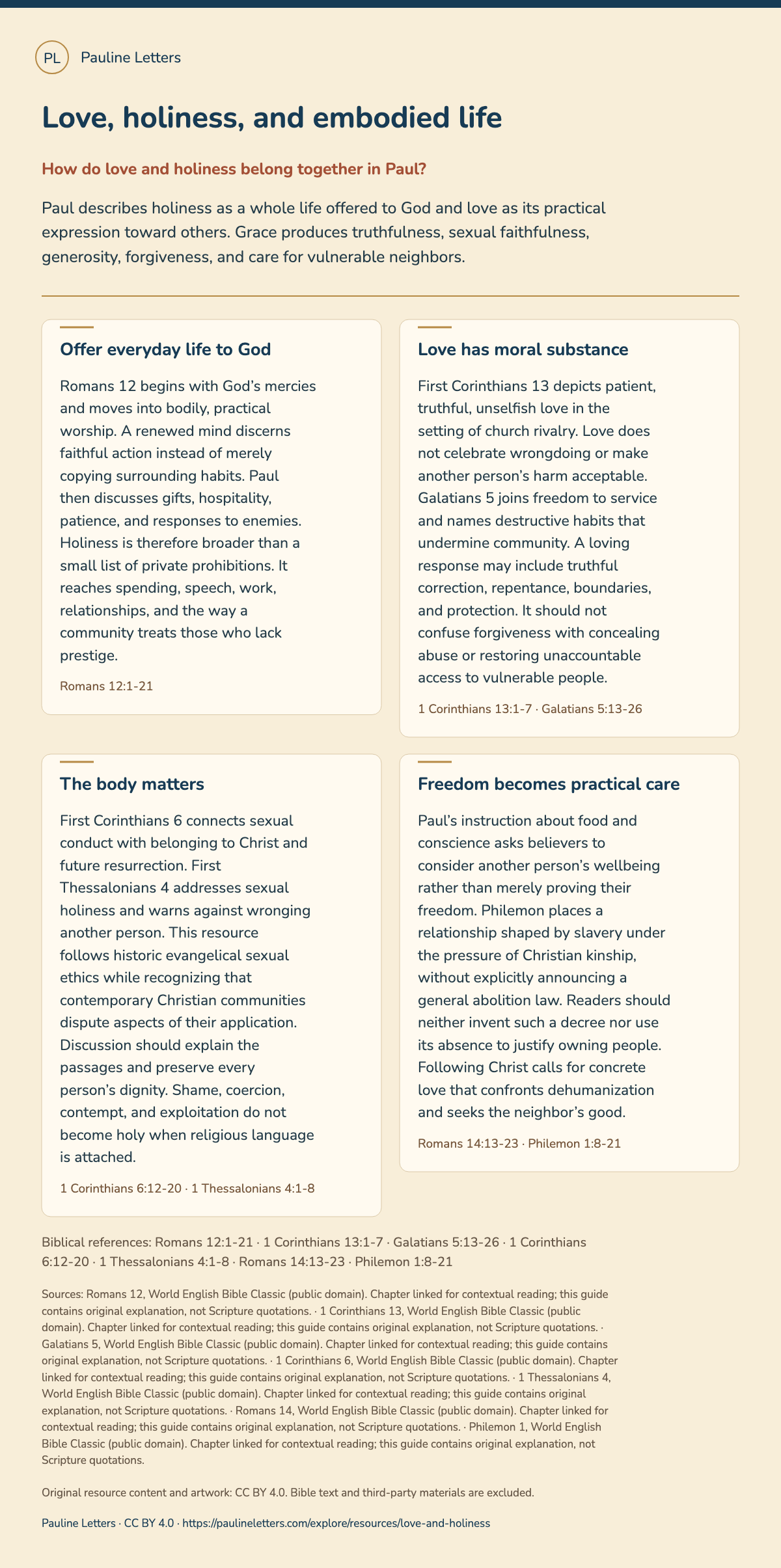
Paul describes holiness as a whole life offered to God and love as its practical expression toward others. Grace produces truthfulness, sexual faithfulness, generosity, forgiveness, and care for vulnerable neighbors.
Open resourceSVG · PNG · PDF
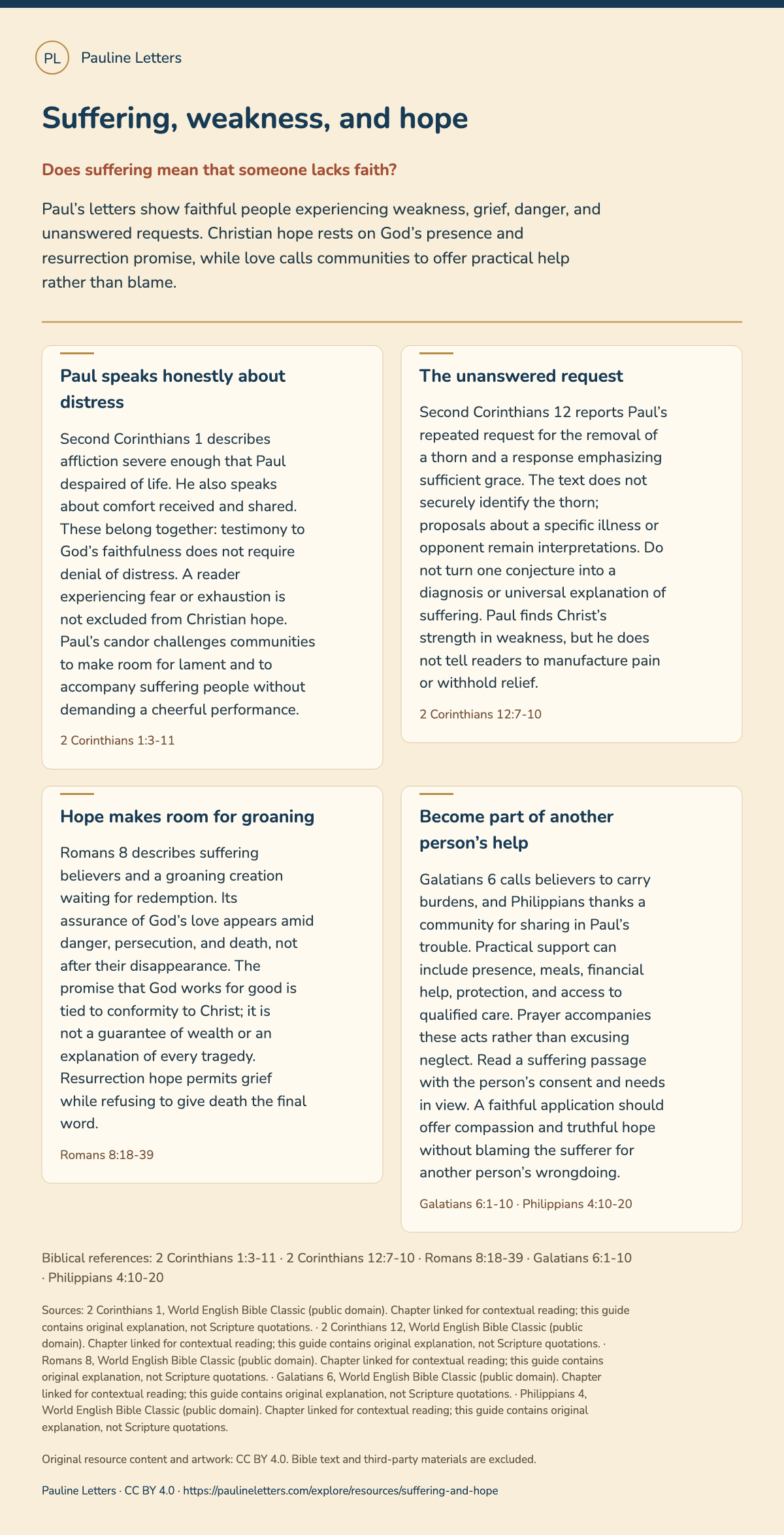
Paul’s letters show faithful people experiencing weakness, grief, danger, and unanswered requests. Christian hope rests on God’s presence and resurrection promise, while love calls communities to offer practical help rather than blame.
Open resourceSVG · PNG · PDF
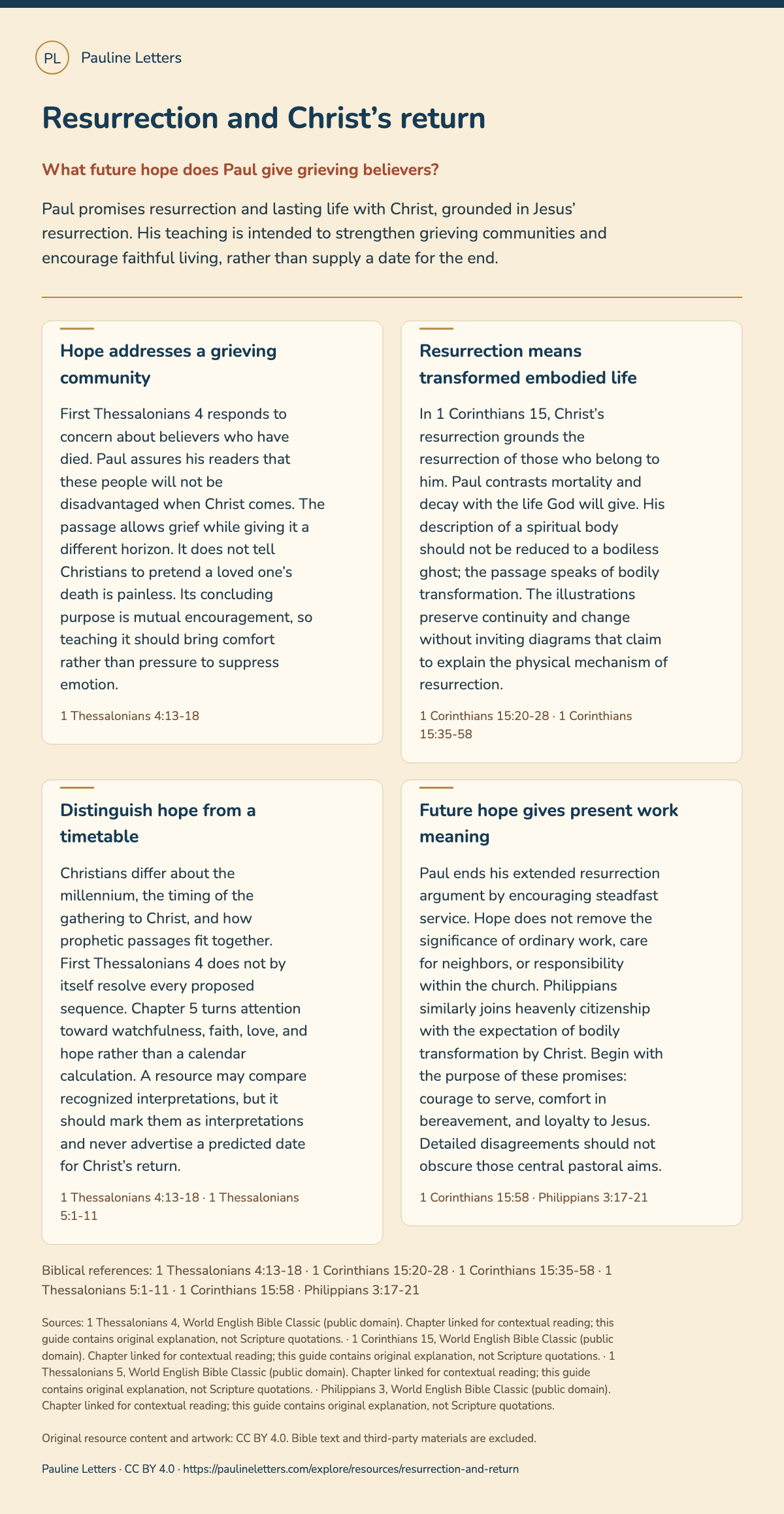
Paul promises resurrection and lasting life with Christ, grounded in Jesus’ resurrection. His teaching is intended to strengthen grieving communities and encourage faithful living, rather than supply a date for the end.
Open resourceSVG · PNG · PDF
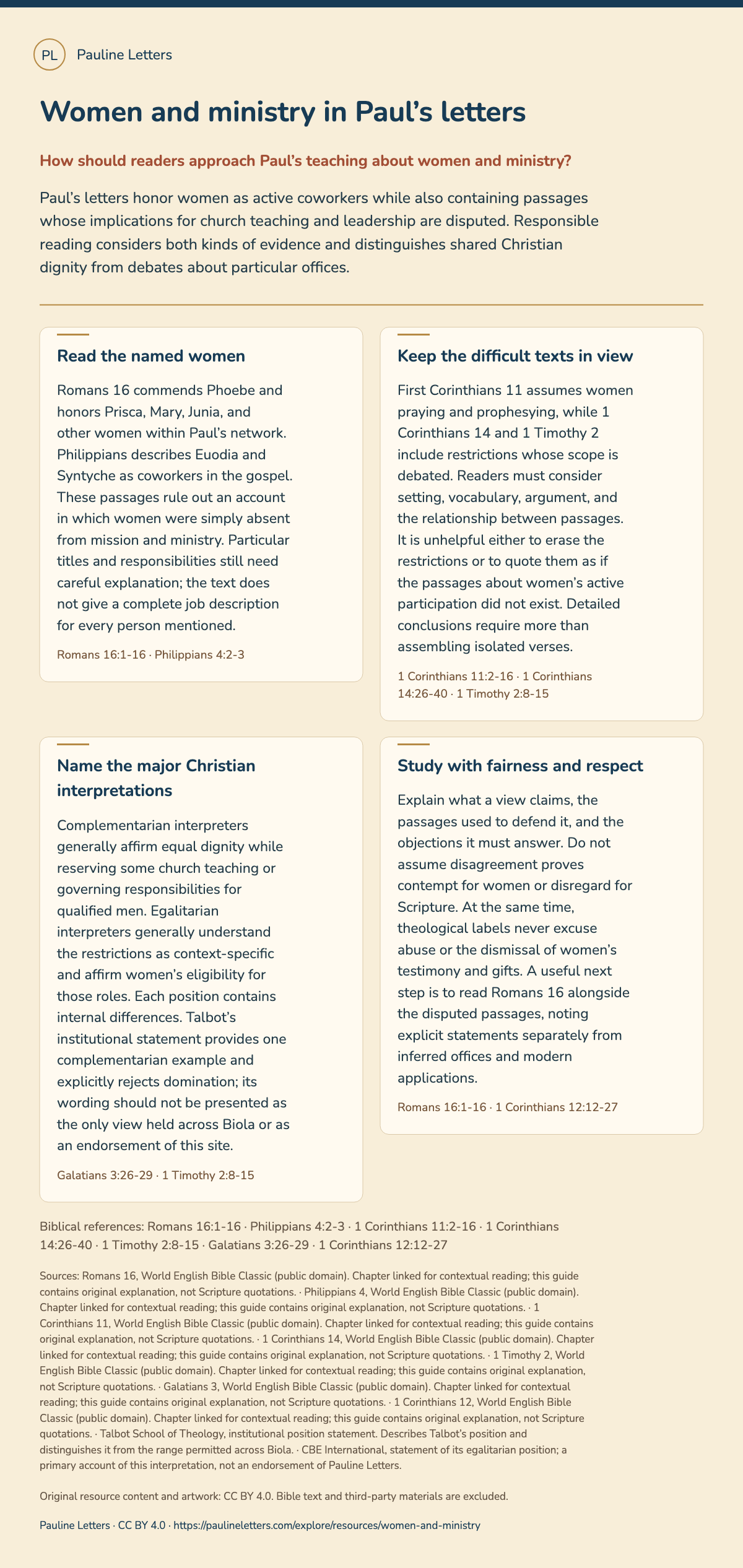
Paul’s letters honor women as active coworkers while also containing passages whose implications for church teaching and leadership are disputed. Responsible reading considers both kinds of evidence and distinguishes shared Christian dignity from debates about particular offices.
Open resourceSVG · PNG · PDF
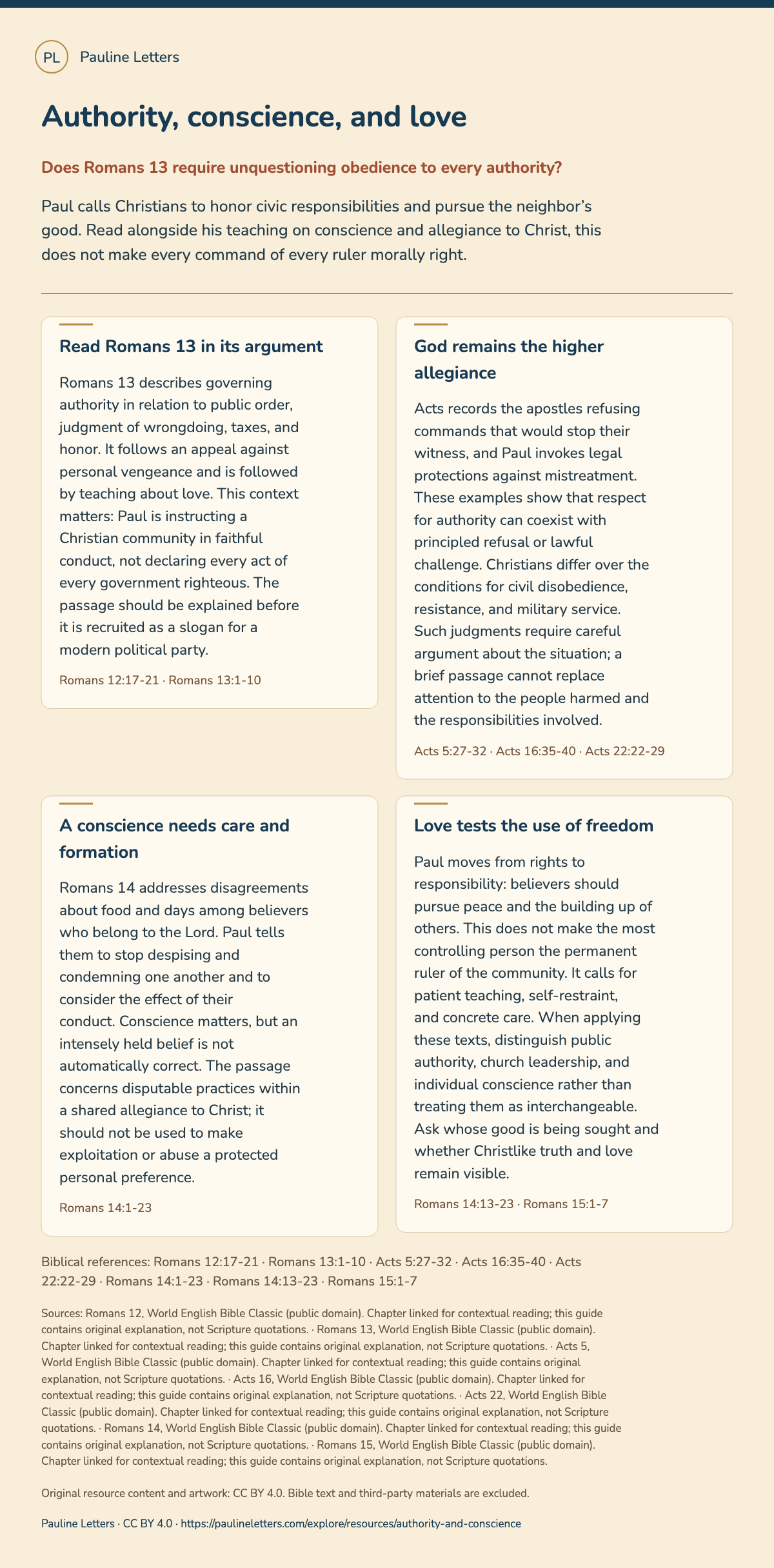
Paul calls Christians to honor civic responsibilities and pursue the neighbor’s good. Read alongside his teaching on conscience and allegiance to Christ, this does not make every command of every ruler morally right.
Open resourceSVG · PNG · PDF
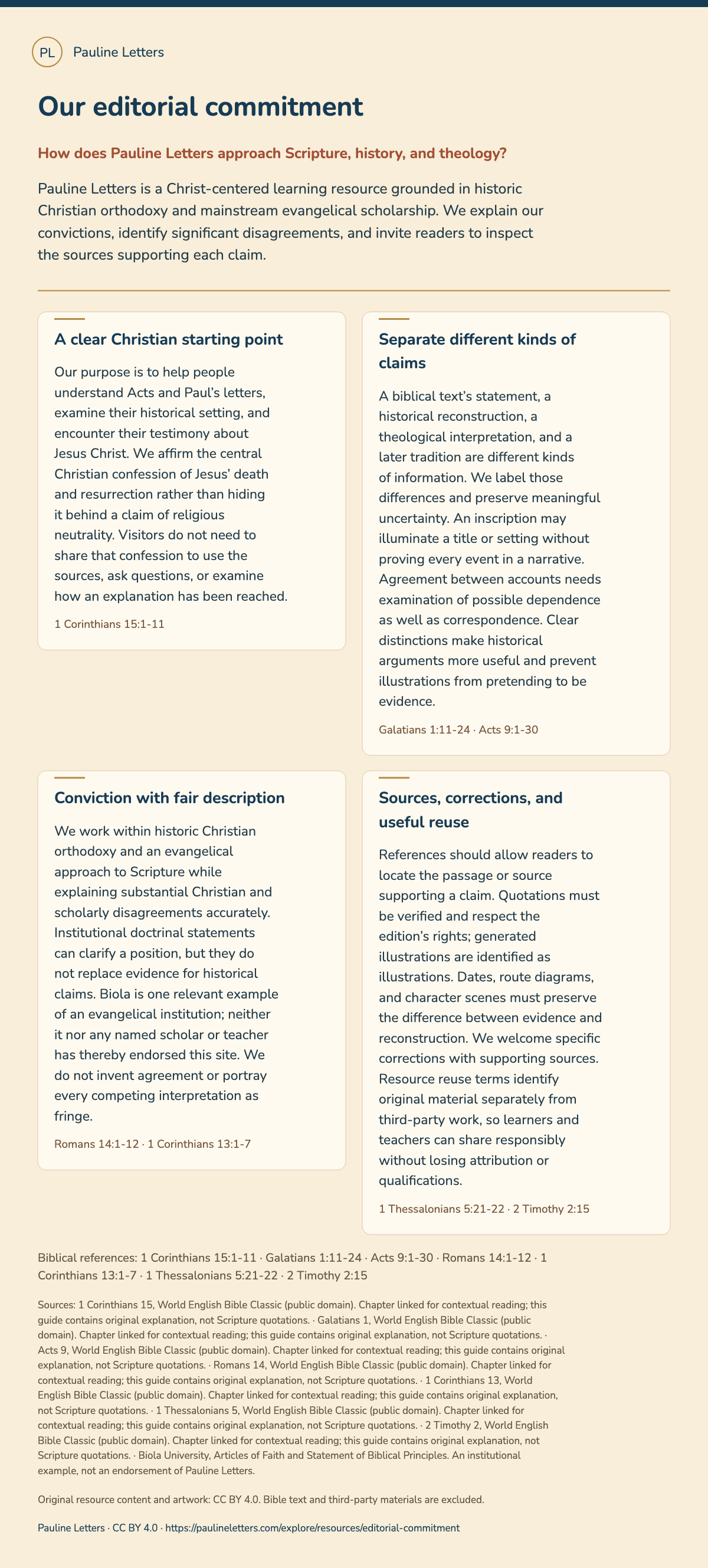
Pauline Letters is a Christ-centered learning resource grounded in historic Christian orthodoxy and mainstream evangelical scholarship. We explain our convictions, identify significant disagreements, and invite readers to inspect the sources supporting each claim.
Open resourceSVG · PNG · PDF
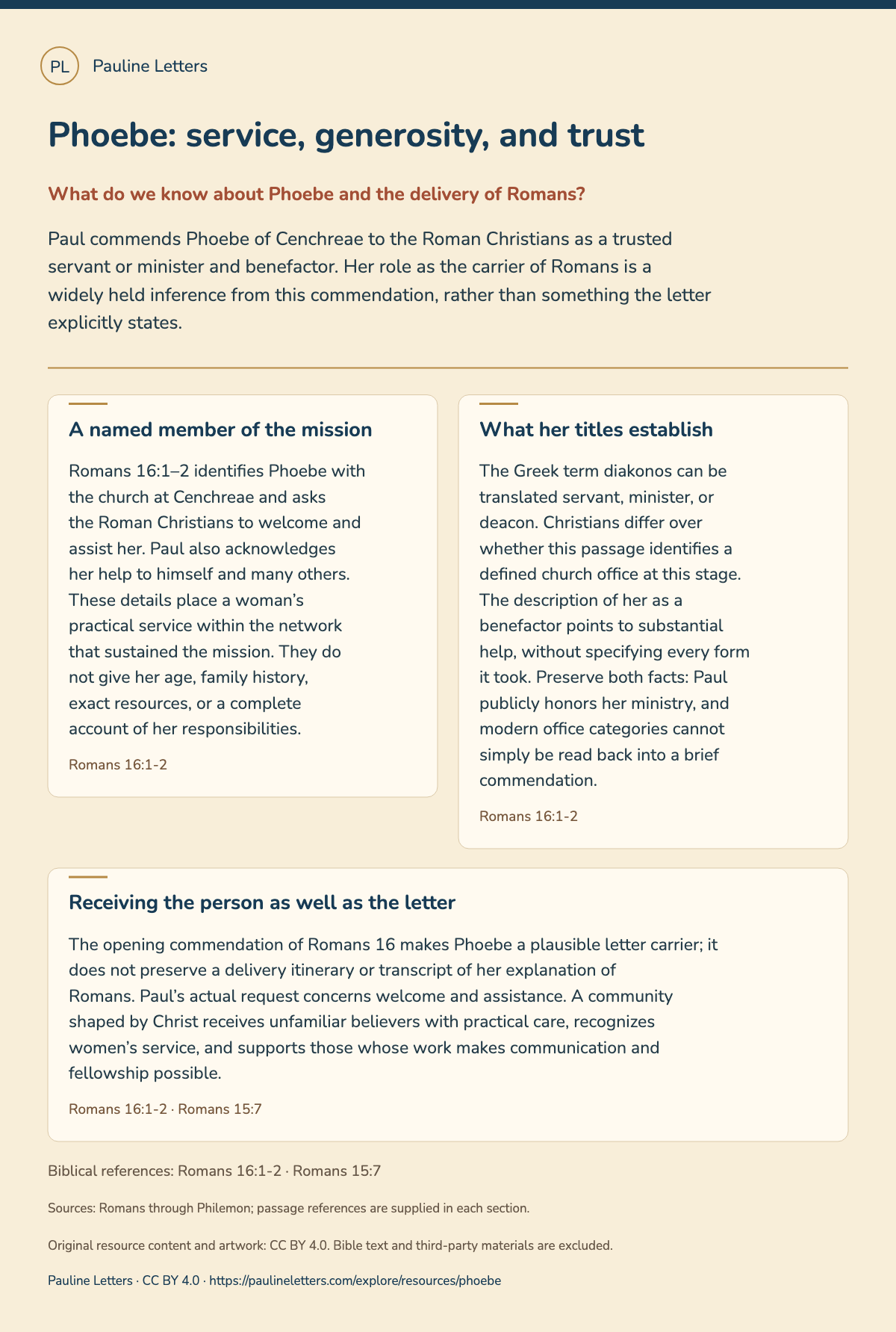
Paul commends Phoebe of Cenchreae to the Roman Christians as a trusted servant or minister and benefactor. Her role as the carrier of Romans is a widely held inference from this commendation, rather than something the letter explicitly states.
Open resourceSVG · PNG · PDF
Priscilla and Aquila worked alongside Paul, helped instruct Apollos, hosted a church, and risked their lives for Paul. Acts and the letters show their shared ministry across several cities without explaining every move or the occasion of that danger.
Open resourceSVG · PNG · PDF
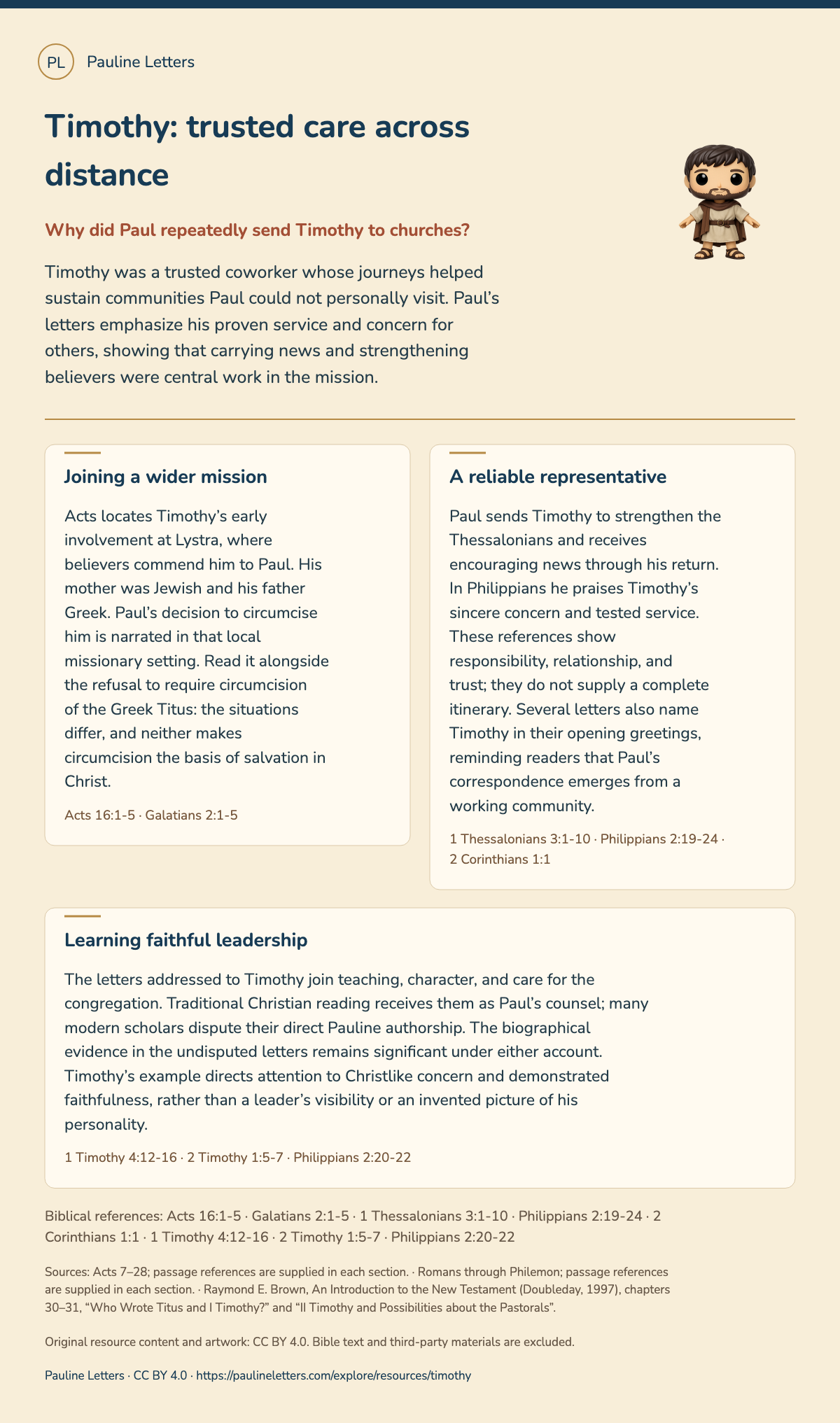
Timothy was a trusted coworker whose journeys helped sustain communities Paul could not personally visit. Paul’s letters emphasize his proven service and concern for others, showing that carrying news and strengthening believers were central work in the mission.
Open resourceSVG · PNG · PDF
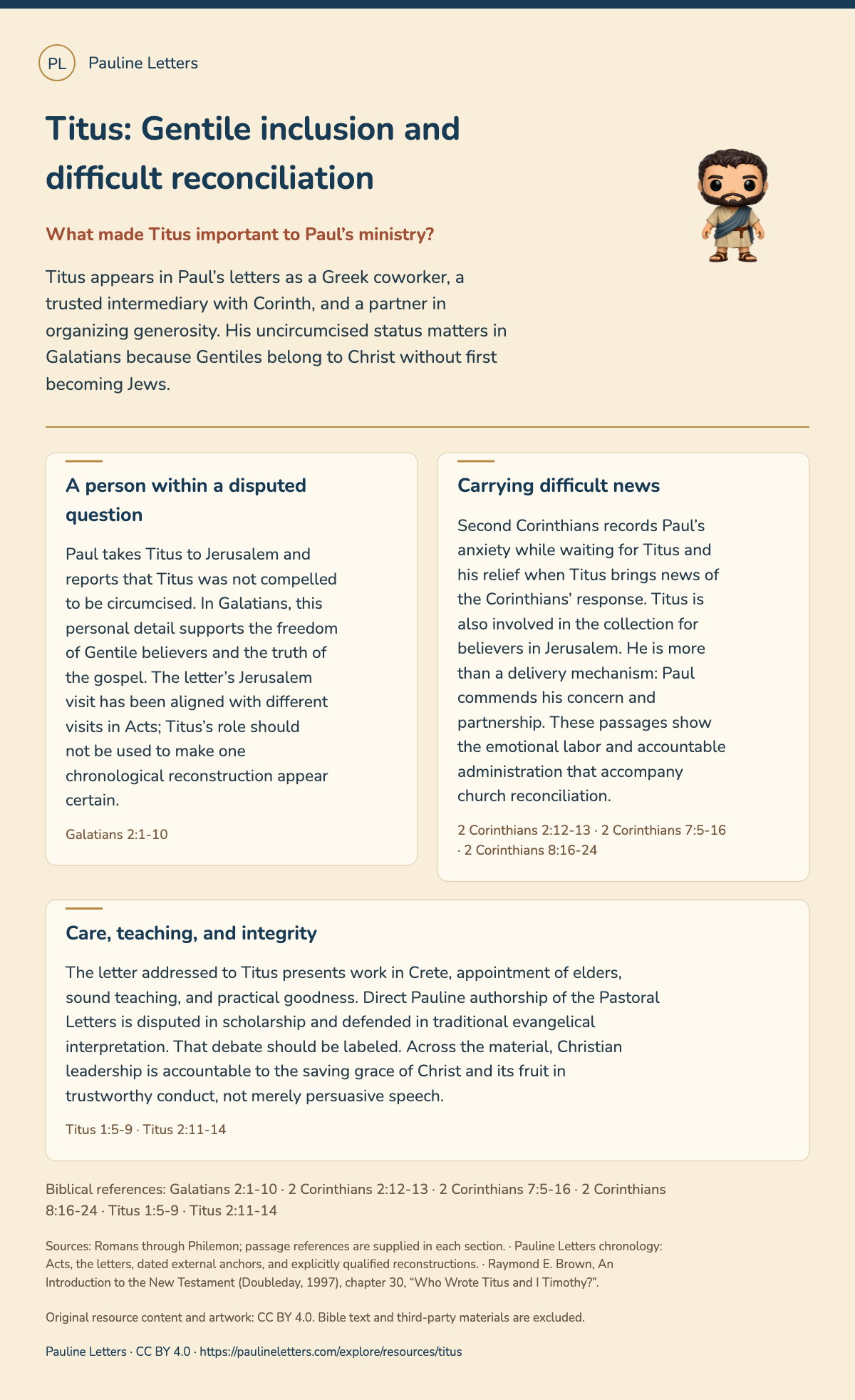
Titus appears in Paul’s letters as a Greek coworker, a trusted intermediary with Corinth, and a partner in organizing generosity. His uncircumcised status matters in Galatians because Gentiles belong to Christ without first becoming Jews.
Open resourceSVG · PNG · PDF
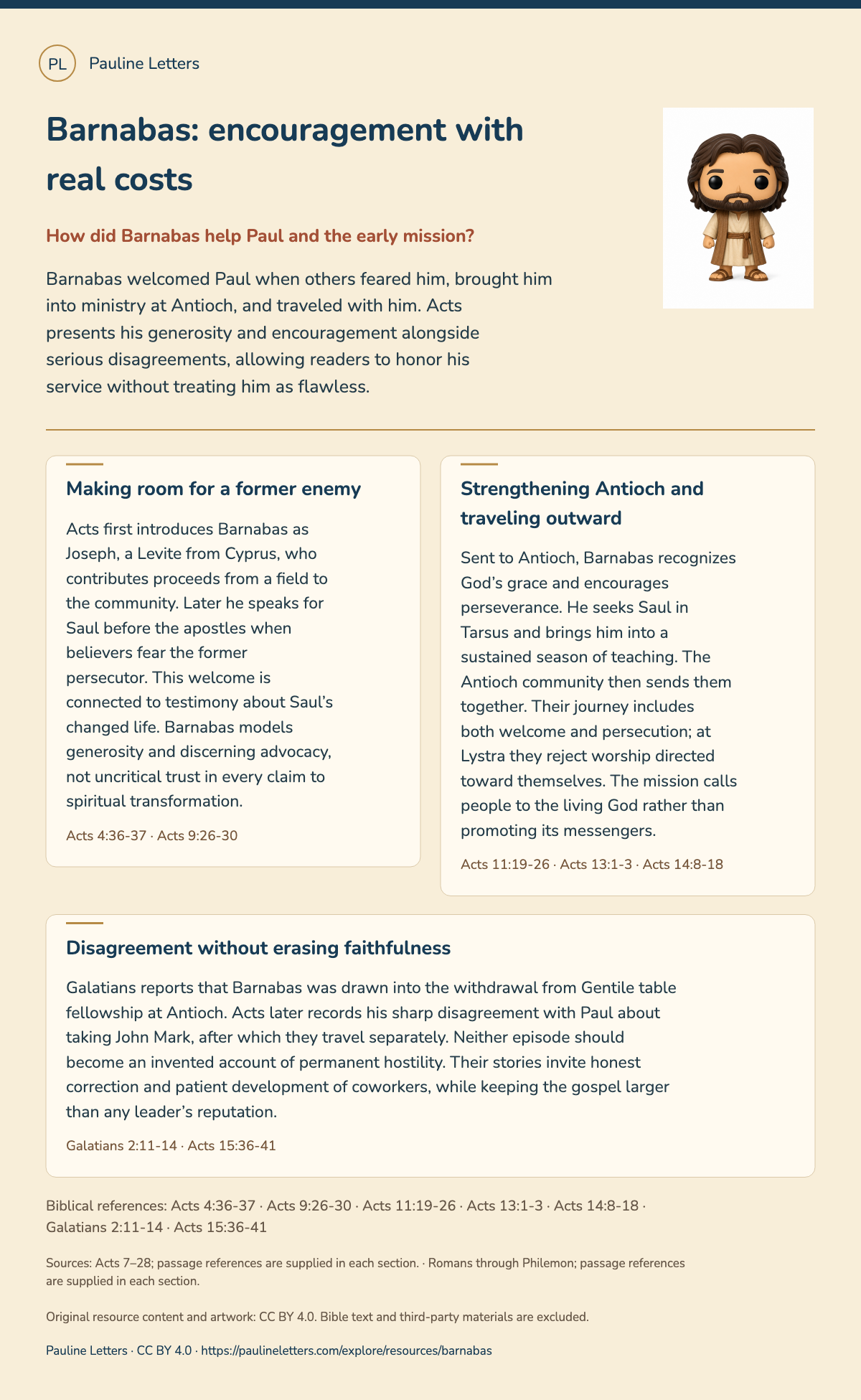
Barnabas welcomed Paul when others feared him, brought him into ministry at Antioch, and traveled with him. Acts presents his generosity and encouragement alongside serious disagreements, allowing readers to honor his service without treating him as flawless.
Open resourceSVG · PNG · PDF
Silas was a Jerusalem leader and prophet who accompanied the council’s message to Antioch and later traveled with Paul. He is commonly identified with the Silvanus named in Pauline letter openings, though Acts does not explicitly explain the two name forms.
Open resourceSVG · PNG · PDF
Acts describes Lydia as a dealer in purple goods from Thyatira who hears Paul at Philippi, responds to the message, and welcomes the missionaries into her home. Her hospitality becomes part of the emerging Christian community’s life.
Open resourceSVG · PNG · PDF
Onesimus is the person at the center of Paul’s appeal to Philemon and is also named in Colossians. Paul asks for his welcome as a beloved brother. The letters do not establish that he was a fugitive or narrate the final outcome.
Open resourceSVG · PNG · PDF
Epaphroditus brought the Philippians’ support to Paul and nearly died while serving. Paul sends him back with public commendation. He is a different person from Epaphras, the coworker associated with Colossae.
Open resourceSVG · PNG · PDF
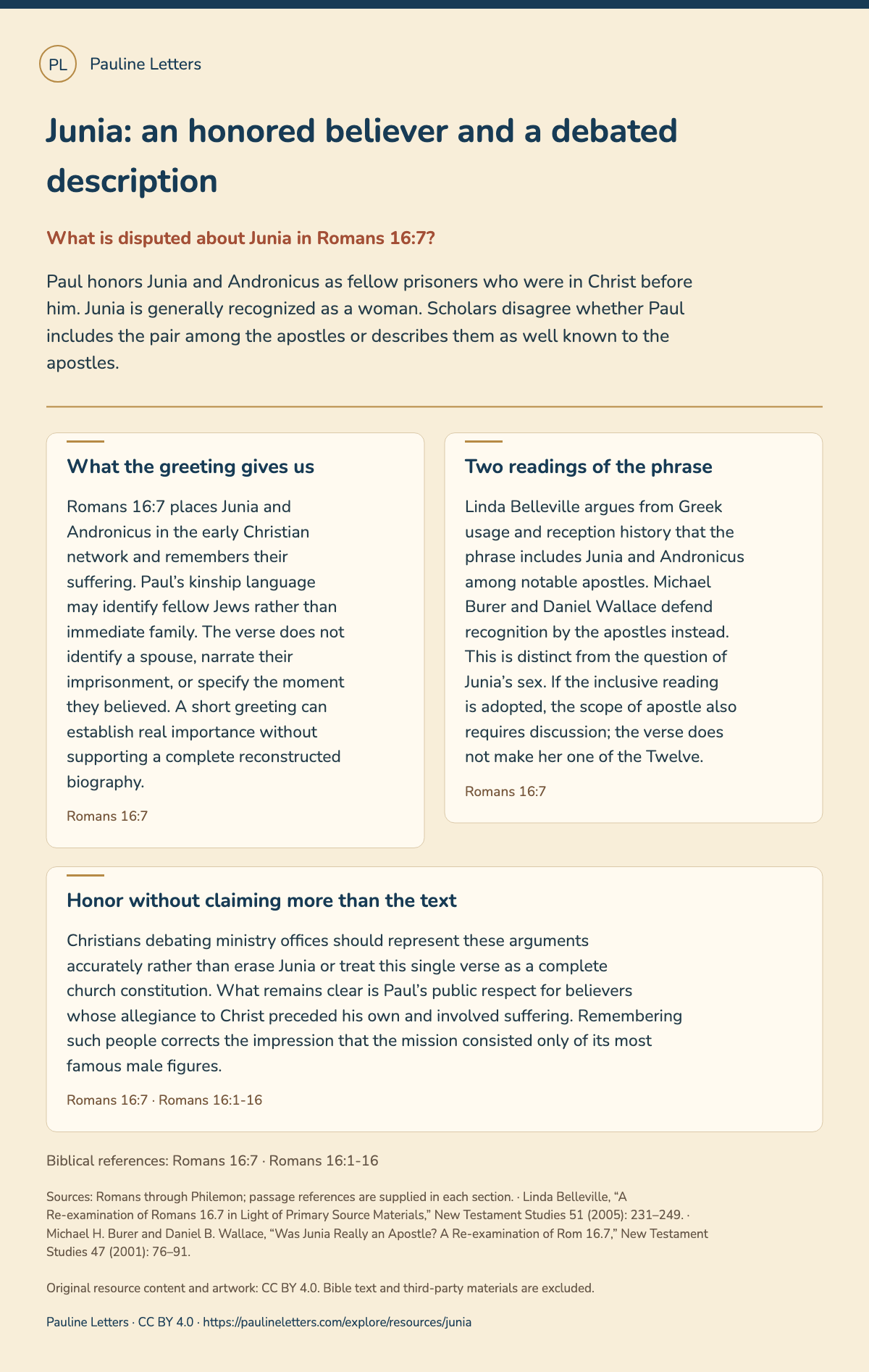
Paul honors Junia and Andronicus as fellow prisoners who were in Christ before him. Junia is generally recognized as a woman. Scholars disagree whether Paul includes the pair among the apostles or describes them as well known to the apostles.
Open resourceSVG · PNG · PDF
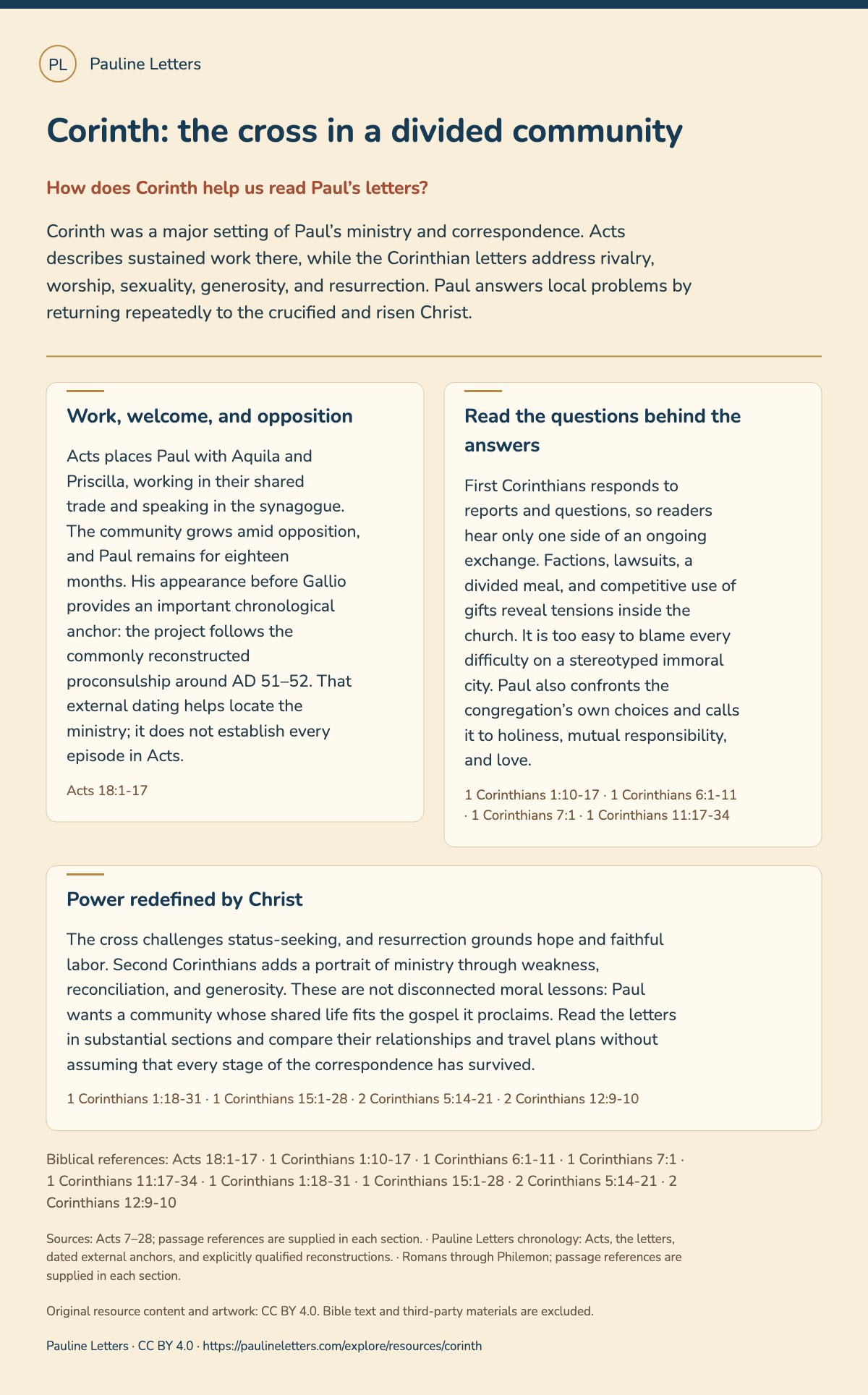
Corinth was a major setting of Paul’s ministry and correspondence. Acts describes sustained work there, while the Corinthian letters address rivalry, worship, sexuality, generosity, and resurrection. Paul answers local problems by returning repeatedly to the crucified and risen Christ.
Open resourceSVG · PNG · PDF
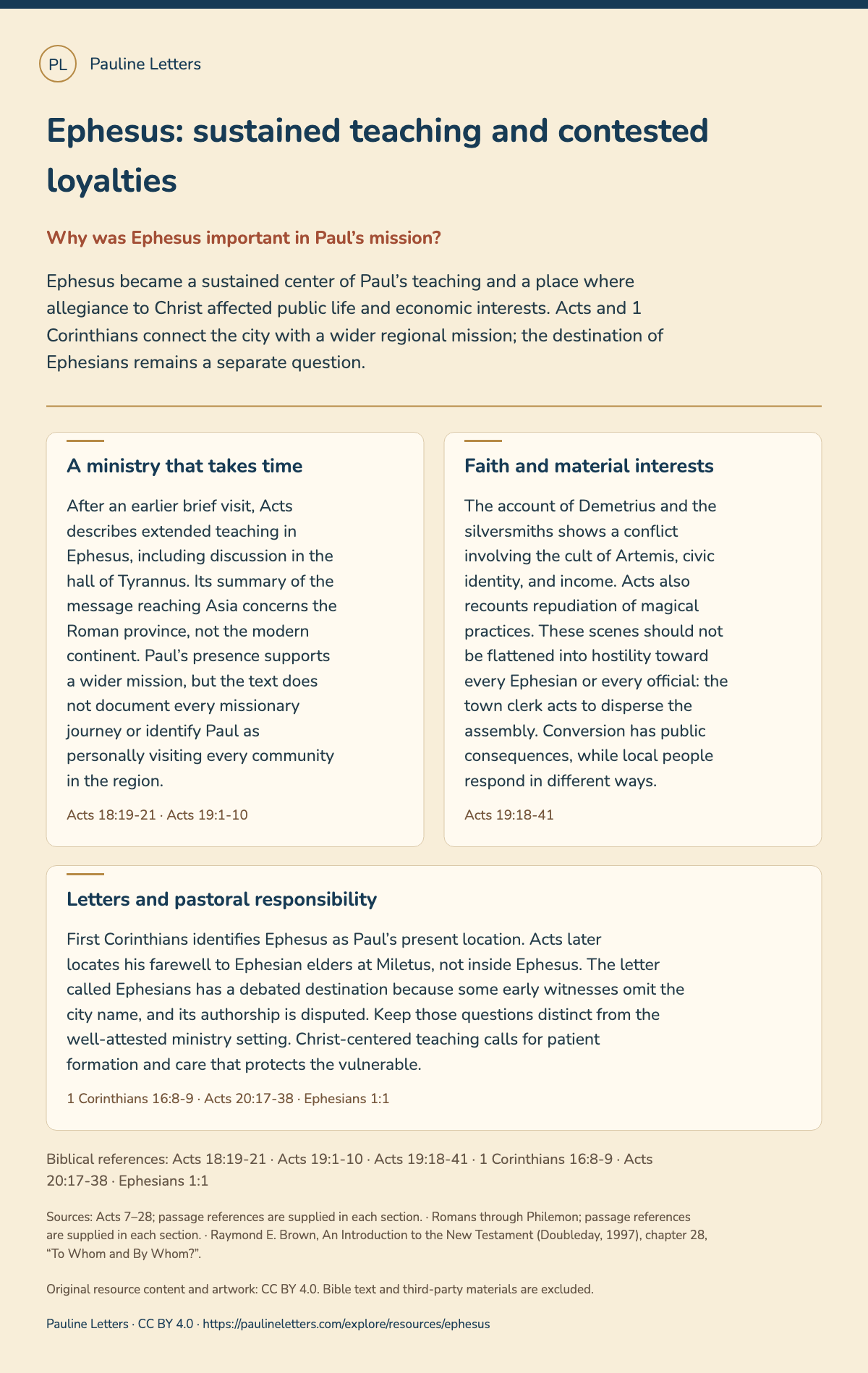
Ephesus became a sustained center of Paul’s teaching and a place where allegiance to Christ affected public life and economic interests. Acts and 1 Corinthians connect the city with a wider regional mission; the destination of Ephesians remains a separate question.
Open resourceSVG · PNG · PDF
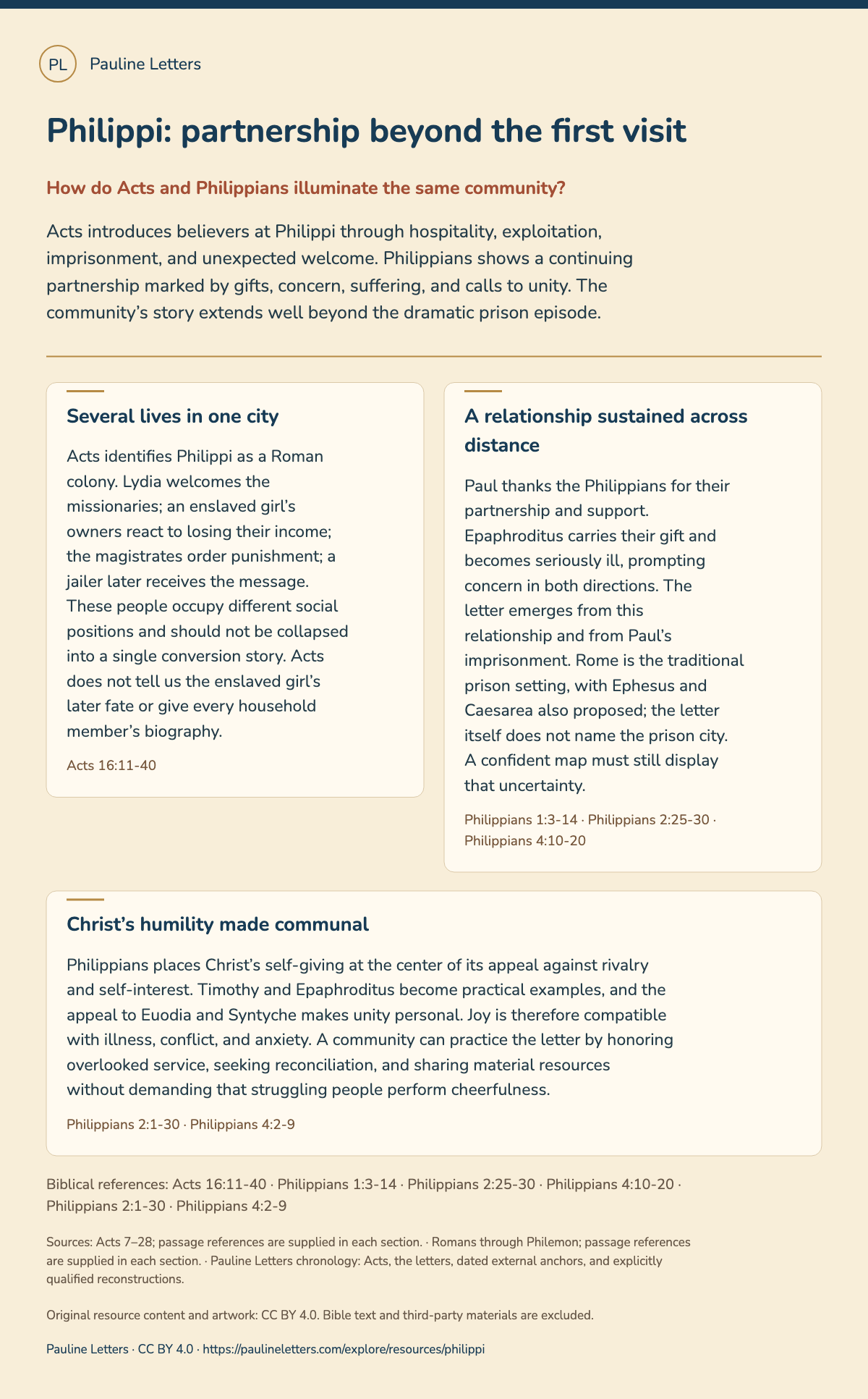
Acts introduces believers at Philippi through hospitality, exploitation, imprisonment, and unexpected welcome. Philippians shows a continuing partnership marked by gifts, concern, suffering, and calls to unity. The community’s story extends well beyond the dramatic prison episode.
Open resourceSVG · PNG · PDF
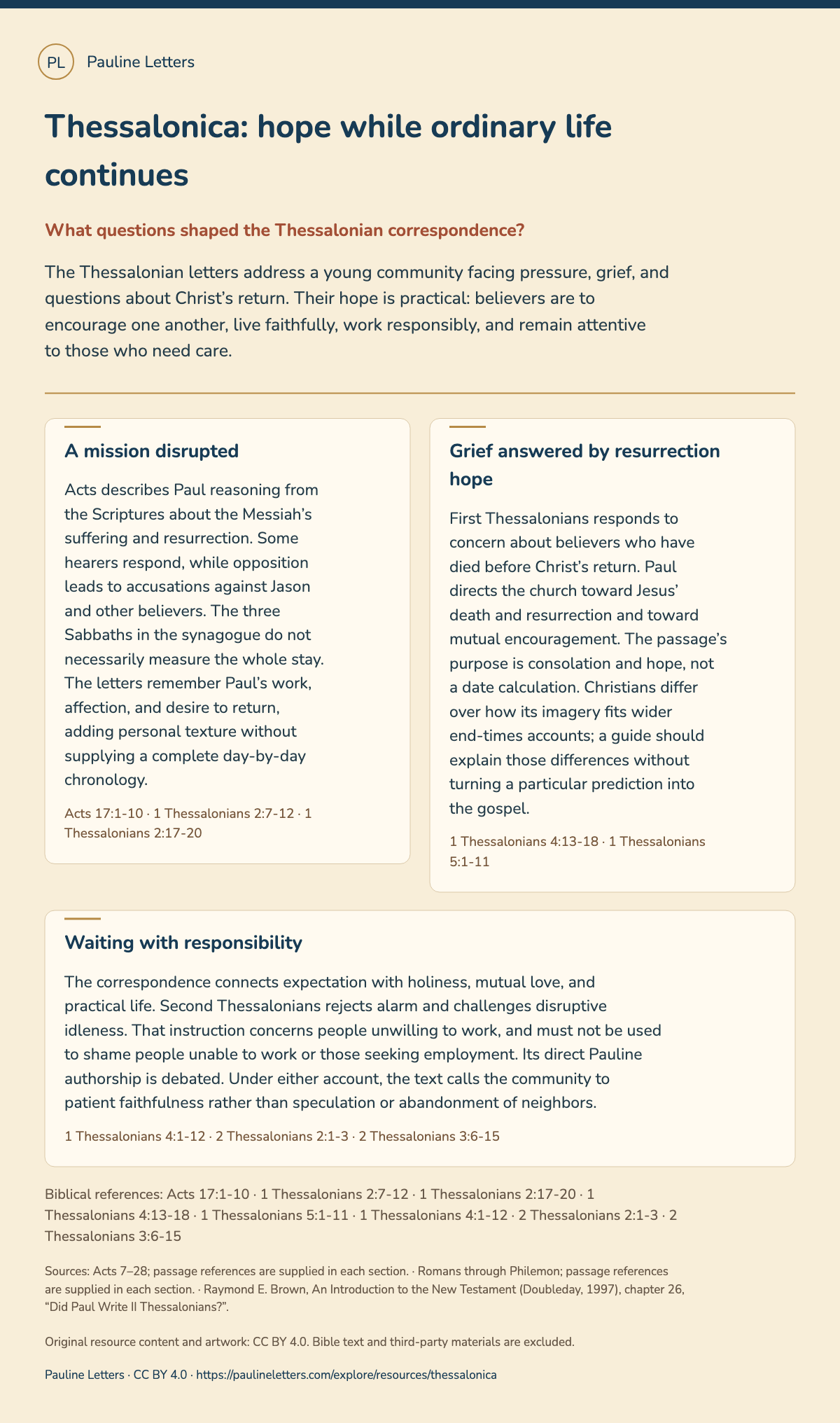
The Thessalonian letters address a young community facing pressure, grief, and questions about Christ’s return. Their hope is practical: believers are to encourage one another, live faithfully, work responsibly, and remain attentive to those who need care.
Open resourceSVG · PNG · PDF
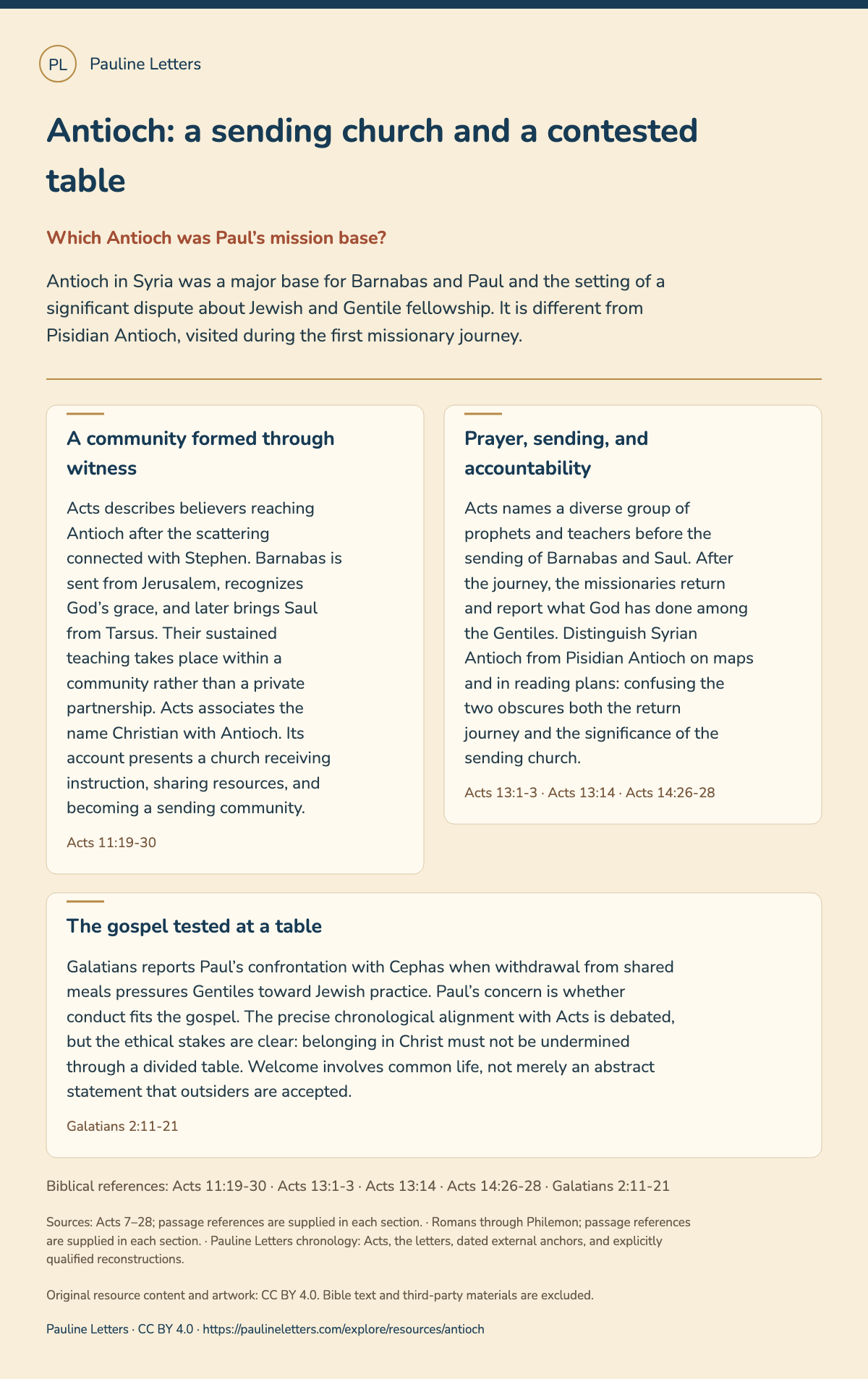
Antioch in Syria was a major base for Barnabas and Paul and the setting of a significant dispute about Jewish and Gentile fellowship. It is different from Pisidian Antioch, visited during the first missionary journey.
Open resourceSVG · PNG · PDF
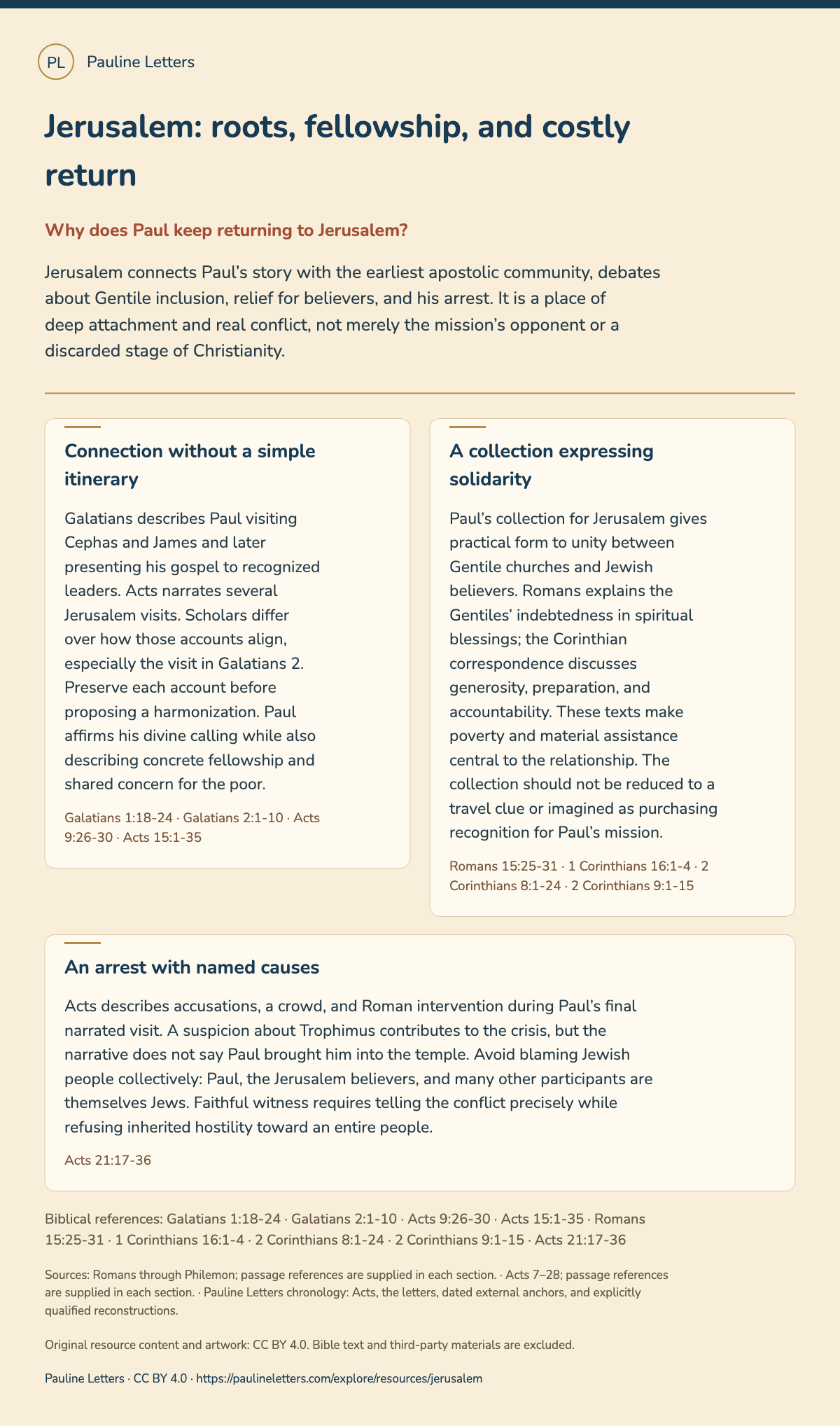
Jerusalem connects Paul’s story with the earliest apostolic community, debates about Gentile inclusion, relief for believers, and his arrest. It is a place of deep attachment and real conflict, not merely the mission’s opponent or a discarded stage of Christianity.
Open resourceSVG · PNG · PDF
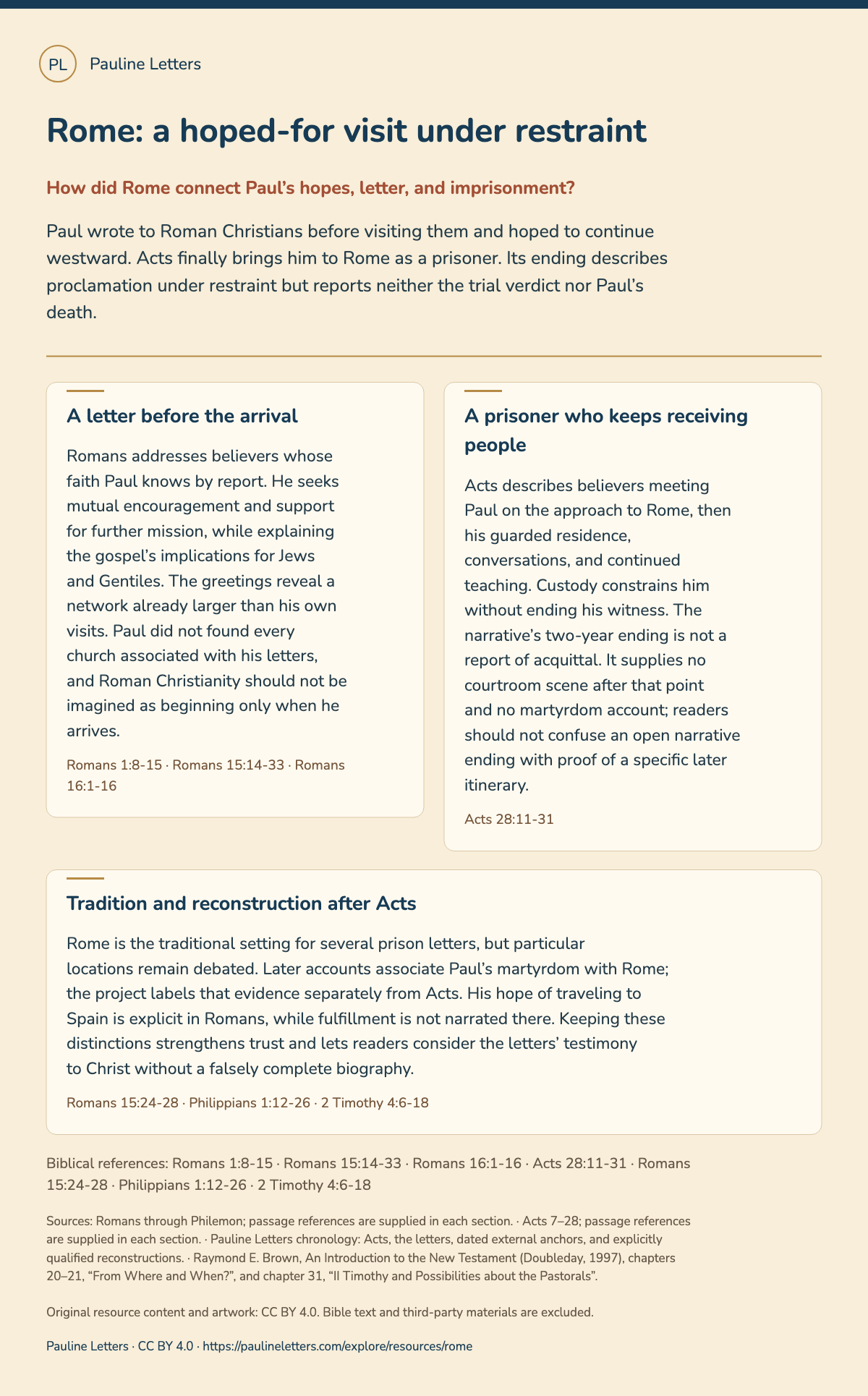
Paul wrote to Roman Christians before visiting them and hoped to continue westward. Acts finally brings him to Rome as a prisoner. Its ending describes proclamation under restraint but reports neither the trial verdict nor Paul’s death.
Open resourceSVG · PNG · PDF
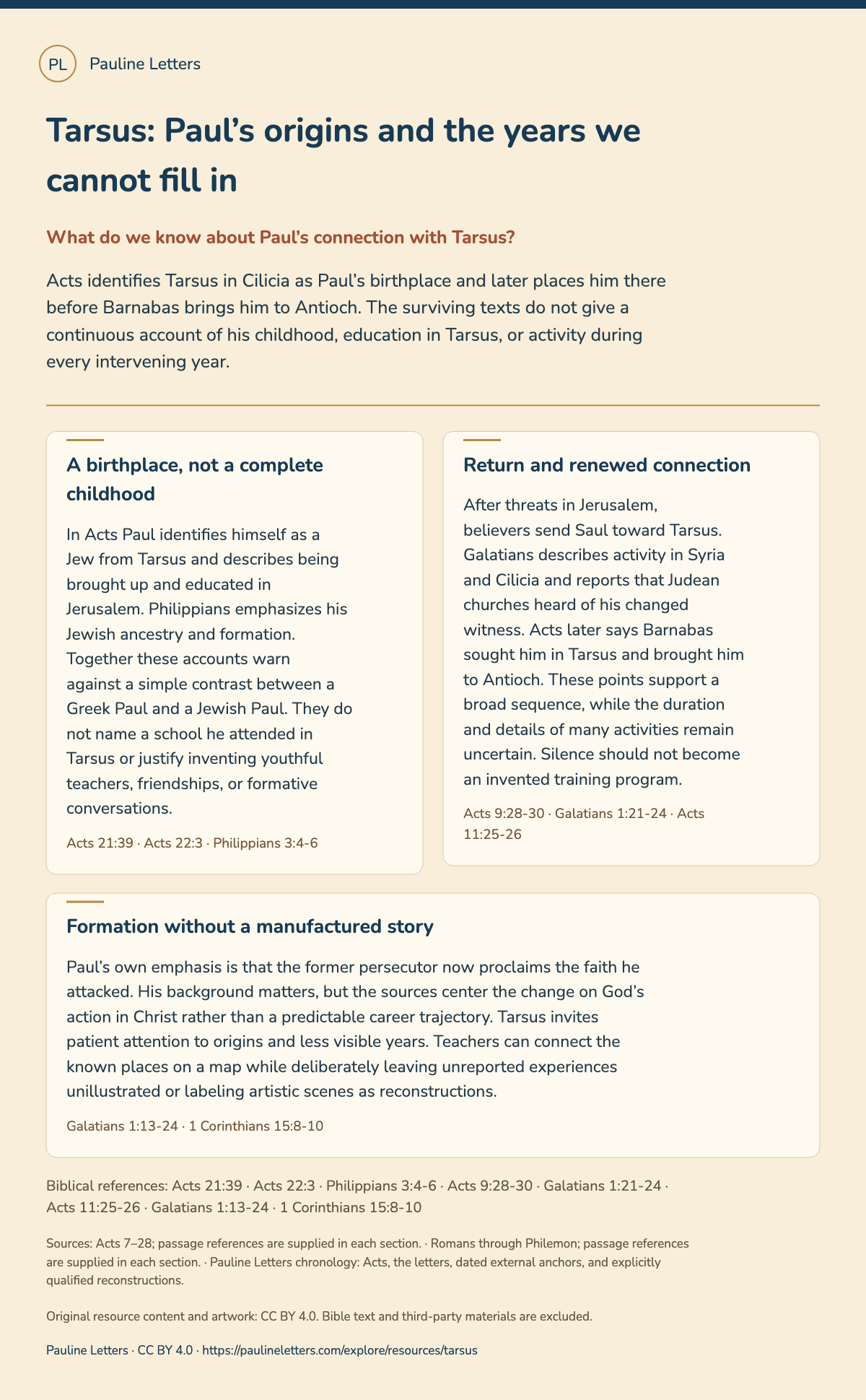
Acts identifies Tarsus in Cilicia as Paul’s birthplace and later places him there before Barnabas brings him to Antioch. The surviving texts do not give a continuous account of his childhood, education in Tarsus, or activity during every intervening year.
Open resourceSVG · PNG · PDF
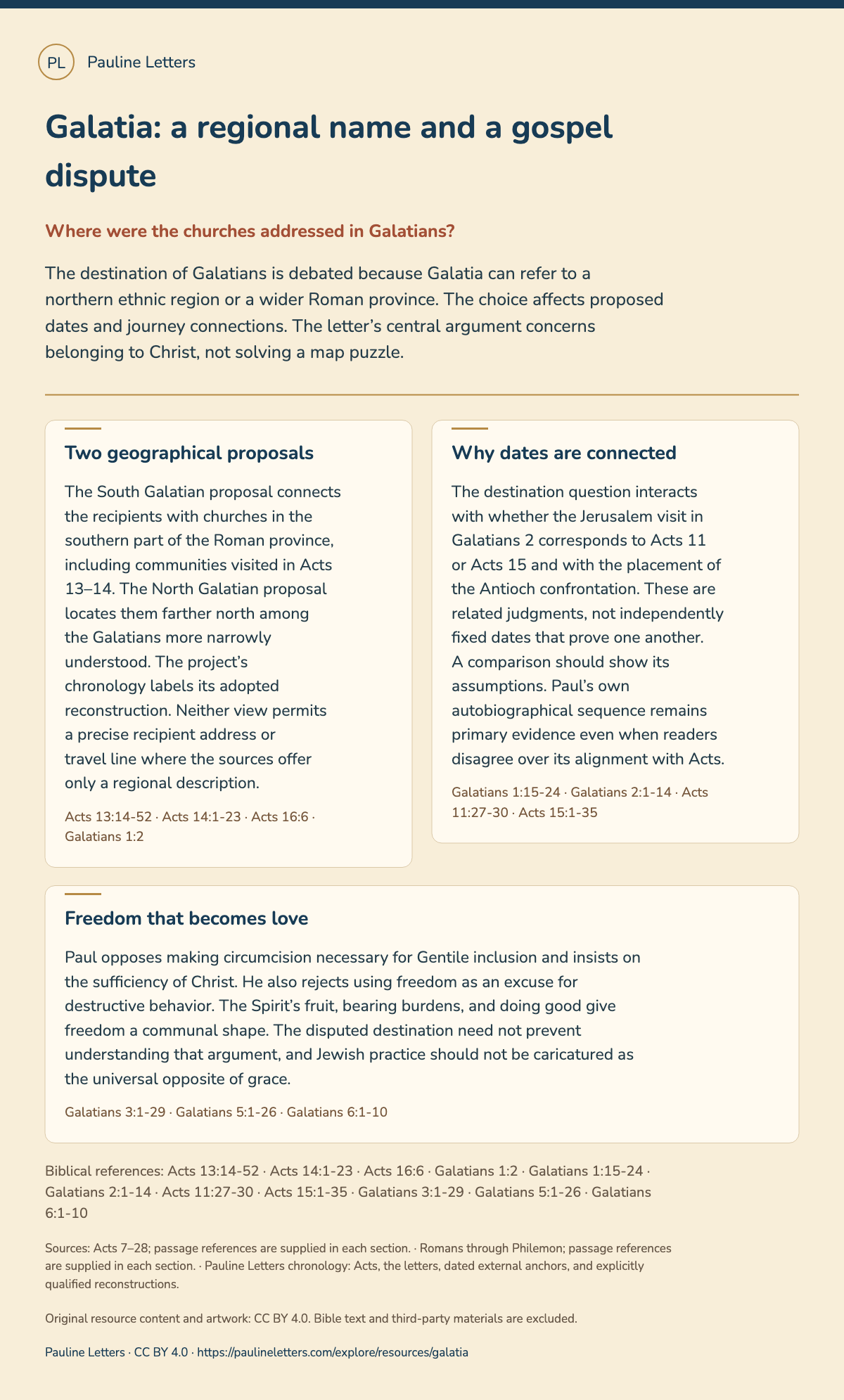
The destination of Galatians is debated because Galatia can refer to a northern ethnic region or a wider Roman province. The choice affects proposed dates and journey connections. The letter’s central argument concerns belonging to Christ, not solving a map puzzle.
Open resourceSVG · PNG · PDF
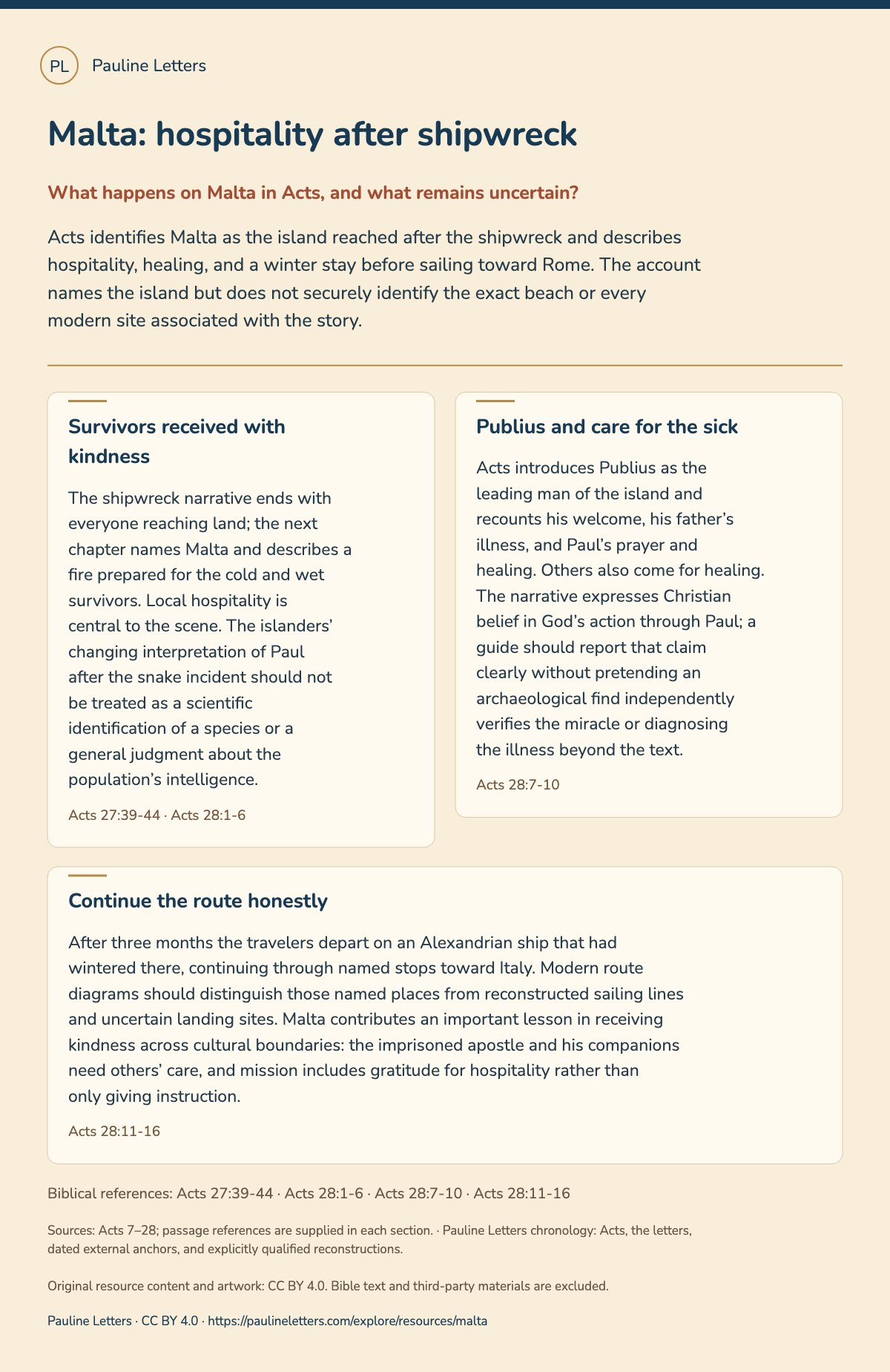
Acts identifies Malta as the island reached after the shipwreck and describes hospitality, healing, and a winter stay before sailing toward Rome. The account names the island but does not securely identify the exact beach or every modern site associated with the story.
Open resourceSVG · PNG · PDF
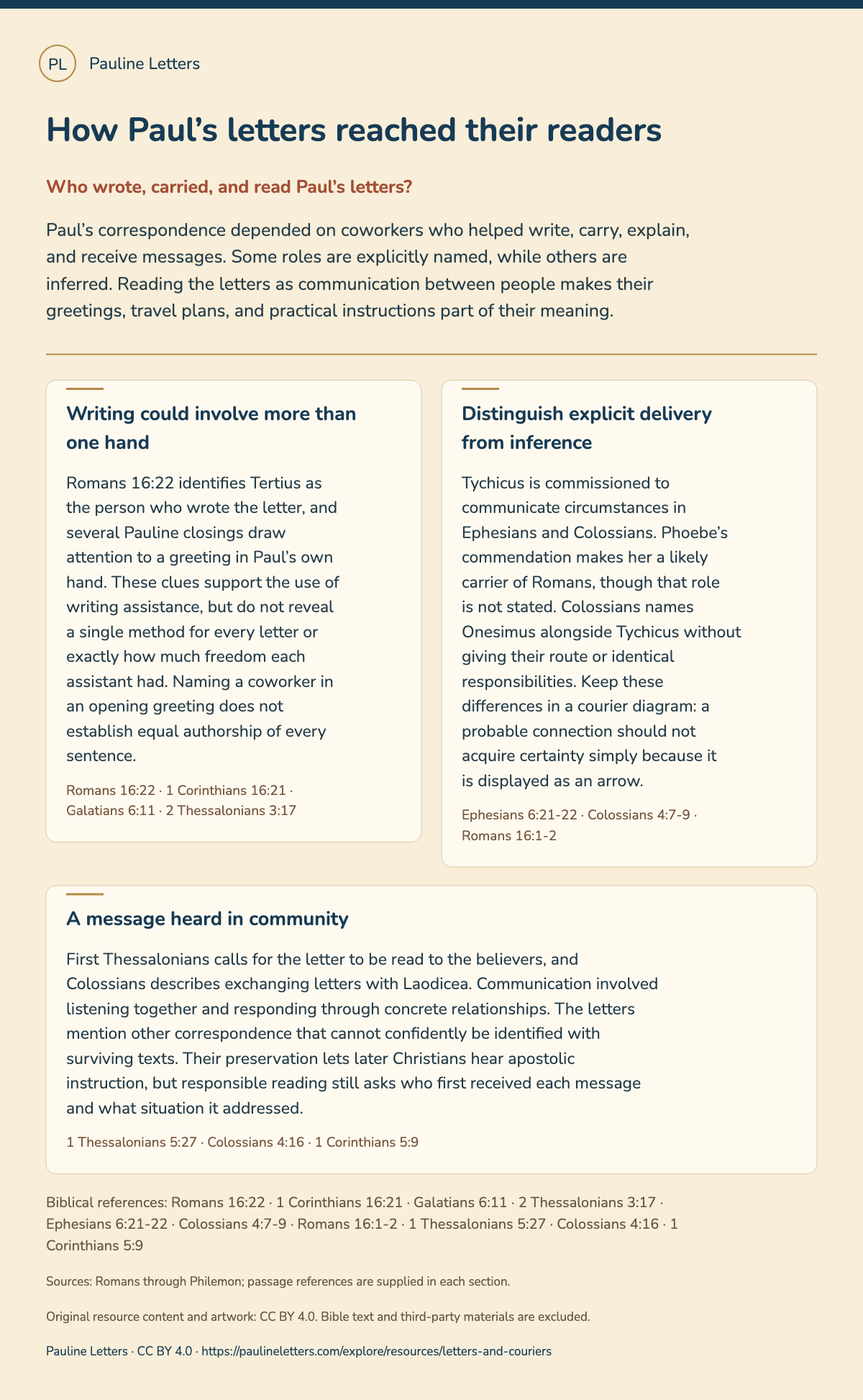
Paul’s correspondence depended on coworkers who helped write, carry, explain, and receive messages. Some roles are explicitly named, while others are inferred. Reading the letters as communication between people makes their greetings, travel plans, and practical instructions part of their meaning.
Open resourceSVG · PNG · PDF
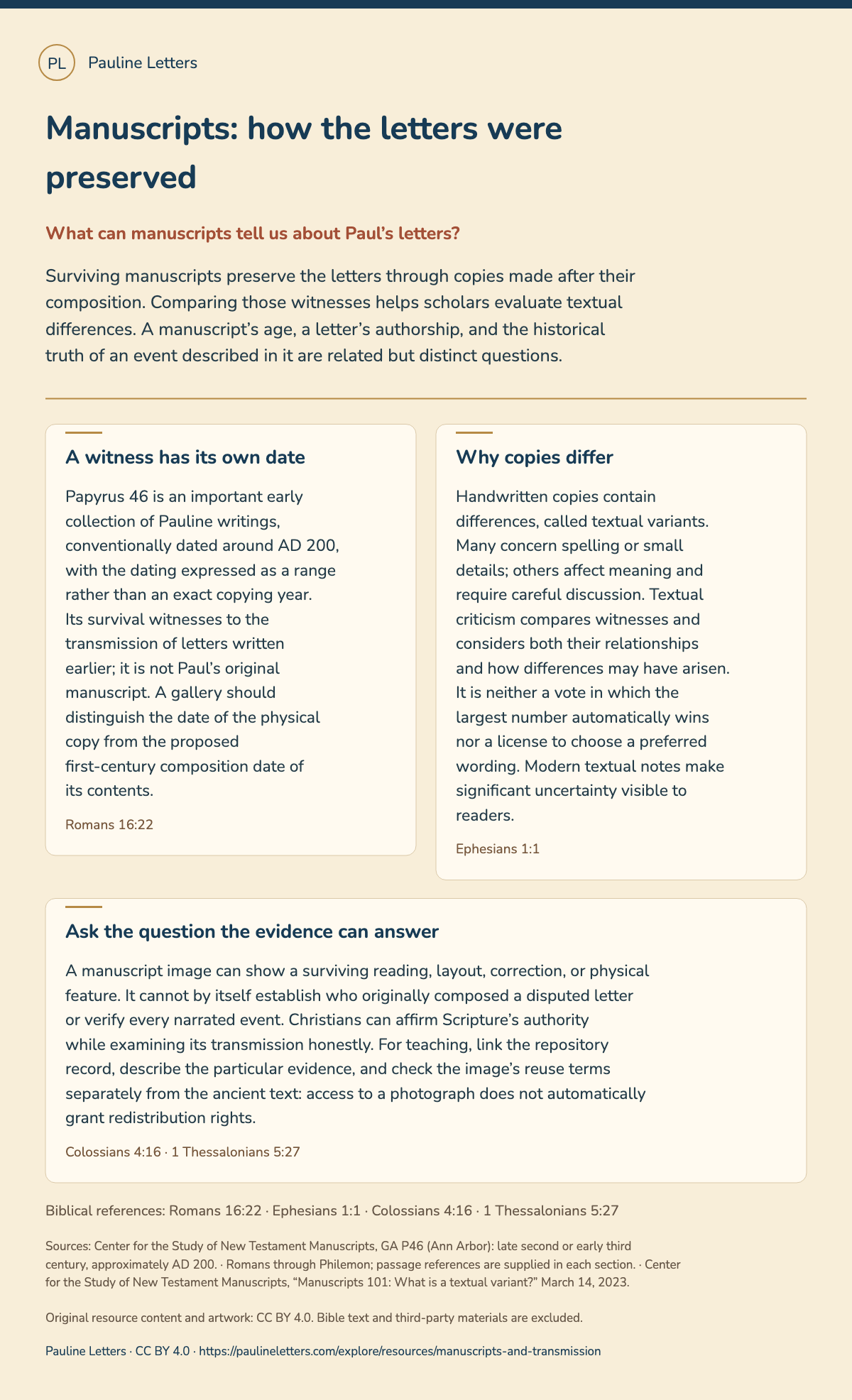
Surviving manuscripts preserve the letters through copies made after their composition. Comparing those witnesses helps scholars evaluate textual differences. A manuscript’s age, a letter’s authorship, and the historical truth of an event described in it are related but distinct questions.
Open resourceSVG · PNG · PDF
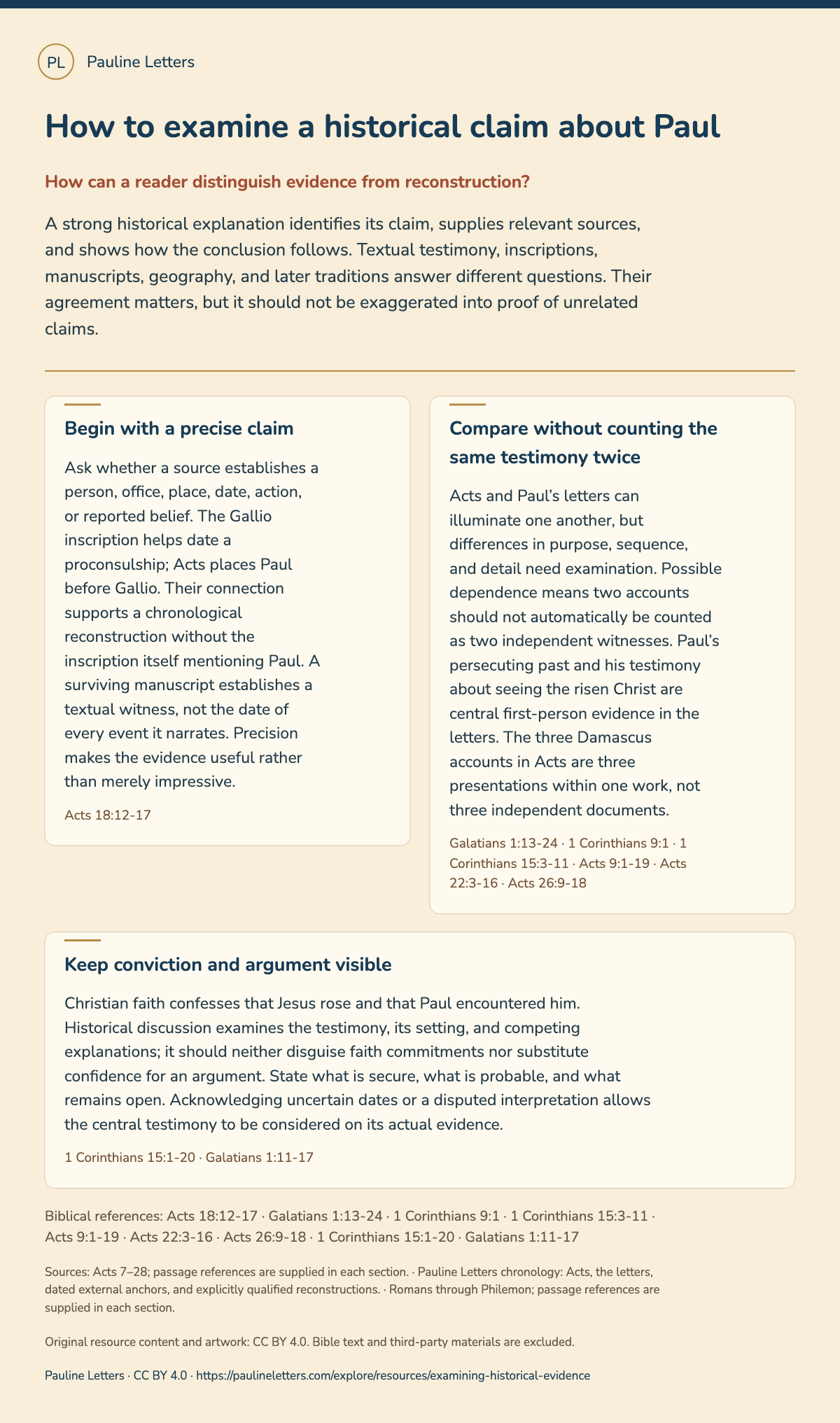
A strong historical explanation identifies its claim, supplies relevant sources, and shows how the conclusion follows. Textual testimony, inscriptions, manuscripts, geography, and later traditions answer different questions. Their agreement matters, but it should not be exaggerated into proof of unrelated claims.
Open resourceSVG · PNG · PDF
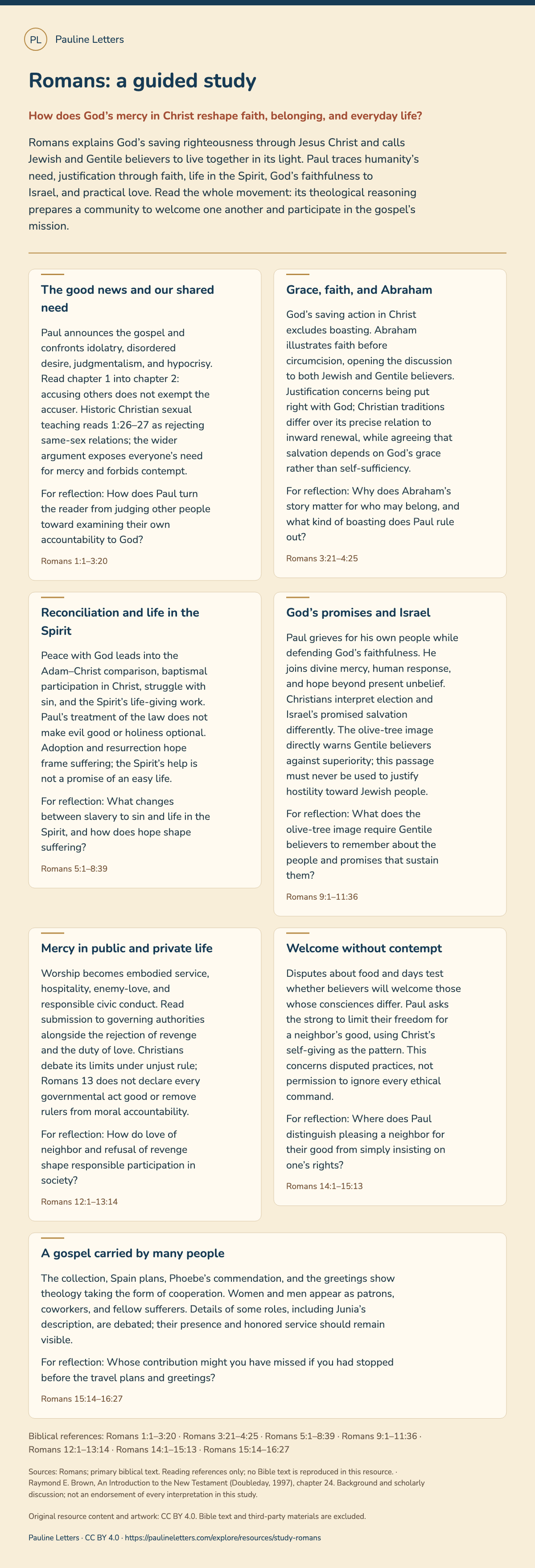
Follow the gospel from humanity’s need and God’s grace to a reconciled life together in seven sessions.
Open resourceSVG · PNG · PDF
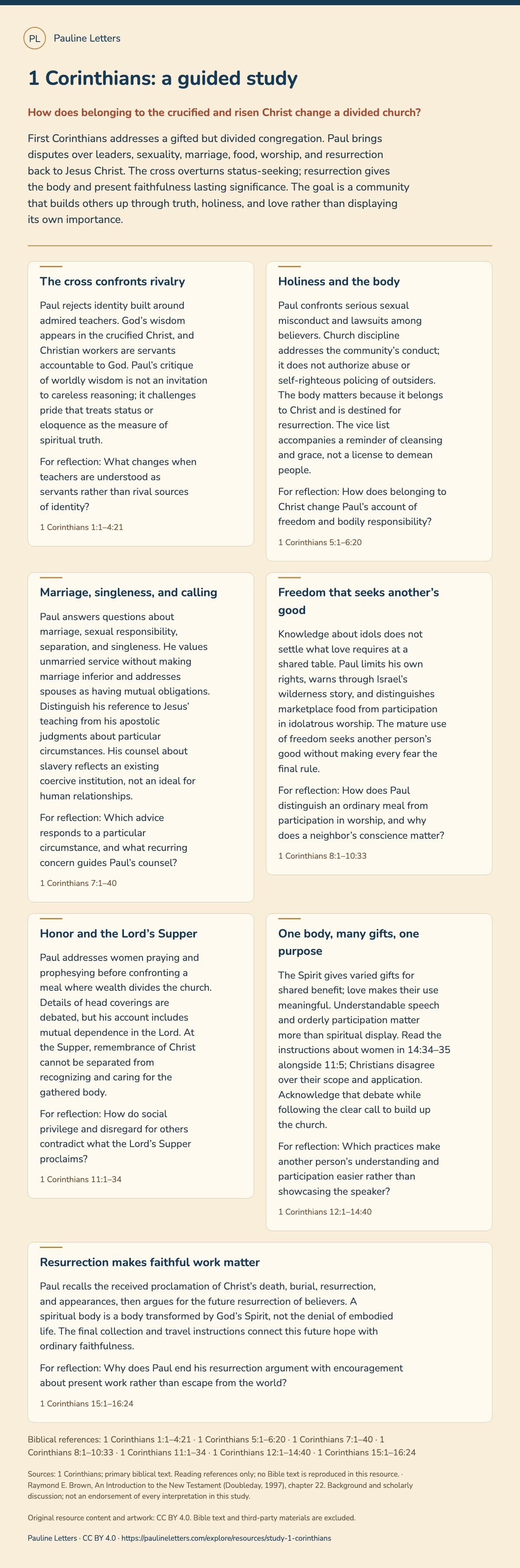
Explore the cross, embodied holiness, gifts, love, and resurrection in seven connected readings.
Open resourceSVG · PNG · PDF
Six sessions on reconciliation, integrity, generosity, and Christ’s power in weakness.
Open resourceSVG · PNG · PDF
Six sessions on the gospel, Abraham, belonging, freedom, and the Spirit’s fruit.
Open resourceSVG · PNG · PDF
Six sessions connecting God’s grace, a reconciled people, and faithful everyday relationships.
Open resourceSVG · PNG · PDF
A seven-session path through partnership, humility, resurrection hope, reconciliation, and generosity.
Open resourceSVG · PNG · PDF
Five sessions on Christ’s supremacy, fullness in him, and the habits of renewed life.
Open resourceSVG · PNG · PDF
Five sessions on a young church’s faith, holiness, grief, and resurrection hope.
Open resourceSVG · PNG · PDF
Four sessions on endurance, discernment about the future, and responsible community life.
Open resourceSVG · PNG · PDF
Six sessions on trustworthy teaching, worship, leadership, care, and contentment.
Open resourceSVG · PNG · PDF
Four sessions on enduring faith, entrusted teaching, Scripture, and a ministry’s final charge.
Open resourceSVG · PNG · PDF
Four sessions on credible leaders, grace-shaped conduct, and good works for neighbors.
Open resourceSVG · PNG · PDF
Four short readings on an enslaved person, Christian kinship, and a costly appeal for welcome.
Open resource