How does saving grace train a community for good works?
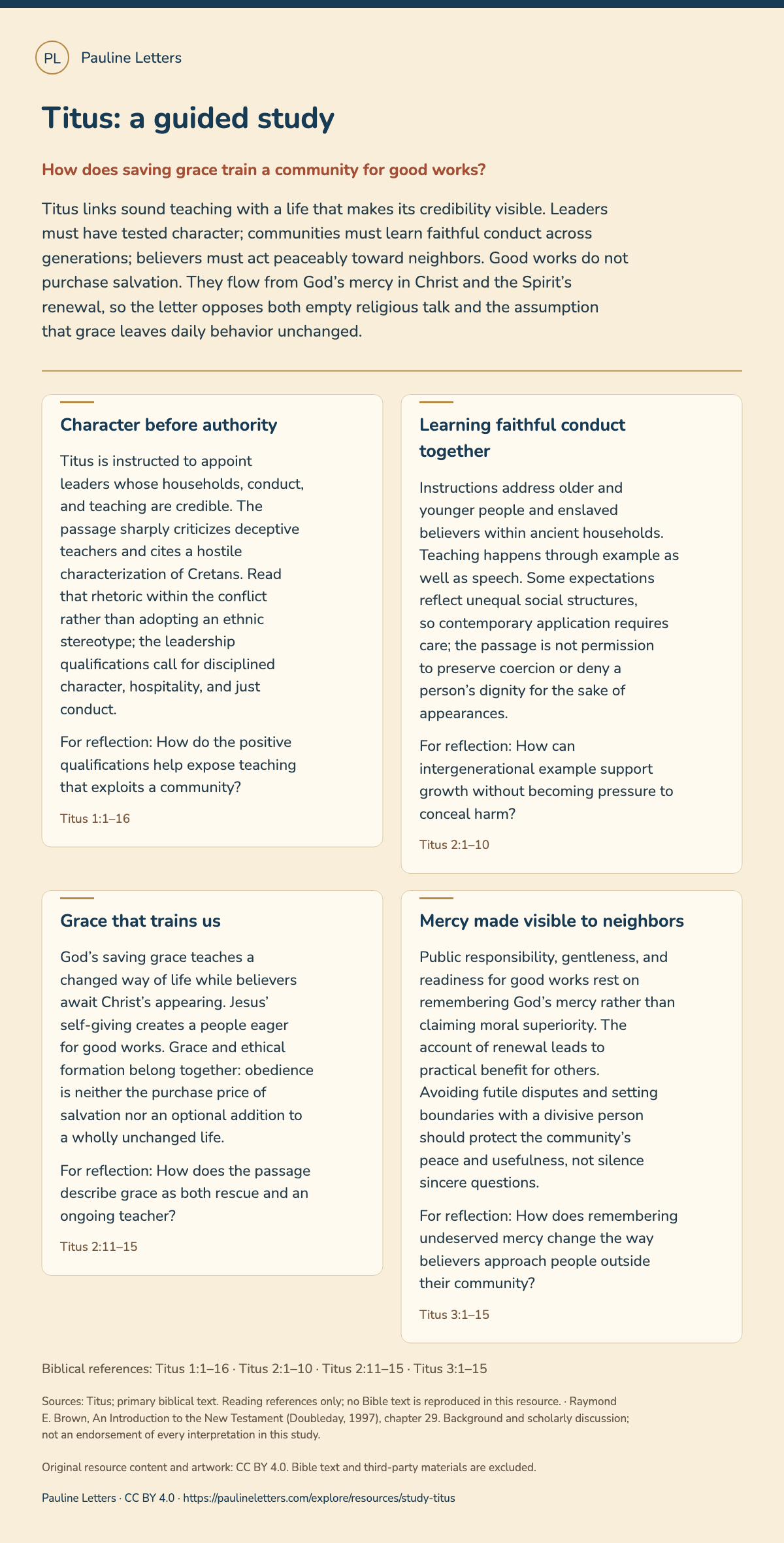
Titus links sound teaching with a life that makes its credibility visible. Leaders must have tested character; communities must learn faithful conduct across generations; believers must act peaceably toward neighbors. Good works do not purchase salvation. They flow from God’s mercy in Christ and the Spirit’s renewal, so the letter opposes both empty religious talk and the assumption that grace leaves daily behavior unchanged.
Titus 1:1–16 · Titus 2:1–10 · Titus 2:11–15 · Titus 3:1–15
Read the letter in its setting
The letter names Paul and addresses Titus in Crete. Traditional reconstruction places this mission after the period covered by Acts; other scholars understand it as a later work in the Pauline tradition. Authorship and dating are therefore disputed, and Acts’ account of passing Crete cannot simply establish this mission’s circumstances. Read the letter’s descriptions of opponents as polemical claims within a pastoral conflict, not a license to stereotype an entire people.
Titus 1:1–16 · Titus 3:12–15
Sources: Titus · An Introduction to the New Testament
Follow the argument
Chapter 1 joins leadership qualifications with correction of harmful teaching. Chapter 2 turns to instruction across the household and grounds it in the appearing of God’s grace. Chapter 3 connects public conduct, mercy, renewal, and useful work. Household instructions address social inequalities the text does not abolish directly; they must not become an endorsement of slavery or abuse. Divisive argument is challenged because the community’s attention should serve faithful and beneficial action.
Titus 2:1–15 · Titus 3:1–11
Sources: Titus
Study sessions
01Character before authority
Titus 1:1–16
Titus is instructed to appoint leaders whose households, conduct, and teaching are credible. The passage sharply criticizes deceptive teachers and cites a hostile characterization of Cretans. Read that rhetoric within the conflict rather than adopting an ethnic stereotype; the leadership qualifications call for disciplined character, hospitality, and just conduct.
For reflection How do the positive qualifications help expose teaching that exploits a community?
Save my place02Learning faithful conduct together
Titus 2:1–10
Instructions address older and younger people and enslaved believers within ancient households. Teaching happens through example as well as speech. Some expectations reflect unequal social structures, so contemporary application requires care; the passage is not permission to preserve coercion or deny a person’s dignity for the sake of appearances.
For reflection How can intergenerational example support growth without becoming pressure to conceal harm?
Save my place03Grace that trains us
Titus 2:11–15
God’s saving grace teaches a changed way of life while believers await Christ’s appearing. Jesus’ self-giving creates a people eager for good works. Grace and ethical formation belong together: obedience is neither the purchase price of salvation nor an optional addition to a wholly unchanged life.
For reflection How does the passage describe grace as both rescue and an ongoing teacher?
Save my place04Mercy made visible to neighbors
Titus 3:1–15
Public responsibility, gentleness, and readiness for good works rest on remembering God’s mercy rather than claiming moral superiority. The account of renewal leads to practical benefit for others. Avoiding futile disputes and setting boundaries with a divisive person should protect the community’s peace and usefulness, not silence sincere questions.
For reflection How does remembering undeserved mercy change the way believers approach people outside their community?
Save my place1. Character before authority
Titus 1:1–16
Titus is instructed to appoint leaders whose households, conduct, and teaching are credible. The passage sharply criticizes deceptive teachers and cites a hostile characterization of Cretans. Read that rhetoric within the conflict rather than adopting an ethnic stereotype; the leadership qualifications call for disciplined character, hospitality, and just conduct.
For reflection How do the positive qualifications help expose teaching that exploits a community?
2. Learning faithful conduct together
Titus 2:1–10
Instructions address older and younger people and enslaved believers within ancient households. Teaching happens through example as well as speech. Some expectations reflect unequal social structures, so contemporary application requires care; the passage is not permission to preserve coercion or deny a person’s dignity for the sake of appearances.
For reflection How can intergenerational example support growth without becoming pressure to conceal harm?
3. Grace that trains us
Titus 2:11–15
God’s saving grace teaches a changed way of life while believers await Christ’s appearing. Jesus’ self-giving creates a people eager for good works. Grace and ethical formation belong together: obedience is neither the purchase price of salvation nor an optional addition to a wholly unchanged life.
For reflection How does the passage describe grace as both rescue and an ongoing teacher?
4. Mercy made visible to neighbors
Titus 3:1–15
Public responsibility, gentleness, and readiness for good works rest on remembering God’s mercy rather than claiming moral superiority. The account of renewal leads to practical benefit for others. Avoiding futile disputes and setting boundaries with a divisive person should protect the community’s peace and usefulness, not silence sincere questions.
For reflection How does remembering undeserved mercy change the way believers approach people outside their community?
Sources
Titus 1:1–16 · Titus 2:1–10 · Titus 2:11–15 · Titus 3:1–15
- Titus
Titus; primary biblical text. Reading references only; no Bible text is reproduced in this resource.
- An Introduction to the New Testament
Raymond E. Brown, An Introduction to the New Testament (Doubleday, 1997), chapter 29. Background and scholarly discussion; not an endorsement of every interpretation in this study.
Explore next
Encounter Christ through Scripture, history, and thoughtful learning.
Enter the story