What makes a church’s teaching and common life trustworthy?
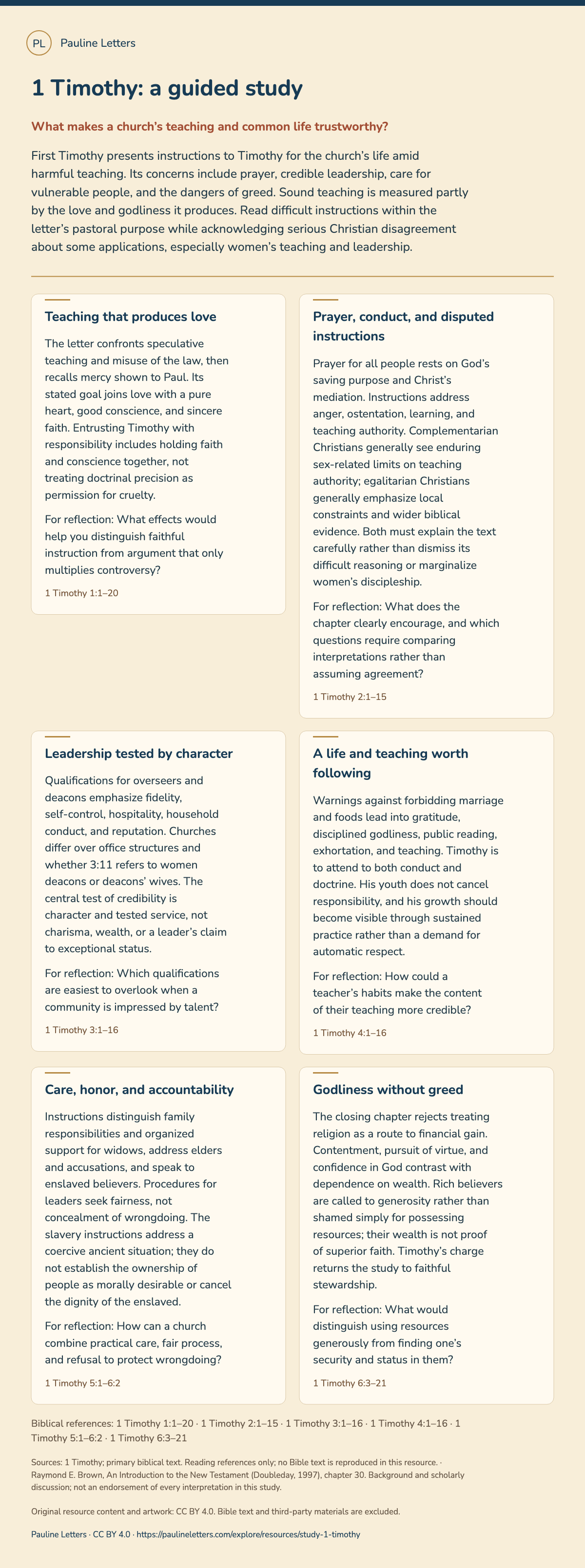
First Timothy presents instructions to Timothy for the church’s life amid harmful teaching. Its concerns include prayer, credible leadership, care for vulnerable people, and the dangers of greed. Sound teaching is measured partly by the love and godliness it produces. Read difficult instructions within the letter’s pastoral purpose while acknowledging serious Christian disagreement about some applications, especially women’s teaching and leadership.
1 Timothy 1:1–20 · 1 Timothy 2:1–15 · 1 Timothy 3:1–16 · 1 Timothy 4:1–16 · 1 Timothy 5:1–6:2 · 1 Timothy 6:3–21
Read the letter in its setting
The letter names Paul and locates Timothy’s task in Ephesus. The traditional setting places it in ministry after the period narrated in Acts, while many scholars propose later composition within the Pauline tradition. The itinerary and date therefore need qualification. Along with Second Timothy and Titus it is called a Pastoral Letter, a later grouping that recognizes their shared attention to teaching, leadership, and household life.
1 Timothy 1:1–7 · 1 Timothy 3:14–16
Sources: 1 Timothy · An Introduction to the New Testament
Follow the argument
The argument moves from the goal of faithful instruction to public prayer, leadership character, Timothy’s example, organized care, and the use of wealth. The church is pictured as God’s household, requiring accountable conduct rather than unquestionable authority. The statement concerning childbirth in 2:15 has several interpretations and must not be made a guarantee of obstetric safety or a claim that women earn salvation by becoming mothers.
1 Timothy 2:1–15 · 1 Timothy 4:1–6:21
Sources: 1 Timothy
Study sessions
01Teaching that produces love
1 Timothy 1:1–20
The letter confronts speculative teaching and misuse of the law, then recalls mercy shown to Paul. Its stated goal joins love with a pure heart, good conscience, and sincere faith. Entrusting Timothy with responsibility includes holding faith and conscience together, not treating doctrinal precision as permission for cruelty.
For reflection What effects would help you distinguish faithful instruction from argument that only multiplies controversy?
Save my place02Prayer, conduct, and disputed instructions
1 Timothy 2:1–15
Prayer for all people rests on God’s saving purpose and Christ’s mediation. Instructions address anger, ostentation, learning, and teaching authority. Complementarian Christians generally see enduring sex-related limits on teaching authority; egalitarian Christians generally emphasize local constraints and wider biblical evidence. Both must explain the text carefully rather than dismiss its difficult reasoning or marginalize women’s discipleship.
For reflection What does the chapter clearly encourage, and which questions require comparing interpretations rather than assuming agreement?
Save my place03Leadership tested by character
1 Timothy 3:1–16
Qualifications for overseers and deacons emphasize fidelity, self-control, hospitality, household conduct, and reputation. Churches differ over office structures and whether 3:11 refers to women deacons or deacons’ wives. The central test of credibility is character and tested service, not charisma, wealth, or a leader’s claim to exceptional status.
For reflection Which qualifications are easiest to overlook when a community is impressed by talent?
Save my place04A life and teaching worth following
1 Timothy 4:1–16
Warnings against forbidding marriage and foods lead into gratitude, disciplined godliness, public reading, exhortation, and teaching. Timothy is to attend to both conduct and doctrine. His youth does not cancel responsibility, and his growth should become visible through sustained practice rather than a demand for automatic respect.
For reflection How could a teacher’s habits make the content of their teaching more credible?
Save my place05Care, honor, and accountability
1 Timothy 5:1–6:2
Instructions distinguish family responsibilities and organized support for widows, address elders and accusations, and speak to enslaved believers. Procedures for leaders seek fairness, not concealment of wrongdoing. The slavery instructions address a coercive ancient situation; they do not establish the ownership of people as morally desirable or cancel the dignity of the enslaved.
For reflection How can a church combine practical care, fair process, and refusal to protect wrongdoing?
Save my place06Godliness without greed
1 Timothy 6:3–21
The closing chapter rejects treating religion as a route to financial gain. Contentment, pursuit of virtue, and confidence in God contrast with dependence on wealth. Rich believers are called to generosity rather than shamed simply for possessing resources; their wealth is not proof of superior faith. Timothy’s charge returns the study to faithful stewardship.
For reflection What would distinguish using resources generously from finding one’s security and status in them?
Save my place1. Teaching that produces love
1 Timothy 1:1–20
The letter confronts speculative teaching and misuse of the law, then recalls mercy shown to Paul. Its stated goal joins love with a pure heart, good conscience, and sincere faith. Entrusting Timothy with responsibility includes holding faith and conscience together, not treating doctrinal precision as permission for cruelty.
For reflection What effects would help you distinguish faithful instruction from argument that only multiplies controversy?
2. Prayer, conduct, and disputed instructions
1 Timothy 2:1–15
Prayer for all people rests on God’s saving purpose and Christ’s mediation. Instructions address anger, ostentation, learning, and teaching authority. Complementarian Christians generally see enduring sex-related limits on teaching authority; egalitarian Christians generally emphasize local constraints and wider biblical evidence. Both must explain the text carefully rather than dismiss its difficult reasoning or marginalize women’s discipleship.
For reflection What does the chapter clearly encourage, and which questions require comparing interpretations rather than assuming agreement?
3. Leadership tested by character
1 Timothy 3:1–16
Qualifications for overseers and deacons emphasize fidelity, self-control, hospitality, household conduct, and reputation. Churches differ over office structures and whether 3:11 refers to women deacons or deacons’ wives. The central test of credibility is character and tested service, not charisma, wealth, or a leader’s claim to exceptional status.
For reflection Which qualifications are easiest to overlook when a community is impressed by talent?
4. A life and teaching worth following
1 Timothy 4:1–16
Warnings against forbidding marriage and foods lead into gratitude, disciplined godliness, public reading, exhortation, and teaching. Timothy is to attend to both conduct and doctrine. His youth does not cancel responsibility, and his growth should become visible through sustained practice rather than a demand for automatic respect.
For reflection How could a teacher’s habits make the content of their teaching more credible?
5. Care, honor, and accountability
1 Timothy 5:1–6:2
Instructions distinguish family responsibilities and organized support for widows, address elders and accusations, and speak to enslaved believers. Procedures for leaders seek fairness, not concealment of wrongdoing. The slavery instructions address a coercive ancient situation; they do not establish the ownership of people as morally desirable or cancel the dignity of the enslaved.
For reflection How can a church combine practical care, fair process, and refusal to protect wrongdoing?
6. Godliness without greed
1 Timothy 6:3–21
The closing chapter rejects treating religion as a route to financial gain. Contentment, pursuit of virtue, and confidence in God contrast with dependence on wealth. Rich believers are called to generosity rather than shamed simply for possessing resources; their wealth is not proof of superior faith. Timothy’s charge returns the study to faithful stewardship.
For reflection What would distinguish using resources generously from finding one’s security and status in them?
Sources
1 Timothy 1:1–20 · 1 Timothy 2:1–15 · 1 Timothy 3:1–16 · 1 Timothy 4:1–16 · 1 Timothy 5:1–6:2 · 1 Timothy 6:3–21
- 1 Timothy
1 Timothy; primary biblical text. Reading references only; no Bible text is reproduced in this resource.
- An Introduction to the New Testament
Raymond E. Brown, An Introduction to the New Testament (Doubleday, 1997), chapter 30. Background and scholarly discussion; not an endorsement of every interpretation in this study.
Explore next
Encounter Christ through Scripture, history, and thoughtful learning.
Enter the story