Pauline Letters · Evidence-led guide
Timeline of Paul’s life and letters
Almost nothing in Paul’s life carries a date in the sources themselves. The whole chronology hangs outward from one Roman proconsul’s term, fixed by an inscription at Delphi.
Reader question
Which events are securely anchored, and where do interpreters reconstruct the sequence differently?
One point is fixed from outside the New Testament: Paul stood before Gallio at Corinth while Gallio was proconsul of Achaia, about AD 51 to 52. Every other date is reasoned outward from that one using the intervals Paul gives in his own letters, so most entries here are ranges rather than years.
All 67 chronology entries
- 1c. AD 5-10?
Saul born in Tarsus — a Jew of Benjamin, Hebrew of Hebrews, Roman citizen by birth.
- Place
- Tarsus
- References
- Acts 21:39; 22:3,25-29; Phil 3:5
- Confidence
- medium-high
- 2c. AD 20s-30s
Raised at the feet of Gamaliel; a strict Pharisee, zealous for the Law.
- Place
- Jerusalem
- References
- Acts 22:3; 26:4-5; Gal 1:13-14; Phil 3:5-6
- Confidence
- medium-high
- 3c. AD 33/34
Appears as Saul at Stephen's execution; approves his death.
- Place
- Jerusalem
- References
- Acts 7:58; 8:1
- Confidence
- high
- 4c. AD 33/34
Ravages the church; drags off and imprisons believers.
- Place
- Jerusalem · Judea
- References
- Acts 8:3; 9:1-2; 22:4-5; Gal 1:13; 1 Cor 15:9
- Confidence
- high
- 5c. AD 33/34
Encounters the risen Jesus on the road; blinded; called as apostle.
- Place
- The Road to Damascus · Damascus
- References
- Acts 9:1-9; 22:6-11; 26:12-18; Gal 1:15-16
- Confidence
- high
- 6c. AD 33/34
Ananias comes; sight restored; baptized; proclaims Jesus as Son of God.
- Place
- Damascus
- References
- Acts 9:10-22; 22:12-16
- Confidence
- high
- 7c. AD 34-37
Goes away into Arabia, then returns to Damascus.
- Place
- Arabia (Nabatea) · Damascus
- References
- Gal 1:16-17
- Confidence
- high
- 8c. AD 34-37
Preaching; opposition under Aretas; escapes lowered in a basket.
- Place
- Damascus
- References
- Acts 9:23-25; 2 Cor 11:32-33
- Confidence
- high
- 9c. AD 36/37
After three years visits Jerusalem; Barnabas vouches; meets Peter and James.
- Place
- Jerusalem
- References
- Acts 9:26-30; Gal 1:18-19
- Confidence
- high
- 10c. AD 37-45
Sent to Tarsus; ministers in Syria and Cilicia.
- Place
- Caesarea Maritima · Tarsus · Syria · Cilicia
- References
- Acts 9:30; Gal 1:21-24
- Confidence
- medium-high
- 11c. AD 42-44?
Caught up to the third heaven; the thorn in the flesh. Location unstated.
- Place
- Location unstated
- References
- 2 Cor 12:1-10
- Confidence
- medium
- 12c. AD 44-46
Barnabas brings him to Antioch; a year of teaching; disciples first called Christians.
- Place
- Antioch
- References
- Acts 11:25-26
- Confidence
- high
- 13c. AD 44-47
Carries famine relief from Antioch to Judea; the route is shown overland by historical inference.
- Place
- Antioch · Jerusalem · Judea
- References
- Acts 11:27-30; 12:25; cf. Acts 15:3
- Confidence
- medium-high
- 14c. AD 46-48
Set apart by the Spirit; to Cyprus; Elymas blinded, Sergius Paulus believes; Saul now Paul.
- Place
- Antioch · Seleucia Pieria · Salamis · Paphos
- References
- Acts 13:1-12
- Confidence
- high
- 15c. AD 46-48
John Mark turns back; the great synagogue sermon at Pisidian Antioch; turn to the Gentiles.
- Place
- Perga · Pisidian Antioch
- References
- Acts 13:13-52
- Confidence
- high
- 16c. AD 46-48
Many believe at Iconium; a plot to stone them; they flee.
- Place
- Iconium
- References
- Acts 14:1-7
- Confidence
- high
- 17c. AD 46-48
Heals a lame man; hailed as Zeus and Hermes; Paul stoned and left for dead, then rises.
- Place
- Lystra
- References
- Acts 14:8-20; 2 Cor 11:25
- Confidence
- high
- 18c. AD 46-48
Many disciples at Derbe; return strengthening churches and appointing elders.
- Place
- Derbe · Lystra · Iconium · Pisidian Antioch
- References
- Acts 14:20-23
- Confidence
- high
- 19c. AD 48
Returns to Antioch; reports God opened a door of faith to the nations.
- Place
- Perga · Attalia · Antioch
- References
- Acts 14:24-28
- Confidence
- high
- 20c. AD 48/49
Up to Jerusalem with Barnabas and Titus; gospel set before the leaders; right hand of fellowship.
- Place
- Jerusalem
- References
- Gal 2:1-10; cf. Acts 15
- Confidence
- high
- 21c. AD 48/49
Confronts Peter over withdrawing from table fellowship with Gentiles.
- Place
- Antioch
- References
- Gal 2:11-14
- Confidence
- high
- 22c. AD 48/49
Likely writes Galatians (early-date / South Galatian view).
- Place
- Antioch
- References
- Galatians 1-6
- Confidence
- medium
- 23c. AD 49
The Jerusalem Council: Gentiles need not be circumcised.
- Place
- Antioch · Jerusalem
- References
- Acts 15:1-35
- Confidence
- high
- 24c. AD 49
Returns with the council letter; the church rejoices.
- Place
- Antioch
- References
- Acts 15:30-35
- Confidence
- high
- 25c. AD 49
Sharp split with Barnabas over John Mark; Paul takes Silas through Syria and Cilicia.
- Place
- Antioch · Syria · Cilicia
- References
- Acts 15:36-41
- Confidence
- high
- 26c. AD 49-50
Strengthens churches; Timothy joins; Paul circumcises him for the local context.
- Place
- Syria · Cilicia · Derbe · Lystra
- References
- Acts 16:1-5
- Confidence
- high
- 27c. AD 50
Forbidden by the Spirit in Asia; the Macedonian vision at Troas; the "we" sections begin.
- Place
- Phrygia · Galatian region · Mysia · Alexandria Troas
- References
- Acts 16:6-10
- Confidence
- high
- 28c. AD 50
Sails Troas→Samothrace→Neapolis, then inland to Philippi: Lydia believes; the slave girl freed; beaten and jailed; the jailer saved; the church founded.
- Place
- Samothrace · Neapolis · Philippi
- References
- Acts 16:11-40; Phil 1:5
- Confidence
- high
- 29c. AD 50
Three Sabbaths reasoning in Thessalonica; some believe; Jason dragged before officials.
- Place
- Amphipolis · Apollonia · Thessalonica
- References
- Acts 17:1-9; 1 Thess 1-3
- Confidence
- high
- 30c. AD 50
The noble Bereans examine the Scriptures daily; opponents arrive; Paul sent on.
- Place
- Berea
- References
- Acts 17:10-15
- Confidence
- high
- 31c. AD 50
The Areopagus address: the unknown God, repentance, resurrection.
- Place
- Athens
- References
- Acts 17:16-34
- Confidence
- high
- 32c. AD 50-52
Meets Aquila and Priscilla; reasons in the synagogue; stays eighteen months.
- Place
- Corinth
- References
- Acts 18:1-11; 1 Thess 3:1-6
- Confidence
- high
- 33c. AD 51/52
Brought before Gallio, who dismisses the case — the chronological anchor.
- Place
- Corinth
- References
- Acts 18:12-17
- Confidence
- high
- 34c. AD 52
Sails from Cenchreae; brief stop at Ephesus; up to greet the church, then down to Antioch.
- Place
- Cenchreae · Ephesus · Caesarea Maritima · Jerusalem · Antioch
- References
- Acts 18:18-22
- Confidence
- high
- 35c. AD 52/53
Third journey begins; strengthens disciples through Galatia and Phrygia.
- Place
- Antioch · Galatian region · Phrygia
- References
- Acts 18:23
- Confidence
- high
- 36c. AD 52/53-55/56
Two years in the hall of Tyrannus; the word spreads through Asia; magic books burned.
- Place
- Ephesus
- References
- Acts 19:1-20; 20:31
- Confidence
- high
- 37c. AD 54/55
Writes 1 Corinthians (Apollos evidently back at Ephesus with Paul, 1 Cor 16:12), answering the Corinthian divisions — Paul/Apollos/Cephas — that "I planted. Apollos watered. But God gave the increase".
- Place
- Ephesus
- References
- 1 Cor 1:11-12; 3:6; 16:8-12
- Confidence
- high
- 38c. AD 55/56
A painful visit and a severe letter (now lost) to Corinth.
- Place
- Ephesus · Corinth
- References
- 2 Cor 2:1-4; 7:8-12
- Confidence
- medium
- 39c. AD 55/56
The silversmiths riot over Artemis; Paul leaves for Macedonia.
- Place
- Ephesus
- References
- Acts 19:21-41; 20:1
- Confidence
- high
- 40c. AD 55/56
A door opens at Troas; on to Macedonia; Titus brings good news; writes 2 Corinthians — defending his ministry against the intruding rivals he brands "false apostles" and ironically calls the "super-apostles", and glorying in weakness.
- Place
- Alexandria Troas · Macedonia
- References
- Acts 20:1-2; 2 Cor 2:12-13; 7:5-7; 11:5, 13; 12:7-11
- Confidence
- high
- 41c. AD 55/56
Encourages Macedonia; organizes the collection; ministry as far as Illyricum.
- Place
- Macedonia · Illyricum
- References
- Acts 20:1-2; Rom 15:19; 2 Cor 8-9
- Confidence
- medium-high
- 42c. AD 56/57
Three months in Greece; writes Romans; a plot changes his route home.
- Place
- Corinth · Cenchreae
- References
- Acts 20:2-3; Rom 15:22-29; 16:1-2
- Confidence
- high
- 43c. AD 57
Sails from Philippi; at Troas, Eutychus falls and is restored.
- Place
- Philippi · Alexandria Troas
- References
- Acts 20:5-12
- Confidence
- high
- 44c. AD 57
Down the coast, hurrying past Ephesus to reach Jerusalem by Pentecost.
- Place
- Assos · Mitylene · Chios · Samos · Miletus
- References
- Acts 20:13-16
- Confidence
- high
- 45c. AD 57
The farewell to the Ephesian elders: they will not see his face again.
- Place
- Miletus
- References
- Acts 20:17-38
- Confidence
- high
- 46c. AD 57
Toward Jerusalem; at Tyre, disciples warn him through the Spirit.
- Place
- Cos · Rhodes · Patara · Tyre
- References
- Acts 21:1-6
- Confidence
- high
- 47c. AD 57
Stays with Philip; Agabus binds himself with Paul’s belt; Paul is ready to die.
- Place
- Ptolemais · Caesarea Maritima
- References
- Acts 21:7-14
- Confidence
- high
- 48c. AD 57
Arrives with the collection; purification rites; accused of defiling the temple; seized.
- Place
- Jerusalem
- References
- Acts 21:15-36; Rom 15:25-28
- Confidence
- high
- 49c. AD 57
Addresses the crowd in Hebrew; the riot when he names the Gentiles; claims citizenship.
- Place
- Jerusalem
- References
- Acts 21:37-22:29
- Confidence
- high
- 50c. AD 57
Before the Sanhedrin; the Lord stands by him: he must testify in Rome.
- Place
- Jerusalem
- References
- Acts 22:30-23:11
- Confidence
- high
- 51c. AD 57
A plot of forty; his nephew warns; armed escort transfers him to Felix at Caesarea.
- Place
- Jerusalem · Caesarea Maritima
- References
- Acts 23:12-35
- Confidence
- high
- 52c. AD 57-59
Two years imprisoned under Felix; speaks of righteousness, self-control, judgment.
- Place
- Caesarea Maritima
- References
- Acts 24
- Confidence
- high
- 53c. AD 59
Festus succeeds Felix; Paul appeals to Caesar.
- Place
- Caesarea Maritima
- References
- Acts 25:1-12
- Confidence
- high
- 54c. AD 59
Defends himself before Agrippa II and Bernice.
- Place
- Caesarea Maritima
- References
- Acts 25:13-26:32
- Confidence
- high
- 55c. AD 59/60
Sent to Rome under Julius; warns against sailing on from Fair Havens.
- Place
- Caesarea Maritima · Sidon · Myra · Cnidus · Fair Havens
- References
- Acts 27:1-12
- Confidence
- high
- 56c. AD 59/60
The storm and shipwreck; all 276 survive; the snakebite; healings on Malta.
- Place
- Malta
- References
- Acts 27:13-28:10
- Confidence
- high
- 57c. AD 60
From Malta to Italy and up the Appian Way to Rome; the brothers meet him.
- Place
- Malta · Syracuse · Rhegium · Puteoli · Forum Appii · Three Taverns · Rome
- References
- Acts 28:11-15
- Confidence
- high
- 58c. AD 60-62
Acts ends with Paul in Rome under house arrest. The prison-letter placements traditionally associated with this period are reconstructions, not claims made by Acts.
- Place
- Rome
- References
- Acts 28:16-31
- Confidence
- high
- 59c. AD 60-62
Philemon says that Paul is sending Onesimus back to Philemon. Overlapping names with Colossians suggest a connection but do not establish a shared delivery, completed route, or prison city.
- Place
- Location unstated
- References
- Col 4:7-18; Philemon 10-24
- Confidence
- medium-high
- 60c. AD 60-62
Ephesians presents union with Christ and Jew–Gentile unity. Direct Pauline authorship, destination, and prison setting are debated.
- Place
- Location unstated
- References
- Eph 1-6; 3:1; 6:20-21
- Confidence
- medium-high
- 61c. AD 60-62
Philippians presents imprisonment as advancing the gospel and includes the Christ hymn. The prison city is debated.
- Place
- Location unstated
- References
- Phil 1:12-26; 2:5-30; 4:10-20
- Confidence
- medium
- 62c. AD 62-64
On a traditional direct-Pauline reading of 1 Timothy and Titus, their letter settings imply post-Acts ministry: Timothy in Ephesus, Titus in Crete, and a winter plan at Nicopolis. Acts narrates neither a release nor the itinerary, and Nicopolis is not a composition city.
- Place
- Location unstated
- References
- 1 Tim 1:3; Titus 1:5; 3:12
- Confidence
- medium
- 63c. AD 62-64
First Timothy presents Timothy in Ephesus; direct Pauline authorship and the proposed post-Acts itinerary are debated.
- Place
- Location unstated
- References
- 1 Timothy 1-6
- Confidence
- medium
- 64c. AD 62-64
Titus presents Titus in Crete to appoint elders; direct Pauline authorship and the proposed post-Acts itinerary are debated.
- Place
- Location unstated
- References
- Titus 1-3
- Confidence
- medium
- 65c. AD 64-67
Second Timothy presents an imprisoned speaker in Rome, chained like a criminal. Direct Pauline authorship and a final post-Acts imprisonment are debated.
- Place
- Location unstated
- References
- 2 Tim 1:8,15-17; 2:9; 4:6-18
- Confidence
- medium-high
- 66c. AD 64-67
On the traditional reading of disputed Second Timothy, the speaker asks Timothy to come and speaks of the good fight, finished race, and kept faith.
- Place
- Location unstated
- References
- 2 Tim 4:6-21
- Confidence
- debated
- 67c. AD 64-67
Later Christian tradition places Paul’s martyrdom in Rome during Nero’s reign; the New Testament does not narrate his death.
- Place
- Location unstated
- References
- Later church tradition
- Confidence
- debated
How this chronology is anchored
Almost nothing in Paul’s life carries a date in the sources themselves. The chronology is built outward from one external fixed point: Paul’s appearance before Gallio, the proconsul of Achaia, whose term is dated to roughly AD 51–52 by an inscription found at Delphi. That anchor fixes the long stay in Corinth, and the rest is reasoned from it using the intervals Paul gives in his own letters.
Those intervals are less precise than they look. When Galatians says after three years and after fourteen years, ancient inclusive counting may mean parts of years rather than whole ones, so a stated fourteen can behave like twelve. Travel also moved with the sailing season rather than the calendar. Dates here are given as ranges and marked approximate rather than rounded into false precision.
What the confidence labels mean
Each of the sixty-seven entries carries a confidence label, and the label describes the placement rather than the event. A high-confidence row means the sequence is secure, not that the underlying episode is beyond dispute. A debated row means responsible interpreters order it differently, usually because Acts and a letter can be harmonised in more than one way.
Letters sit on the same line as events on purpose. A letter written from Corinth in the early fifties reads differently once you can see what Paul had just done and where he was going next. Where a letter’s setting is itself reconstructed, the entry says so rather than quietly inheriting the confidence of the events around it.
Common questions
What is the Gallio inscription?
A stone found at Delphi carrying a letter from the emperor Claudius that names Gallio as proconsul of Achaia. Proconsuls served a single year, and the letter can be dated within a narrow window, so Gallio’s term lands around AD 51 to 52. Acts 18 puts Paul before Gallio at Corinth, which converts a story into a date.
Why are the dates given as ranges?
Because the sources give intervals rather than years, and ancient counting was inclusive. When Galatians says after three years and after fourteen years, part of a year could be counted as a whole one, so a stated fourteen may behave like twelve. Travel also followed the sailing season rather than the calendar. A range is the honest width of what the evidence supports.
What does a confidence label describe?
The placement, not the event. A high-confidence row means the sequence is secure, not that the episode is beyond dispute. A debated row means responsible interpreters order it differently, usually because Acts and one of the letters can be harmonised in more than one way.
Why are the letters on the same line as the events?
Because a letter written from Corinth in the early fifties reads differently once you can see what Paul had just done and where he was going next. Where a letter’s own setting is reconstructed rather than stated, the entry says so instead of quietly borrowing the confidence of the events around it.
Reading sessions
Acts and the letters: a teaching pack
A flexible lesson in reading journeys, relationships, and evidence together.
Plan one 45–60 minute session, or spread these five activities across a short series. Learners need a Bible, the route map, and space to write. Begin with the story, compare it with a letter, and end by naming both a connection and a question. The printable pack includes room for observation, interpretation, and application.
Find the route
Read: Acts 13:1–4 · Acts 16:6–12 · Acts 20:1–6
Allow about eight minutes. Find Antioch, Philippi, Corinth, Ephesus, and Rome on the map. Ask learners to trace the broad movement from the eastern Mediterranean toward Rome. The familiar numbered “missionary journeys” are a way of organizing Acts; they are not headings Paul gives his own life.
Consider
Which places recur? How might a second visit differ from a first arrival?
A place becomes a partnership
Read: Acts 16:11–40 · Philippians 1:3–11 · Philippians 4:10–20
Allow about twelve minutes. Read Acts’ account of Philippi, then compare Paul’s gratitude and thanks for support. List the people and actions explicitly mentioned in each reading. Put possible connections in a separate column. Acts and Philippians illuminate a relationship from different angles.
Consider
What can you say directly from each passage? Which connection is plausible but not directly stated?
Read beside a historical anchor
Read: Acts 18:1–18 · 1 Corinthians 1:10–17
Allow about ten minutes. Acts places Paul in Corinth during Gallio’s time as proconsul. An inscription from Delphi helps date Gallio’s office, giving the chronology an external point of reference. It does not date every event in Paul’s life. The later letter shows a community facing divisions beyond the moment of its founding.
Consider
What does the Gallio evidence help establish? What does it leave open about the letter’s exact date and circumstances?
Leave room for a question
Read: Acts 9:26–30 · Acts 11:27–30 · Acts 15:1–29 · Galatians 1:18–2:10
Allow about ten minutes. Compare the Jerusalem visits in Acts with Paul’s account in Galatians. Readers differ over how the visits correspond. Invite learners to notice purpose, companions, and sequence before choosing an explanation. It is reasonable to leave a question open while learning from what each passage clearly says.
Consider
Which details would a proposed correspondence need to explain? How can a timeline display uncertainty honestly?
Explain one connection
Read: Acts 16:11–40 · Philippians 1:3–11
Allow about ten minutes. In pairs, prepare a two-minute explanation linking one place, one passage from Acts, and one passage from a letter. Include a clear observation, an interpretation supported by the reading, and one question that remains. Finish by considering how the relationship described might shape a community today.
Consider
What would you want a new reader to understand, and what would you avoid claiming more confidently than the evidence allows?
The idea in three steps
- Locate
Find the place and follow the broad sequence in Acts.
- Compare
Read a related letter for the community’s relationships and concerns.
- Explain with care
Name what the texts state, what you infer, and what remains uncertain.
Take this with you
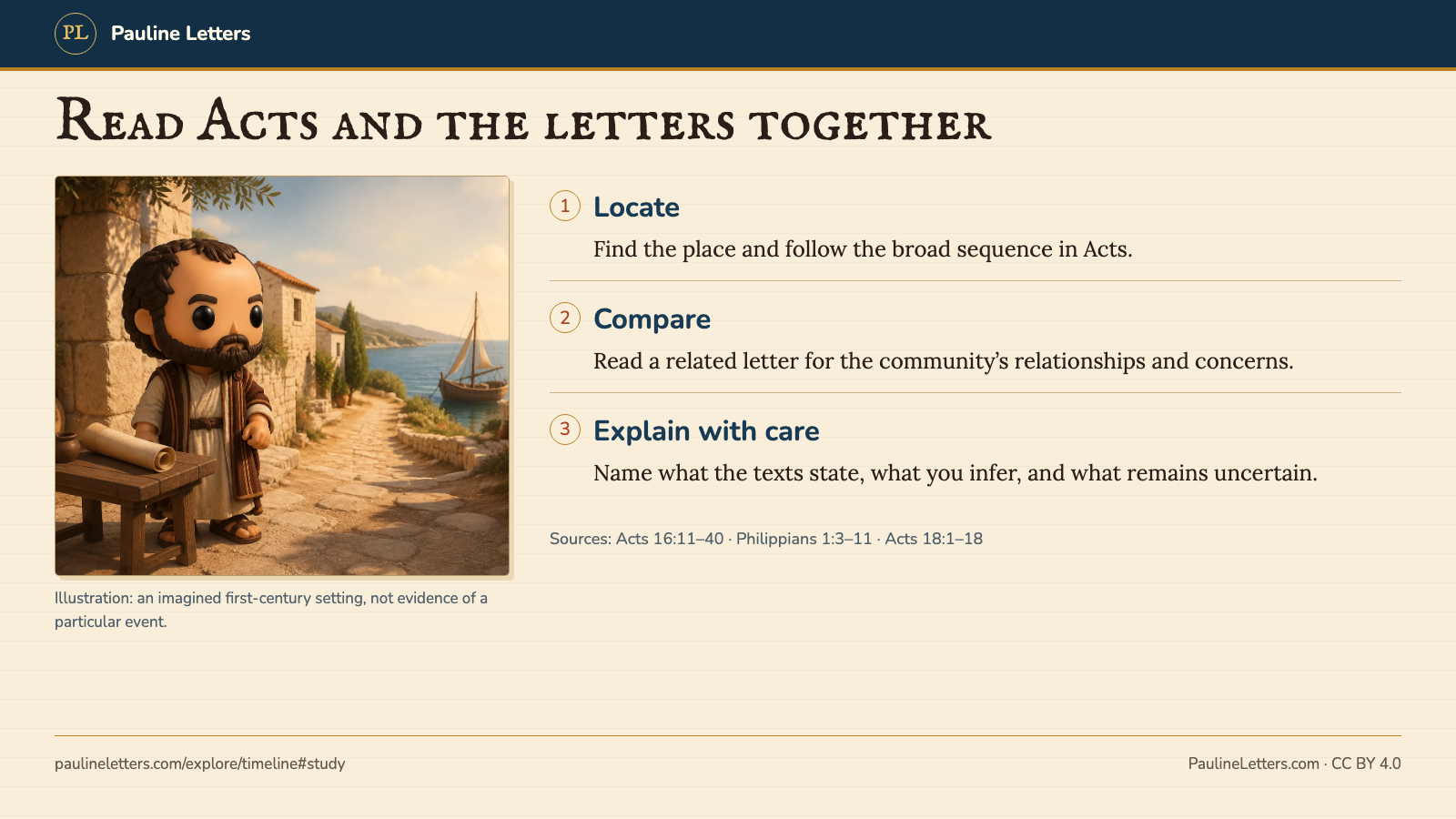
You may share and adapt these original study resources with credit to PaulineLetters.com (CC BY 4.0). Bible text is not included. Reuse terms
Bibliography and sources
- Acts 7–28, World English Bible (public domain). View source
- Romans through Philemon, World English Bible (public domain). View source
- The project’s 67-row chronology, cross-referencing Acts and the letters and labeling debated dates.