Why is Christ sufficient for the community’s faith and growth?
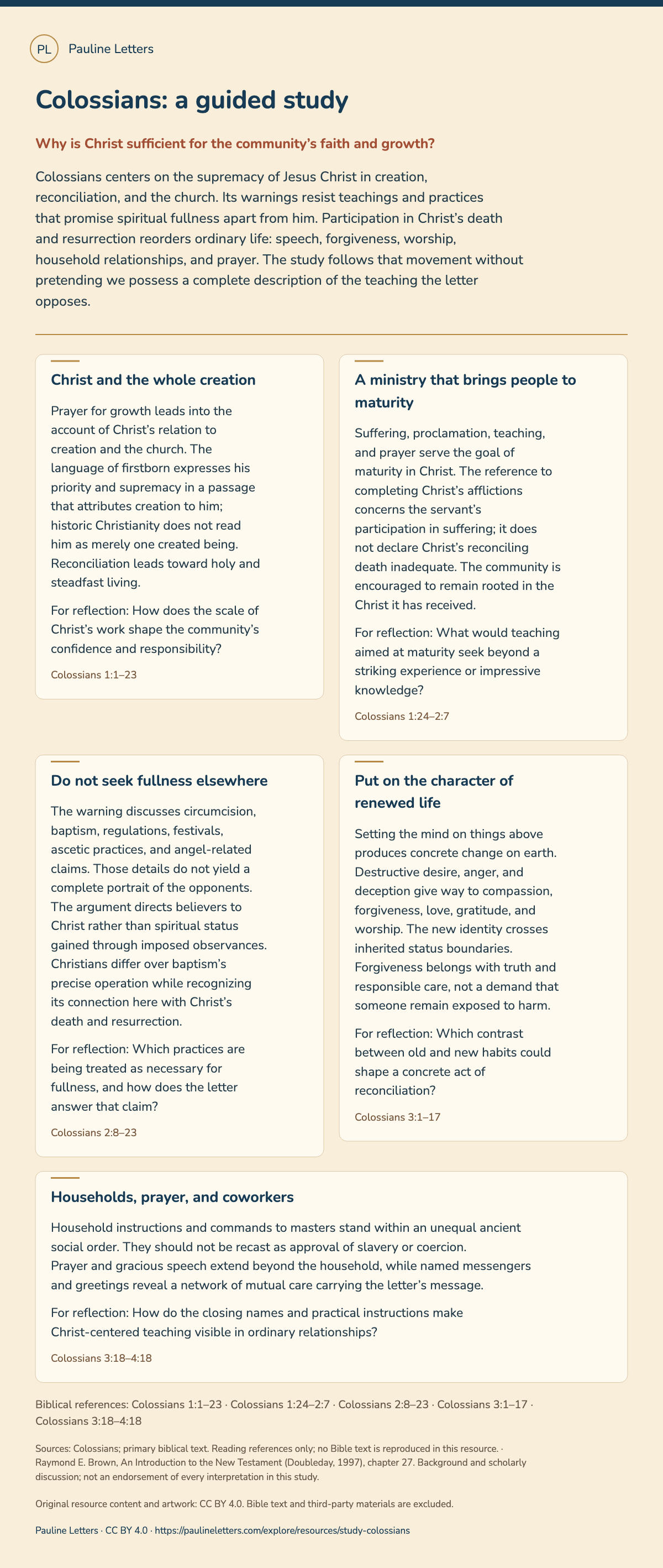
Colossians centers on the supremacy of Jesus Christ in creation, reconciliation, and the church. Its warnings resist teachings and practices that promise spiritual fullness apart from him. Participation in Christ’s death and resurrection reorders ordinary life: speech, forgiveness, worship, household relationships, and prayer. The study follows that movement without pretending we possess a complete description of the teaching the letter opposes.
Colossians 1:1–23 · Colossians 1:24–2:7 · Colossians 2:8–23 · Colossians 3:1–17 · Colossians 3:18–4:18
Read the letter in its setting
The letter names Paul and Timothy, mentions imprisonment, and connects the recipients with Epaphras. Rome is a traditional setting; Ephesus and Caesarea are also proposed, and scholars debate direct Pauline authorship. The text supplies clues to the pressures facing the community but does not name a fully developed religious system. Avoid labeling the opponents with a later movement as though that identification were established fact.
Colossians 1:1–8 · Colossians 4:7–18
Sources: Colossians · An Introduction to the New Testament
Follow the argument
Gratitude and prayer lead into a sweeping account of Christ and reconciliation. The warning section returns believers to their fullness in Christ; the ethical section asks them to put away destructive habits and clothe themselves in compassion. Household instructions speak within ancient structures of inequality. Their demand that masters act justly does not convert slavery into a just institution. Final greetings reveal the wider network supporting the teaching.
Colossians 1:15–2:23 · Colossians 3:1–4:6
Sources: Colossians
Study sessions
01Christ and the whole creation
Colossians 1:1–23
Prayer for growth leads into the account of Christ’s relation to creation and the church. The language of firstborn expresses his priority and supremacy in a passage that attributes creation to him; historic Christianity does not read him as merely one created being. Reconciliation leads toward holy and steadfast living.
For reflection How does the scale of Christ’s work shape the community’s confidence and responsibility?
Save my place02A ministry that brings people to maturity
Colossians 1:24–2:7
Suffering, proclamation, teaching, and prayer serve the goal of maturity in Christ. The reference to completing Christ’s afflictions concerns the servant’s participation in suffering; it does not declare Christ’s reconciling death inadequate. The community is encouraged to remain rooted in the Christ it has received.
For reflection What would teaching aimed at maturity seek beyond a striking experience or impressive knowledge?
Save my place03Do not seek fullness elsewhere
Colossians 2:8–23
The warning discusses circumcision, baptism, regulations, festivals, ascetic practices, and angel-related claims. Those details do not yield a complete portrait of the opponents. The argument directs believers to Christ rather than spiritual status gained through imposed observances. Christians differ over baptism’s precise operation while recognizing its connection here with Christ’s death and resurrection.
For reflection Which practices are being treated as necessary for fullness, and how does the letter answer that claim?
Save my place04Put on the character of renewed life
Colossians 3:1–17
Setting the mind on things above produces concrete change on earth. Destructive desire, anger, and deception give way to compassion, forgiveness, love, gratitude, and worship. The new identity crosses inherited status boundaries. Forgiveness belongs with truth and responsible care, not a demand that someone remain exposed to harm.
For reflection Which contrast between old and new habits could shape a concrete act of reconciliation?
Save my place05Households, prayer, and coworkers
Colossians 3:18–4:18
Household instructions and commands to masters stand within an unequal ancient social order. They should not be recast as approval of slavery or coercion. Prayer and gracious speech extend beyond the household, while named messengers and greetings reveal a network of mutual care carrying the letter’s message.
For reflection How do the closing names and practical instructions make Christ-centered teaching visible in ordinary relationships?
Save my place1. Christ and the whole creation
Colossians 1:1–23
Prayer for growth leads into the account of Christ’s relation to creation and the church. The language of firstborn expresses his priority and supremacy in a passage that attributes creation to him; historic Christianity does not read him as merely one created being. Reconciliation leads toward holy and steadfast living.
For reflection How does the scale of Christ’s work shape the community’s confidence and responsibility?
2. A ministry that brings people to maturity
Colossians 1:24–2:7
Suffering, proclamation, teaching, and prayer serve the goal of maturity in Christ. The reference to completing Christ’s afflictions concerns the servant’s participation in suffering; it does not declare Christ’s reconciling death inadequate. The community is encouraged to remain rooted in the Christ it has received.
For reflection What would teaching aimed at maturity seek beyond a striking experience or impressive knowledge?
3. Do not seek fullness elsewhere
Colossians 2:8–23
The warning discusses circumcision, baptism, regulations, festivals, ascetic practices, and angel-related claims. Those details do not yield a complete portrait of the opponents. The argument directs believers to Christ rather than spiritual status gained through imposed observances. Christians differ over baptism’s precise operation while recognizing its connection here with Christ’s death and resurrection.
For reflection Which practices are being treated as necessary for fullness, and how does the letter answer that claim?
4. Put on the character of renewed life
Colossians 3:1–17
Setting the mind on things above produces concrete change on earth. Destructive desire, anger, and deception give way to compassion, forgiveness, love, gratitude, and worship. The new identity crosses inherited status boundaries. Forgiveness belongs with truth and responsible care, not a demand that someone remain exposed to harm.
For reflection Which contrast between old and new habits could shape a concrete act of reconciliation?
5. Households, prayer, and coworkers
Colossians 3:18–4:18
Household instructions and commands to masters stand within an unequal ancient social order. They should not be recast as approval of slavery or coercion. Prayer and gracious speech extend beyond the household, while named messengers and greetings reveal a network of mutual care carrying the letter’s message.
For reflection How do the closing names and practical instructions make Christ-centered teaching visible in ordinary relationships?
Sources
Colossians 1:1–23 · Colossians 1:24–2:7 · Colossians 2:8–23 · Colossians 3:1–17 · Colossians 3:18–4:18
- Colossians
Colossians; primary biblical text. Reading references only; no Bible text is reproduced in this resource.
- An Introduction to the New Testament
Raymond E. Brown, An Introduction to the New Testament (Doubleday, 1997), chapter 27. Background and scholarly discussion; not an endorsement of every interpretation in this study.
Explore next
Encounter Christ through Scripture, history, and thoughtful learning.
Enter the story