What does receiving Onesimus as a brother require of Philemon?
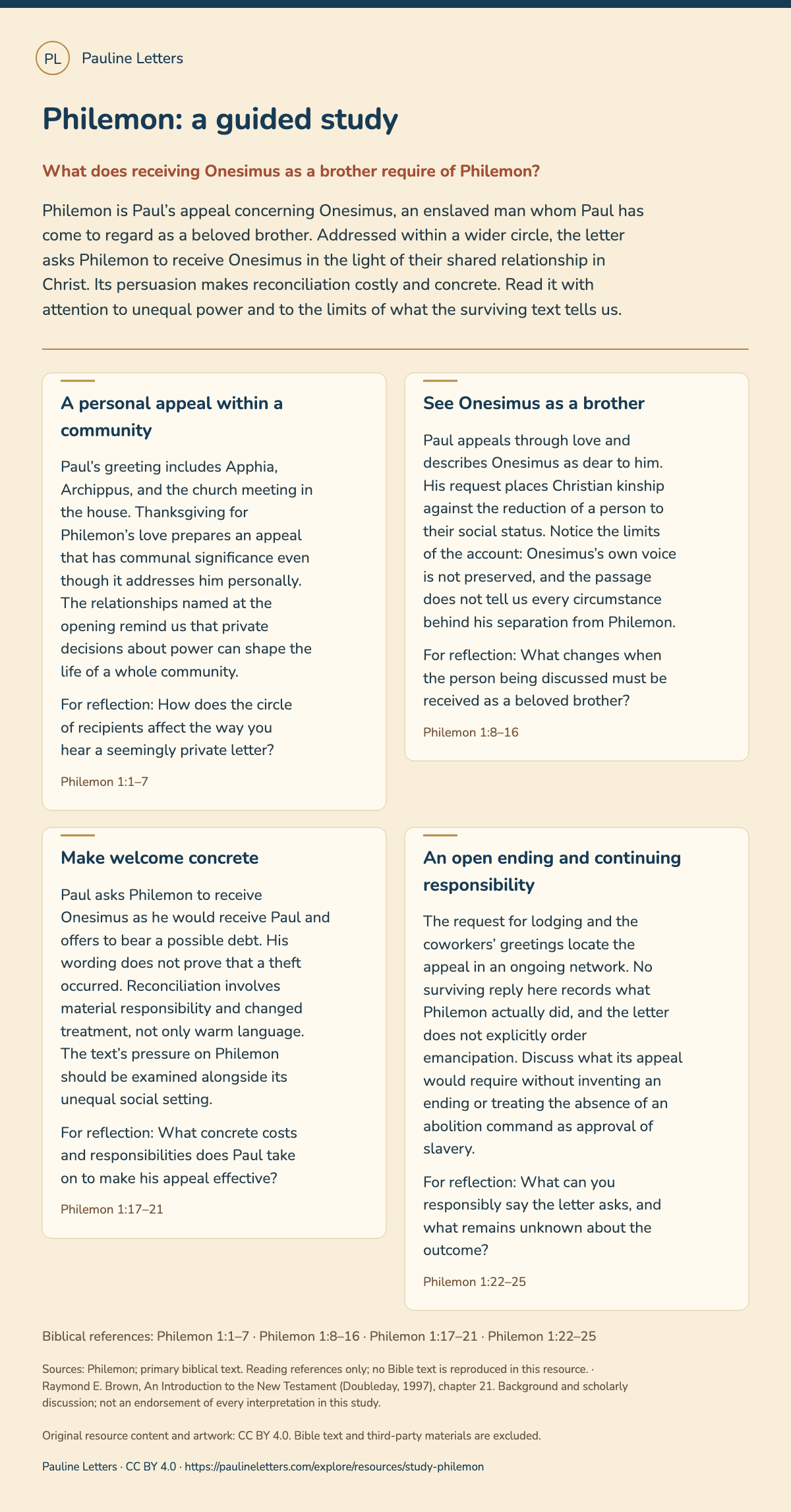
Philemon is Paul’s appeal concerning Onesimus, an enslaved man whom Paul has come to regard as a beloved brother. Addressed within a wider circle, the letter asks Philemon to receive Onesimus in the light of their shared relationship in Christ. Its persuasion makes reconciliation costly and concrete. Read it with attention to unequal power and to the limits of what the surviving text tells us.
Philemon 1:1–7 · Philemon 1:8–16 · Philemon 1:17–21 · Philemon 1:22–25
Read the letter in its setting
Paul writes as a prisoner; the prison city is unnamed, with Rome and other settings discussed. Direct Pauline authorship is widely accepted. Onesimus’s name also appears in Colossians, linking the letters in traditional reconstruction. The common story that he was a runaway who stole from Philemon is an inference, not an explicit account: Paul refers conditionally to wrongdoing or debt without explaining how Onesimus reached him.
Philemon 1:1–7 · Philemon 1:10–19 · Philemon 1:22–25
Sources: Philemon · An Introduction to the New Testament
Follow the argument
The letter moves from thanks for Philemon’s love to an appeal for Onesimus, an offer to bear a possible debt, and closing expectations and greetings. It does not explicitly command legal emancipation, and interpreters debate whether Paul’s appeal implies it. That limitation should be acknowledged alongside its powerful challenge to treating a fellow believer merely as property. Christian kinship must not be used to conceal coercion or to romanticize ancient slavery.
Philemon 1:8–21
Sources: Philemon
Study sessions
01A personal appeal within a community
Philemon 1:1–7
Paul’s greeting includes Apphia, Archippus, and the church meeting in the house. Thanksgiving for Philemon’s love prepares an appeal that has communal significance even though it addresses him personally. The relationships named at the opening remind us that private decisions about power can shape the life of a whole community.
For reflection How does the circle of recipients affect the way you hear a seemingly private letter?
Save my place02See Onesimus as a brother
Philemon 1:8–16
Paul appeals through love and describes Onesimus as dear to him. His request places Christian kinship against the reduction of a person to their social status. Notice the limits of the account: Onesimus’s own voice is not preserved, and the passage does not tell us every circumstance behind his separation from Philemon.
For reflection What changes when the person being discussed must be received as a beloved brother?
Save my place03Make welcome concrete
Philemon 1:17–21
Paul asks Philemon to receive Onesimus as he would receive Paul and offers to bear a possible debt. His wording does not prove that a theft occurred. Reconciliation involves material responsibility and changed treatment, not only warm language. The text’s pressure on Philemon should be examined alongside its unequal social setting.
For reflection What concrete costs and responsibilities does Paul take on to make his appeal effective?
Save my place04An open ending and continuing responsibility
Philemon 1:22–25
The request for lodging and the coworkers’ greetings locate the appeal in an ongoing network. No surviving reply here records what Philemon actually did, and the letter does not explicitly order emancipation. Discuss what its appeal would require without inventing an ending or treating the absence of an abolition command as approval of slavery.
For reflection What can you responsibly say the letter asks, and what remains unknown about the outcome?
Save my place1. A personal appeal within a community
Philemon 1:1–7
Paul’s greeting includes Apphia, Archippus, and the church meeting in the house. Thanksgiving for Philemon’s love prepares an appeal that has communal significance even though it addresses him personally. The relationships named at the opening remind us that private decisions about power can shape the life of a whole community.
For reflection How does the circle of recipients affect the way you hear a seemingly private letter?
2. See Onesimus as a brother
Philemon 1:8–16
Paul appeals through love and describes Onesimus as dear to him. His request places Christian kinship against the reduction of a person to their social status. Notice the limits of the account: Onesimus’s own voice is not preserved, and the passage does not tell us every circumstance behind his separation from Philemon.
For reflection What changes when the person being discussed must be received as a beloved brother?
3. Make welcome concrete
Philemon 1:17–21
Paul asks Philemon to receive Onesimus as he would receive Paul and offers to bear a possible debt. His wording does not prove that a theft occurred. Reconciliation involves material responsibility and changed treatment, not only warm language. The text’s pressure on Philemon should be examined alongside its unequal social setting.
For reflection What concrete costs and responsibilities does Paul take on to make his appeal effective?
4. An open ending and continuing responsibility
Philemon 1:22–25
The request for lodging and the coworkers’ greetings locate the appeal in an ongoing network. No surviving reply here records what Philemon actually did, and the letter does not explicitly order emancipation. Discuss what its appeal would require without inventing an ending or treating the absence of an abolition command as approval of slavery.
For reflection What can you responsibly say the letter asks, and what remains unknown about the outcome?
Sources
Philemon 1:1–7 · Philemon 1:8–16 · Philemon 1:17–21 · Philemon 1:22–25
- Philemon
Philemon; primary biblical text. Reading references only; no Bible text is reproduced in this resource.
- An Introduction to the New Testament
Raymond E. Brown, An Introduction to the New Testament (Doubleday, 1997), chapter 21. Background and scholarly discussion; not an endorsement of every interpretation in this study.
Explore next
Encounter Christ through Scripture, history, and thoughtful learning.
Enter the story