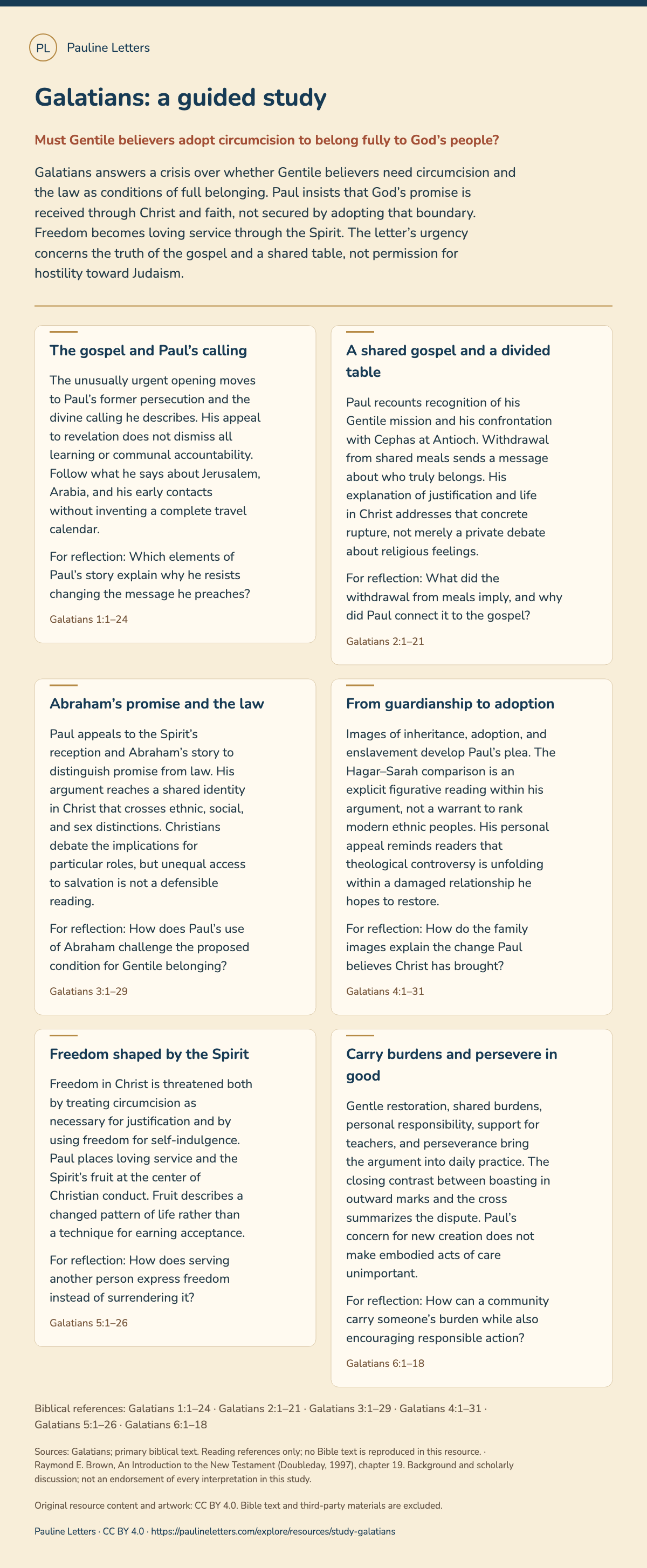
Must Gentile believers adopt circumcision to belong fully to God’s people?
Galatians answers a crisis over whether Gentile believers need circumcision and the law as conditions of full belonging. Paul insists that God’s promise is received through Christ and faith, not secured by adopting that boundary. Freedom becomes loving service through the Spirit. The letter’s urgency concerns the truth of the gospel and a shared table, not permission for hostility toward Judaism.
Galatians 1:1–24 · Galatians 2:1–21 · Galatians 3:1–29 · Galatians 4:1–31 · Galatians 5:1–26 · Galatians 6:1–18
Read the letter in its setting
Paul’s authorship is widely accepted. The recipients’ location and the date remain debated: South Galatian and North Galatian reconstructions connect the letter differently with Acts and Paul’s Jerusalem visits. Paul’s autobiographical account is central evidence, but matching each visit to Acts requires argument. The dispute is heard through Paul’s response; the opponents’ full teaching cannot simply be reconstructed from every phrase he rejects.
Galatians 1:1–2:14
Sources: Galatians · An Introduction to the New Testament
Follow the argument
Chapters 1–2 defend Paul’s commission and expose a breach of table fellowship. Chapters 3–4 reason from Abraham, promise, law, and adoption. Chapters 5–6 explain freedom as life directed by the Spirit, bearing others’ burdens and doing good. Christians debate aspects of justification and the law’s continuing role; the study keeps grace, faith in Christ, and active love together without turning Paul’s Jewish opponents into caricatures.
Galatians 3:1–4:31 · Galatians 5:1–6:18
Sources: Galatians
Study sessions
01The gospel and Paul’s calling
Galatians 1:1–24
The unusually urgent opening moves to Paul’s former persecution and the divine calling he describes. His appeal to revelation does not dismiss all learning or communal accountability. Follow what he says about Jerusalem, Arabia, and his early contacts without inventing a complete travel calendar.
For reflection Which elements of Paul’s story explain why he resists changing the message he preaches?
Save my place02A shared gospel and a divided table
Galatians 2:1–21
Paul recounts recognition of his Gentile mission and his confrontation with Cephas at Antioch. Withdrawal from shared meals sends a message about who truly belongs. His explanation of justification and life in Christ addresses that concrete rupture, not merely a private debate about religious feelings.
For reflection What did the withdrawal from meals imply, and why did Paul connect it to the gospel?
Save my place03Abraham’s promise and the law
Galatians 3:1–29
Paul appeals to the Spirit’s reception and Abraham’s story to distinguish promise from law. His argument reaches a shared identity in Christ that crosses ethnic, social, and sex distinctions. Christians debate the implications for particular roles, but unequal access to salvation is not a defensible reading.
For reflection How does Paul’s use of Abraham challenge the proposed condition for Gentile belonging?
Save my place04From guardianship to adoption
Galatians 4:1–31
Images of inheritance, adoption, and enslavement develop Paul’s plea. The Hagar–Sarah comparison is an explicit figurative reading within his argument, not a warrant to rank modern ethnic peoples. His personal appeal reminds readers that theological controversy is unfolding within a damaged relationship he hopes to restore.
For reflection How do the family images explain the change Paul believes Christ has brought?
Save my place05Freedom shaped by the Spirit
Galatians 5:1–26
Freedom in Christ is threatened both by treating circumcision as necessary for justification and by using freedom for self-indulgence. Paul places loving service and the Spirit’s fruit at the center of Christian conduct. Fruit describes a changed pattern of life rather than a technique for earning acceptance.
For reflection How does serving another person express freedom instead of surrendering it?
Save my place06Carry burdens and persevere in good
Galatians 6:1–18
Gentle restoration, shared burdens, personal responsibility, support for teachers, and perseverance bring the argument into daily practice. The closing contrast between boasting in outward marks and the cross summarizes the dispute. Paul’s concern for new creation does not make embodied acts of care unimportant.
For reflection How can a community carry someone’s burden while also encouraging responsible action?
Save my place1. The gospel and Paul’s calling
Galatians 1:1–24
The unusually urgent opening moves to Paul’s former persecution and the divine calling he describes. His appeal to revelation does not dismiss all learning or communal accountability. Follow what he says about Jerusalem, Arabia, and his early contacts without inventing a complete travel calendar.
For reflection Which elements of Paul’s story explain why he resists changing the message he preaches?
2. A shared gospel and a divided table
Galatians 2:1–21
Paul recounts recognition of his Gentile mission and his confrontation with Cephas at Antioch. Withdrawal from shared meals sends a message about who truly belongs. His explanation of justification and life in Christ addresses that concrete rupture, not merely a private debate about religious feelings.
For reflection What did the withdrawal from meals imply, and why did Paul connect it to the gospel?
3. Abraham’s promise and the law
Galatians 3:1–29
Paul appeals to the Spirit’s reception and Abraham’s story to distinguish promise from law. His argument reaches a shared identity in Christ that crosses ethnic, social, and sex distinctions. Christians debate the implications for particular roles, but unequal access to salvation is not a defensible reading.
For reflection How does Paul’s use of Abraham challenge the proposed condition for Gentile belonging?
4. From guardianship to adoption
Galatians 4:1–31
Images of inheritance, adoption, and enslavement develop Paul’s plea. The Hagar–Sarah comparison is an explicit figurative reading within his argument, not a warrant to rank modern ethnic peoples. His personal appeal reminds readers that theological controversy is unfolding within a damaged relationship he hopes to restore.
For reflection How do the family images explain the change Paul believes Christ has brought?
5. Freedom shaped by the Spirit
Galatians 5:1–26
Freedom in Christ is threatened both by treating circumcision as necessary for justification and by using freedom for self-indulgence. Paul places loving service and the Spirit’s fruit at the center of Christian conduct. Fruit describes a changed pattern of life rather than a technique for earning acceptance.
For reflection How does serving another person express freedom instead of surrendering it?
6. Carry burdens and persevere in good
Galatians 6:1–18
Gentle restoration, shared burdens, personal responsibility, support for teachers, and perseverance bring the argument into daily practice. The closing contrast between boasting in outward marks and the cross summarizes the dispute. Paul’s concern for new creation does not make embodied acts of care unimportant.
For reflection How can a community carry someone’s burden while also encouraging responsible action?
Sources
Galatians 1:1–24 · Galatians 2:1–21 · Galatians 3:1–29 · Galatians 4:1–31 · Galatians 5:1–26 · Galatians 6:1–18
- Galatians
Galatians; primary biblical text. Reading references only; no Bible text is reproduced in this resource.
- An Introduction to the New Testament
Raymond E. Brown, An Introduction to the New Testament (Doubleday, 1997), chapter 19. Background and scholarly discussion; not an endorsement of every interpretation in this study.
Explore next
Encounter Christ through Scripture, history, and thoughtful learning.
Enter the story