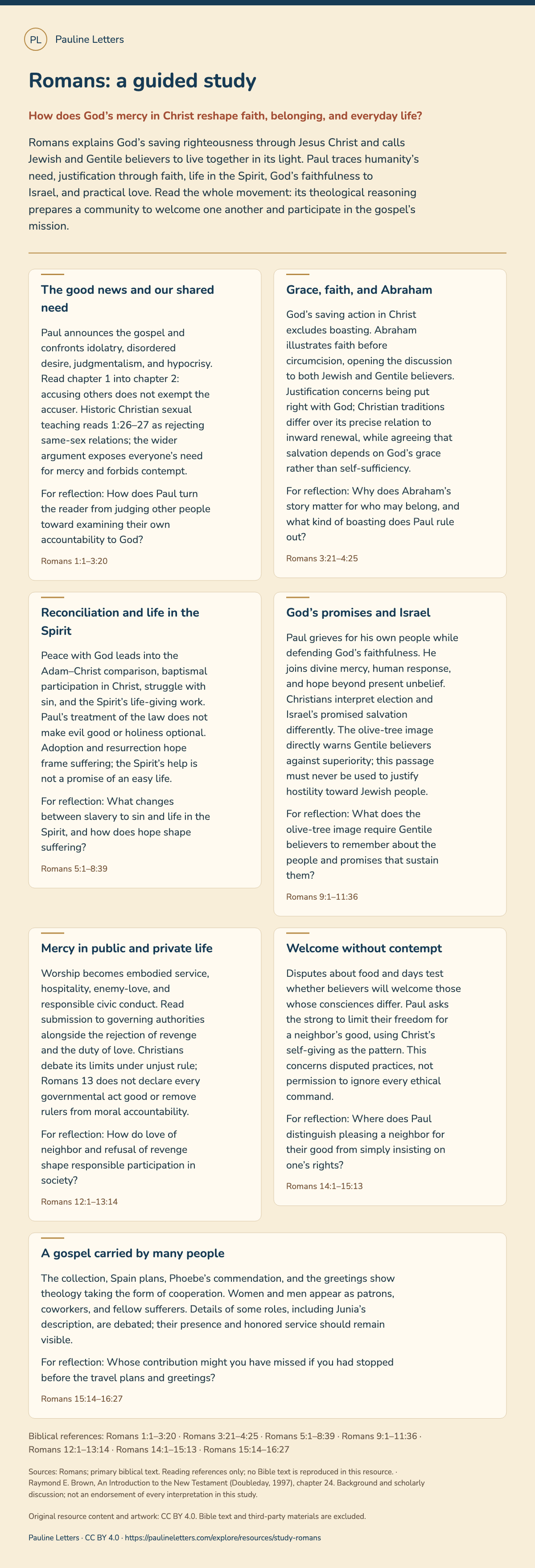
How does God’s mercy in Christ reshape faith, belonging, and everyday life?
Romans explains God’s saving righteousness through Jesus Christ and calls Jewish and Gentile believers to live together in its light. Paul traces humanity’s need, justification through faith, life in the Spirit, God’s faithfulness to Israel, and practical love. Read the whole movement: its theological reasoning prepares a community to welcome one another and participate in the gospel’s mission.
Romans 1:1–3:20 · Romans 3:21–4:25 · Romans 5:1–8:39 · Romans 9:1–11:36 · Romans 12:1–13:14 · Romans 14:1–15:13 · Romans 15:14–16:27
Read the letter in its setting
Paul addresses believers in Rome before visiting them. His plans to bring aid to Jerusalem and then travel west place the letter near the close of the third missionary journey, commonly in the later AD 50s; Corinth is a strong reconstruction rather than an explicit heading. Direct Pauline authorship is widely accepted. The greetings reveal a network of women and men whose work belongs within the letter’s story.
Romans 1:1–15 · Romans 15:22–16:23
Sources: Romans · An Introduction to the New Testament
Follow the argument
The argument moves from sin and judgment to grace, reconciliation, and new life. Chapters 9–11 ask how God’s promises to Israel remain trustworthy; they are essential to the argument, not an interruption. Chapters 12–16 translate mercy into worship, public responsibility, hospitality, and shared mission. Christians disagree over election and the future of Israel, but Paul’s warning against Gentile arrogance is unmistakable.
Romans 1:16–17 · Romans 8:1–39 · Romans 11:17–36 · Romans 12:1–2
Sources: Romans
Study sessions
01The good news and our shared need
Romans 1:1–3:20
Paul announces the gospel and confronts idolatry, disordered desire, judgmentalism, and hypocrisy. Read chapter 1 into chapter 2: accusing others does not exempt the accuser. Historic Christian sexual teaching reads 1:26–27 as rejecting same-sex relations; the wider argument exposes everyone’s need for mercy and forbids contempt.
For reflection How does Paul turn the reader from judging other people toward examining their own accountability to God?
Save my place02Grace, faith, and Abraham
Romans 3:21–4:25
God’s saving action in Christ excludes boasting. Abraham illustrates faith before circumcision, opening the discussion to both Jewish and Gentile believers. Justification concerns being put right with God; Christian traditions differ over its precise relation to inward renewal, while agreeing that salvation depends on God’s grace rather than self-sufficiency.
For reflection Why does Abraham’s story matter for who may belong, and what kind of boasting does Paul rule out?
Save my place03Reconciliation and life in the Spirit
Romans 5:1–8:39
Peace with God leads into the Adam–Christ comparison, baptismal participation in Christ, struggle with sin, and the Spirit’s life-giving work. Paul’s treatment of the law does not make evil good or holiness optional. Adoption and resurrection hope frame suffering; the Spirit’s help is not a promise of an easy life.
For reflection What changes between slavery to sin and life in the Spirit, and how does hope shape suffering?
Save my place04God’s promises and Israel
Romans 9:1–11:36
Paul grieves for his own people while defending God’s faithfulness. He joins divine mercy, human response, and hope beyond present unbelief. Christians interpret election and Israel’s promised salvation differently. The olive-tree image directly warns Gentile believers against superiority; this passage must never be used to justify hostility toward Jewish people.
For reflection What does the olive-tree image require Gentile believers to remember about the people and promises that sustain them?
Save my place05Mercy in public and private life
Romans 12:1–13:14
Worship becomes embodied service, hospitality, enemy-love, and responsible civic conduct. Read submission to governing authorities alongside the rejection of revenge and the duty of love. Christians debate its limits under unjust rule; Romans 13 does not declare every governmental act good or remove rulers from moral accountability.
For reflection How do love of neighbor and refusal of revenge shape responsible participation in society?
Save my place06Welcome without contempt
Romans 14:1–15:13
Disputes about food and days test whether believers will welcome those whose consciences differ. Paul asks the strong to limit their freedom for a neighbor’s good, using Christ’s self-giving as the pattern. This concerns disputed practices, not permission to ignore every ethical command.
For reflection Where does Paul distinguish pleasing a neighbor for their good from simply insisting on one’s rights?
Save my place07A gospel carried by many people
Romans 15:14–16:27
The collection, Spain plans, Phoebe’s commendation, and the greetings show theology taking the form of cooperation. Women and men appear as patrons, coworkers, and fellow sufferers. Details of some roles, including Junia’s description, are debated; their presence and honored service should remain visible.
For reflection Whose contribution might you have missed if you had stopped before the travel plans and greetings?
Save my place1. The good news and our shared need
Romans 1:1–3:20
Paul announces the gospel and confronts idolatry, disordered desire, judgmentalism, and hypocrisy. Read chapter 1 into chapter 2: accusing others does not exempt the accuser. Historic Christian sexual teaching reads 1:26–27 as rejecting same-sex relations; the wider argument exposes everyone’s need for mercy and forbids contempt.
For reflection How does Paul turn the reader from judging other people toward examining their own accountability to God?
2. Grace, faith, and Abraham
Romans 3:21–4:25
God’s saving action in Christ excludes boasting. Abraham illustrates faith before circumcision, opening the discussion to both Jewish and Gentile believers. Justification concerns being put right with God; Christian traditions differ over its precise relation to inward renewal, while agreeing that salvation depends on God’s grace rather than self-sufficiency.
For reflection Why does Abraham’s story matter for who may belong, and what kind of boasting does Paul rule out?
3. Reconciliation and life in the Spirit
Romans 5:1–8:39
Peace with God leads into the Adam–Christ comparison, baptismal participation in Christ, struggle with sin, and the Spirit’s life-giving work. Paul’s treatment of the law does not make evil good or holiness optional. Adoption and resurrection hope frame suffering; the Spirit’s help is not a promise of an easy life.
For reflection What changes between slavery to sin and life in the Spirit, and how does hope shape suffering?
4. God’s promises and Israel
Romans 9:1–11:36
Paul grieves for his own people while defending God’s faithfulness. He joins divine mercy, human response, and hope beyond present unbelief. Christians interpret election and Israel’s promised salvation differently. The olive-tree image directly warns Gentile believers against superiority; this passage must never be used to justify hostility toward Jewish people.
For reflection What does the olive-tree image require Gentile believers to remember about the people and promises that sustain them?
5. Mercy in public and private life
Romans 12:1–13:14
Worship becomes embodied service, hospitality, enemy-love, and responsible civic conduct. Read submission to governing authorities alongside the rejection of revenge and the duty of love. Christians debate its limits under unjust rule; Romans 13 does not declare every governmental act good or remove rulers from moral accountability.
For reflection How do love of neighbor and refusal of revenge shape responsible participation in society?
6. Welcome without contempt
Romans 14:1–15:13
Disputes about food and days test whether believers will welcome those whose consciences differ. Paul asks the strong to limit their freedom for a neighbor’s good, using Christ’s self-giving as the pattern. This concerns disputed practices, not permission to ignore every ethical command.
For reflection Where does Paul distinguish pleasing a neighbor for their good from simply insisting on one’s rights?
7. A gospel carried by many people
Romans 15:14–16:27
The collection, Spain plans, Phoebe’s commendation, and the greetings show theology taking the form of cooperation. Women and men appear as patrons, coworkers, and fellow sufferers. Details of some roles, including Junia’s description, are debated; their presence and honored service should remain visible.
For reflection Whose contribution might you have missed if you had stopped before the travel plans and greetings?
Sources
Romans 1:1–3:20 · Romans 3:21–4:25 · Romans 5:1–8:39 · Romans 9:1–11:36 · Romans 12:1–13:14 · Romans 14:1–15:13 · Romans 15:14–16:27
- Romans
Romans; primary biblical text. Reading references only; no Bible text is reproduced in this resource.
- An Introduction to the New Testament
Raymond E. Brown, An Introduction to the New Testament (Doubleday, 1997), chapter 24. Background and scholarly discussion; not an endorsement of every interpretation in this study.
Explore next
Encounter Christ through Scripture, history, and thoughtful learning.
Enter the story