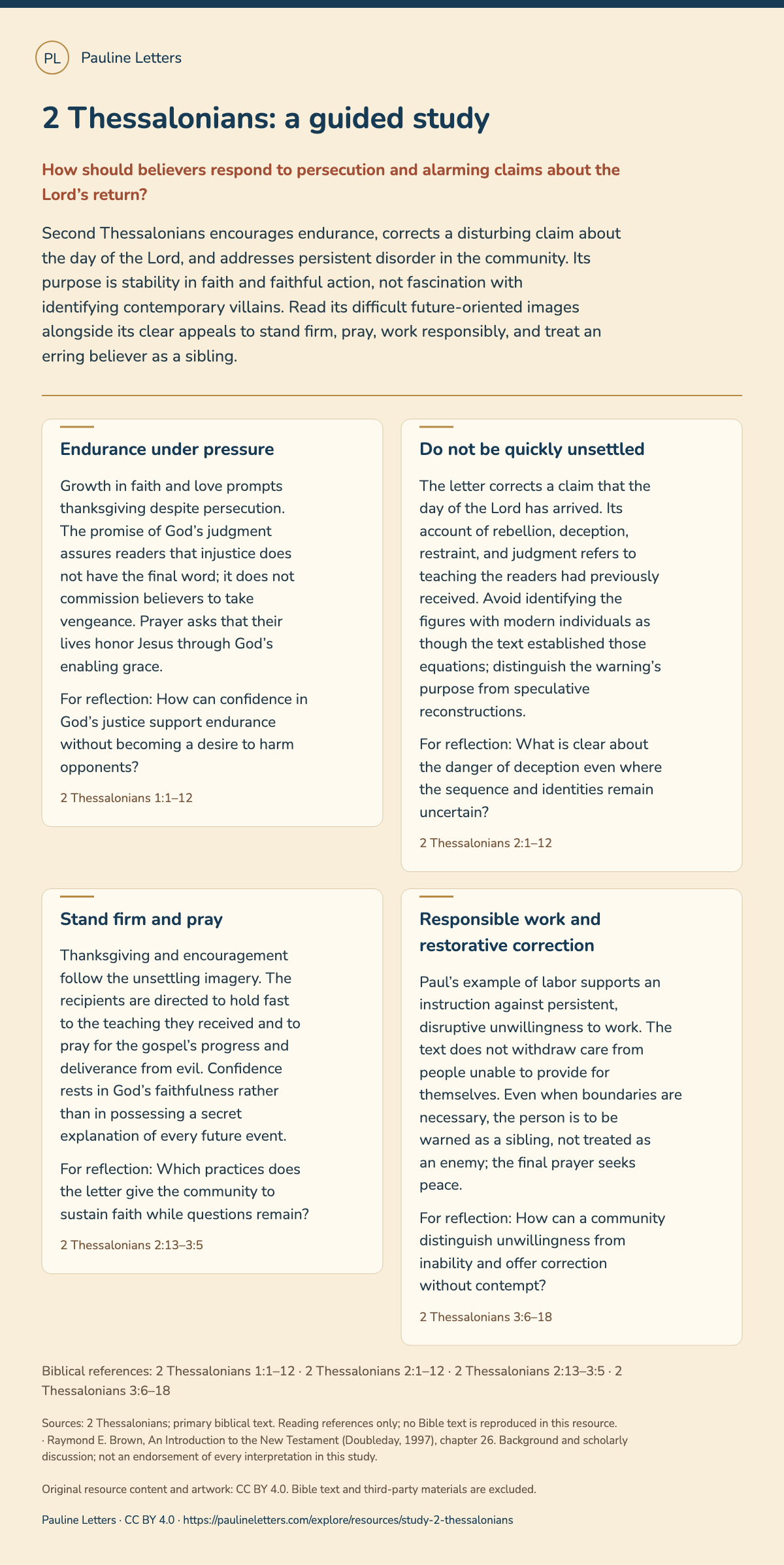
How should believers respond to persecution and alarming claims about the Lord’s return?
Second Thessalonians encourages endurance, corrects a disturbing claim about the day of the Lord, and addresses persistent disorder in the community. Its purpose is stability in faith and faithful action, not fascination with identifying contemporary villains. Read its difficult future-oriented images alongside its clear appeals to stand firm, pray, work responsibly, and treat an erring believer as a sibling.
2 Thessalonians 1:1–12 · 2 Thessalonians 2:1–12 · 2 Thessalonians 2:13–3:5 · 2 Thessalonians 3:6–18
Read the letter in its setting
The opening names Paul, Silvanus, and Timothy. A date soon after First Thessalonians is traditional if Paul wrote it directly; scholars also argue for a later writer in the Pauline tradition, and authorship remains debated. The letter does not identify every figure or event discussed in chapter 2. Its reminders presume earlier teaching shared with the recipients that modern readers cannot fully reconstruct.
2 Thessalonians 1:1–12 · 2 Thessalonians 2:5 · 2 Thessalonians 3:17
Sources: 2 Thessalonians · An Introduction to the New Testament
Follow the argument
The movement runs from gratitude and the promise of righteous judgment to clarification about the day of the Lord, then prayer and practical correction. Christians differ over the restrainer, the lawless figure, and the sequence of final events. The interpretive limit is part of responsible reading. The instruction about unwillingness to work must be distinguished from inability to work, and discipline must remain consistent with the final call to peace.
2 Thessalonians 2:1–17 · 2 Thessalonians 3:1–18
Sources: 2 Thessalonians
Study sessions
01Endurance under pressure
2 Thessalonians 1:1–12
Growth in faith and love prompts thanksgiving despite persecution. The promise of God’s judgment assures readers that injustice does not have the final word; it does not commission believers to take vengeance. Prayer asks that their lives honor Jesus through God’s enabling grace.
For reflection How can confidence in God’s justice support endurance without becoming a desire to harm opponents?
Save my place02Do not be quickly unsettled
2 Thessalonians 2:1–12
The letter corrects a claim that the day of the Lord has arrived. Its account of rebellion, deception, restraint, and judgment refers to teaching the readers had previously received. Avoid identifying the figures with modern individuals as though the text established those equations; distinguish the warning’s purpose from speculative reconstructions.
For reflection What is clear about the danger of deception even where the sequence and identities remain uncertain?
Save my place03Stand firm and pray
2 Thessalonians 2:13–3:5
Thanksgiving and encouragement follow the unsettling imagery. The recipients are directed to hold fast to the teaching they received and to pray for the gospel’s progress and deliverance from evil. Confidence rests in God’s faithfulness rather than in possessing a secret explanation of every future event.
For reflection Which practices does the letter give the community to sustain faith while questions remain?
Save my place04Responsible work and restorative correction
2 Thessalonians 3:6–18
Paul’s example of labor supports an instruction against persistent, disruptive unwillingness to work. The text does not withdraw care from people unable to provide for themselves. Even when boundaries are necessary, the person is to be warned as a sibling, not treated as an enemy; the final prayer seeks peace.
For reflection How can a community distinguish unwillingness from inability and offer correction without contempt?
Save my place1. Endurance under pressure
2 Thessalonians 1:1–12
Growth in faith and love prompts thanksgiving despite persecution. The promise of God’s judgment assures readers that injustice does not have the final word; it does not commission believers to take vengeance. Prayer asks that their lives honor Jesus through God’s enabling grace.
For reflection How can confidence in God’s justice support endurance without becoming a desire to harm opponents?
2. Do not be quickly unsettled
2 Thessalonians 2:1–12
The letter corrects a claim that the day of the Lord has arrived. Its account of rebellion, deception, restraint, and judgment refers to teaching the readers had previously received. Avoid identifying the figures with modern individuals as though the text established those equations; distinguish the warning’s purpose from speculative reconstructions.
For reflection What is clear about the danger of deception even where the sequence and identities remain uncertain?
3. Stand firm and pray
2 Thessalonians 2:13–3:5
Thanksgiving and encouragement follow the unsettling imagery. The recipients are directed to hold fast to the teaching they received and to pray for the gospel’s progress and deliverance from evil. Confidence rests in God’s faithfulness rather than in possessing a secret explanation of every future event.
For reflection Which practices does the letter give the community to sustain faith while questions remain?
4. Responsible work and restorative correction
2 Thessalonians 3:6–18
Paul’s example of labor supports an instruction against persistent, disruptive unwillingness to work. The text does not withdraw care from people unable to provide for themselves. Even when boundaries are necessary, the person is to be warned as a sibling, not treated as an enemy; the final prayer seeks peace.
For reflection How can a community distinguish unwillingness from inability and offer correction without contempt?
Sources
2 Thessalonians 1:1–12 · 2 Thessalonians 2:1–12 · 2 Thessalonians 2:13–3:5 · 2 Thessalonians 3:6–18
- 2 Thessalonians
2 Thessalonians; primary biblical text. Reading references only; no Bible text is reproduced in this resource.
- An Introduction to the New Testament
Raymond E. Brown, An Introduction to the New Testament (Doubleday, 1997), chapter 26. Background and scholarly discussion; not an endorsement of every interpretation in this study.
Explore next
Encounter Christ through Scripture, history, and thoughtful learning.
Enter the story