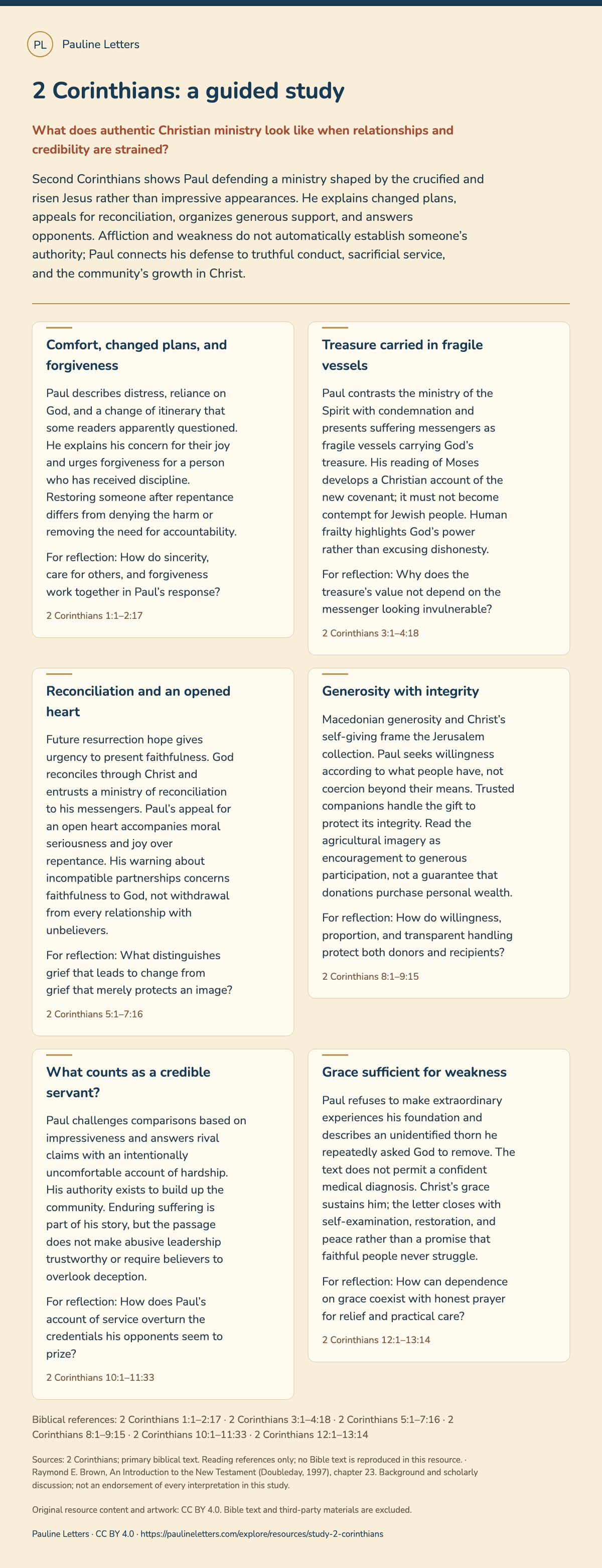
What does authentic Christian ministry look like when relationships and credibility are strained?
Second Corinthians shows Paul defending a ministry shaped by the crucified and risen Jesus rather than impressive appearances. He explains changed plans, appeals for reconciliation, organizes generous support, and answers opponents. Affliction and weakness do not automatically establish someone’s authority; Paul connects his defense to truthful conduct, sacrificial service, and the community’s growth in Christ.
2 Corinthians 1:1–2:17 · 2 Corinthians 3:1–4:18 · 2 Corinthians 5:1–7:16 · 2 Corinthians 8:1–9:15 · 2 Corinthians 10:1–11:33 · 2 Corinthians 12:1–13:14
Read the letter in its setting
The letter belongs to a strained relationship involving earlier correspondence, a painful visit, and news brought by Titus. A Macedonian setting in the mid-to-late AD 50s is commonly reconstructed. Pauline authorship is widely accepted, while scholars debate whether the canonical text combines more than one letter, especially around chapters 10–13. Read its present form attentively without pretending the complete exchange or sequence can be recovered.
2 Corinthians 1:12–2:13 · 2 Corinthians 7:5–16
Sources: 2 Corinthians · An Introduction to the New Testament
Follow the argument
Comfort received from God becomes care for others. Paul develops the themes of new-covenant ministry, fragile messengers, reconciliation through Christ, and generosity across communities. His accounts of suffering and visions culminate in dependence on Christ’s grace. The collection chapters show that spiritual fellowship has material consequences, with willing giving and public accountability. The severe closing warnings aim at restoration rather than the celebration of domination.
2 Corinthians 3:1–5:21 · 2 Corinthians 8:1–9:15 · 2 Corinthians 12:1–13:14
Sources: 2 Corinthians
Study sessions
01Comfort, changed plans, and forgiveness
2 Corinthians 1:1–2:17
Paul describes distress, reliance on God, and a change of itinerary that some readers apparently questioned. He explains his concern for their joy and urges forgiveness for a person who has received discipline. Restoring someone after repentance differs from denying the harm or removing the need for accountability.
For reflection How do sincerity, care for others, and forgiveness work together in Paul’s response?
Save my place02Treasure carried in fragile vessels
2 Corinthians 3:1–4:18
Paul contrasts the ministry of the Spirit with condemnation and presents suffering messengers as fragile vessels carrying God’s treasure. His reading of Moses develops a Christian account of the new covenant; it must not become contempt for Jewish people. Human frailty highlights God’s power rather than excusing dishonesty.
For reflection Why does the treasure’s value not depend on the messenger looking invulnerable?
Save my place03Reconciliation and an opened heart
2 Corinthians 5:1–7:16
Future resurrection hope gives urgency to present faithfulness. God reconciles through Christ and entrusts a ministry of reconciliation to his messengers. Paul’s appeal for an open heart accompanies moral seriousness and joy over repentance. His warning about incompatible partnerships concerns faithfulness to God, not withdrawal from every relationship with unbelievers.
For reflection What distinguishes grief that leads to change from grief that merely protects an image?
Save my place04Generosity with integrity
2 Corinthians 8:1–9:15
Macedonian generosity and Christ’s self-giving frame the Jerusalem collection. Paul seeks willingness according to what people have, not coercion beyond their means. Trusted companions handle the gift to protect its integrity. Read the agricultural imagery as encouragement to generous participation, not a guarantee that donations purchase personal wealth.
For reflection How do willingness, proportion, and transparent handling protect both donors and recipients?
Save my place05What counts as a credible servant?
2 Corinthians 10:1–11:33
Paul challenges comparisons based on impressiveness and answers rival claims with an intentionally uncomfortable account of hardship. His authority exists to build up the community. Enduring suffering is part of his story, but the passage does not make abusive leadership trustworthy or require believers to overlook deception.
For reflection How does Paul’s account of service overturn the credentials his opponents seem to prize?
Save my place06Grace sufficient for weakness
2 Corinthians 12:1–13:14
Paul refuses to make extraordinary experiences his foundation and describes an unidentified thorn he repeatedly asked God to remove. The text does not permit a confident medical diagnosis. Christ’s grace sustains him; the letter closes with self-examination, restoration, and peace rather than a promise that faithful people never struggle.
For reflection How can dependence on grace coexist with honest prayer for relief and practical care?
Save my place1. Comfort, changed plans, and forgiveness
2 Corinthians 1:1–2:17
Paul describes distress, reliance on God, and a change of itinerary that some readers apparently questioned. He explains his concern for their joy and urges forgiveness for a person who has received discipline. Restoring someone after repentance differs from denying the harm or removing the need for accountability.
For reflection How do sincerity, care for others, and forgiveness work together in Paul’s response?
2. Treasure carried in fragile vessels
2 Corinthians 3:1–4:18
Paul contrasts the ministry of the Spirit with condemnation and presents suffering messengers as fragile vessels carrying God’s treasure. His reading of Moses develops a Christian account of the new covenant; it must not become contempt for Jewish people. Human frailty highlights God’s power rather than excusing dishonesty.
For reflection Why does the treasure’s value not depend on the messenger looking invulnerable?
3. Reconciliation and an opened heart
2 Corinthians 5:1–7:16
Future resurrection hope gives urgency to present faithfulness. God reconciles through Christ and entrusts a ministry of reconciliation to his messengers. Paul’s appeal for an open heart accompanies moral seriousness and joy over repentance. His warning about incompatible partnerships concerns faithfulness to God, not withdrawal from every relationship with unbelievers.
For reflection What distinguishes grief that leads to change from grief that merely protects an image?
4. Generosity with integrity
2 Corinthians 8:1–9:15
Macedonian generosity and Christ’s self-giving frame the Jerusalem collection. Paul seeks willingness according to what people have, not coercion beyond their means. Trusted companions handle the gift to protect its integrity. Read the agricultural imagery as encouragement to generous participation, not a guarantee that donations purchase personal wealth.
For reflection How do willingness, proportion, and transparent handling protect both donors and recipients?
5. What counts as a credible servant?
2 Corinthians 10:1–11:33
Paul challenges comparisons based on impressiveness and answers rival claims with an intentionally uncomfortable account of hardship. His authority exists to build up the community. Enduring suffering is part of his story, but the passage does not make abusive leadership trustworthy or require believers to overlook deception.
For reflection How does Paul’s account of service overturn the credentials his opponents seem to prize?
6. Grace sufficient for weakness
2 Corinthians 12:1–13:14
Paul refuses to make extraordinary experiences his foundation and describes an unidentified thorn he repeatedly asked God to remove. The text does not permit a confident medical diagnosis. Christ’s grace sustains him; the letter closes with self-examination, restoration, and peace rather than a promise that faithful people never struggle.
For reflection How can dependence on grace coexist with honest prayer for relief and practical care?
Sources
2 Corinthians 1:1–2:17 · 2 Corinthians 3:1–4:18 · 2 Corinthians 5:1–7:16 · 2 Corinthians 8:1–9:15 · 2 Corinthians 10:1–11:33 · 2 Corinthians 12:1–13:14
- 2 Corinthians
2 Corinthians; primary biblical text. Reading references only; no Bible text is reproduced in this resource.
- An Introduction to the New Testament
Raymond E. Brown, An Introduction to the New Testament (Doubleday, 1997), chapter 23. Background and scholarly discussion; not an endorsement of every interpretation in this study.
Explore next
Encounter Christ through Scripture, history, and thoughtful learning.
Enter the story