Meet Paul: a beginner’s path
You do not need to know the whole Bible to begin. Paul’s letters grew out of real relationships: communities learning to follow Jesus, friends supporting one another, and disagreements that needed patient attention. Read one session at a time, with a Bible beside you. The links lead to fuller explanations whenever a question catches your interest.
Galatians 1:13–24 · Acts 16:11–40 · Philippians 1:3–11
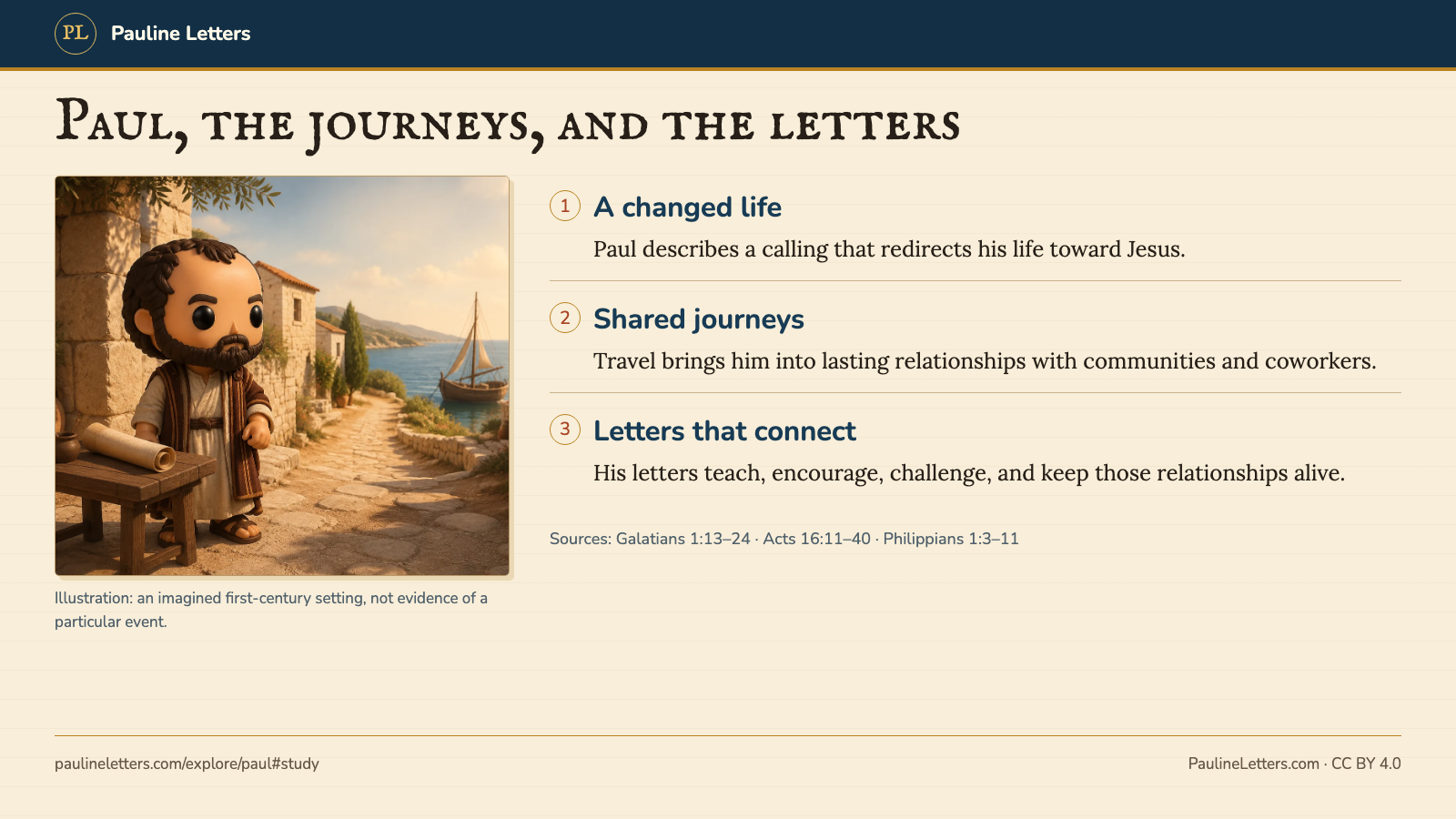
What this shows
Acts tells the story of Paul’s travels from a later narrative perspective. Paul’s letters let us hear him address particular communities and coworkers. Reading them together is rewarding, but they do not answer every historical question in the same way.
Galatians 1:13–24 · Acts 16:11–40 · Philippians 1:3–11
Study sessions
01A person before a timeline
Philippians 3:4–11 · Galatians 1:13–24
Paul was Jewish and remained deeply shaped by Israel’s Scriptures. He remembers opposing the movement he later joined. In his letters, encountering Jesus changes what he values and gives his work a new direction. “Apostle” means someone sent with a commission; Paul understands his calling as bringing the good news of Jesus to the nations.
For reflection What does Paul say changed, and what parts of his earlier life still matter to his story?
Save my place02Journeys that became relationships
Acts 16:11–40 · Philippians 1:3–11
Paul’s travels were more than a route across a map. In Philippi, Acts introduces households, conflict, imprisonment, and a new community. Later, Philippians remembers a continuing partnership. A place name becomes easier to remember when it is connected to people who welcomed, opposed, helped, or needed one another.
For reflection Which people stand out in Acts 16? What does Paul thank the Philippians for?
Save my place03Why write a letter?
1 Corinthians 1:10–17 · Philippians 4:10–20
A letter responds to a situation. Paul may thank a community, address divisions, explain his plans, or ask friends to help someone. We hear one side of a conversation, so careful readers distinguish what the letter says from what they infer about its recipients. An “epistle” is simply a letter.
For reflection What need or relationship seems to have prompted each passage? Which details are explicit, and which are your best inference?
Save my place04The good news and a shared life
1 Corinthians 15:1–5 · Romans 5:1–15 · Galatians 5:13–26
For Paul, the good news centers on Jesus’ death and resurrection and the new life God gives through him. Grace means God’s generous gift, rather than something people earn. This gift shapes how a community lives: trust in God belongs with love, patience, generosity, and service toward others.
For reflection How does Paul connect what God has done with the way people treat one another?
Save my place05Read a whole letter next
Philippians 1:1–4:23
Short passages become clearer within a whole letter. Philippians is a good next step: it moves through gratitude, hardship, humility, hope, reconciliation, and generosity. Read it once for the overall movement, then return slowly to the passages that raise questions. You do not need to solve everything on your first reading.
For reflection What repeated word, relationship, or question would you like to follow through Philippians?
Save my place1. A person before a timeline
Philippians 3:4–11 · Galatians 1:13–24
Paul was Jewish and remained deeply shaped by Israel’s Scriptures. He remembers opposing the movement he later joined. In his letters, encountering Jesus changes what he values and gives his work a new direction. “Apostle” means someone sent with a commission; Paul understands his calling as bringing the good news of Jesus to the nations.
For reflection What does Paul say changed, and what parts of his earlier life still matter to his story?
2. Journeys that became relationships
Acts 16:11–40 · Philippians 1:3–11
Paul’s travels were more than a route across a map. In Philippi, Acts introduces households, conflict, imprisonment, and a new community. Later, Philippians remembers a continuing partnership. A place name becomes easier to remember when it is connected to people who welcomed, opposed, helped, or needed one another.
For reflection Which people stand out in Acts 16? What does Paul thank the Philippians for?
3. Why write a letter?
1 Corinthians 1:10–17 · Philippians 4:10–20
A letter responds to a situation. Paul may thank a community, address divisions, explain his plans, or ask friends to help someone. We hear one side of a conversation, so careful readers distinguish what the letter says from what they infer about its recipients. An “epistle” is simply a letter.
For reflection What need or relationship seems to have prompted each passage? Which details are explicit, and which are your best inference?
4. The good news and a shared life
1 Corinthians 15:1–5 · Romans 5:1–15 · Galatians 5:13–26
For Paul, the good news centers on Jesus’ death and resurrection and the new life God gives through him. Grace means God’s generous gift, rather than something people earn. This gift shapes how a community lives: trust in God belongs with love, patience, generosity, and service toward others.
For reflection How does Paul connect what God has done with the way people treat one another?
5. Read a whole letter next
Philippians 1:1–4:23
Short passages become clearer within a whole letter. Philippians is a good next step: it moves through gratitude, hardship, humility, hope, reconciliation, and generosity. Read it once for the overall movement, then return slowly to the passages that raise questions. You do not need to solve everything on your first reading.
For reflection What repeated word, relationship, or question would you like to follow through Philippians?
Sources
Galatians 1:13–24 · Acts 16:11–40 · Philippians 1:3–11
Encounter Christ through Scripture, history, and thoughtful learning.
Enter the story