Pauline Letters · Evidence-led guide
Paul the Apostle: life, journeys, and letters
Paul is best understood as both a first-century Jewish apostle and a traveler whose letters arose from real communities and conflicts.
Reader question
What can Acts, Paul’s own letters, and later tradition each tell us about his life?
A Jewish apostle in the Roman world
Paul identifies himself as an Israelite of Benjamin and a Pharisee; Acts also presents him as a Roman citizen from Tarsus who was educated in Jerusalem. Those overlapping identities shaped his ability to move among synagogues, Greek-speaking cities, Roman officials, and emerging Gentile churches.
The earliest narrative scenes remember him as Saul, approving Stephen’s death and persecuting believers. The Damascus encounter reverses the direction of his life without erasing his Jewish formation: his later arguments continue to reason from Israel’s Scriptures while insisting that Gentiles are welcomed through Christ without first becoming Jews.
What the evidence can and cannot settle
Acts supplies the main travel narrative. The undisputed letters give Paul’s own occasional testimony and sometimes complicate Acts’ compressed sequence. The Pastoral Letters and later martyrdom traditions extend the proposed timeline beyond Acts, but their authorship and historical use are debated and are labeled accordingly throughout this project.
Common questions
When did Paul live?
No source records his birth or death dates. His documented activity runs from the persecution of the church around AD 33-34, through journeys and letters datable by the Gallio inscription to the 50s, to a Roman custody around AD 60-62 where Acts ends. Later tradition places his death under Nero in the mid-60s, and this project labels that as tradition rather than narrative.
Was Paul one of the twelve apostles?
No. The Twelve were followers of Jesus during his ministry, and Acts treats them as a distinct group. No surviving source records Paul meeting Jesus before the crucifixion; he grounds his apostleship in the Damascus encounter, calling himself one born at the wrong time, the least of the apostles because he persecuted the church.
How did Paul die?
Scripture never says. Acts ends with Paul under guard in Rome, still preaching, and no New Testament text narrates his death. A Roman letter from the late first century — 1 Clement — already speaks of his martyrdom, and later writers place his execution under Nero. This project presents that ending as tradition — early and widely held, but outside the narrative of Acts.
Why did Paul change his name from Saul?
He did not, as far as the texts show. Acts introduces the change in passing — "Saul, who is also called Paul" — with no conversion scene attached. The two names simply served two worlds: a Jewish name and a Roman one, for a man who moved through both. The story keeps calling him Saul until his mission turns toward Gentile cities.
Reading sessions
Meet Paul: a beginner’s path
Five short readings to connect the person, the journeys, and the letters.

You do not need to know the whole Bible to begin. Paul’s letters grew out of real relationships: communities learning to follow Jesus, friends supporting one another, and disagreements that needed patient attention. Read one session at a time, with a Bible beside you. The links lead to fuller explanations whenever a question catches your interest.
A person before a timeline
Read: Philippians 3:4–11 · Galatians 1:13–24
Paul was Jewish and remained deeply shaped by Israel’s Scriptures. He remembers opposing the movement he later joined. In his letters, encountering Jesus changes what he values and gives his work a new direction. “Apostle” means someone sent with a commission; Paul understands his calling as bringing the good news of Jesus to the nations.
Consider
What does Paul say changed, and what parts of his earlier life still matter to his story?
Journeys that became relationships
Read: Acts 16:11–40 · Philippians 1:3–11
Paul’s travels were more than a route across a map. In Philippi, Acts introduces households, conflict, imprisonment, and a new community. Later, Philippians remembers a continuing partnership. A place name becomes easier to remember when it is connected to people who welcomed, opposed, helped, or needed one another.
Consider
Which people stand out in Acts 16? What does Paul thank the Philippians for?
Why write a letter?
Read: 1 Corinthians 1:10–17 · Philippians 4:10–20
A letter responds to a situation. Paul may thank a community, address divisions, explain his plans, or ask friends to help someone. We hear one side of a conversation, so careful readers distinguish what the letter says from what they infer about its recipients. An “epistle” is simply a letter.
Consider
What need or relationship seems to have prompted each passage? Which details are explicit, and which are your best inference?
The good news and a shared life
Read: 1 Corinthians 15:1–5 · Romans 5:1–15 · Galatians 5:13–26
For Paul, the good news centers on Jesus’ death and resurrection and the new life God gives through him. Grace means God’s generous gift, rather than something people earn. This gift shapes how a community lives: trust in God belongs with love, patience, generosity, and service toward others.
Consider
How does Paul connect what God has done with the way people treat one another?
Read a whole letter next
Read: Philippians 1:1–4:23
Short passages become clearer within a whole letter. Philippians is a good next step: it moves through gratitude, hardship, humility, hope, reconciliation, and generosity. Read it once for the overall movement, then return slowly to the passages that raise questions. You do not need to solve everything on your first reading.
Consider
What repeated word, relationship, or question would you like to follow through Philippians?
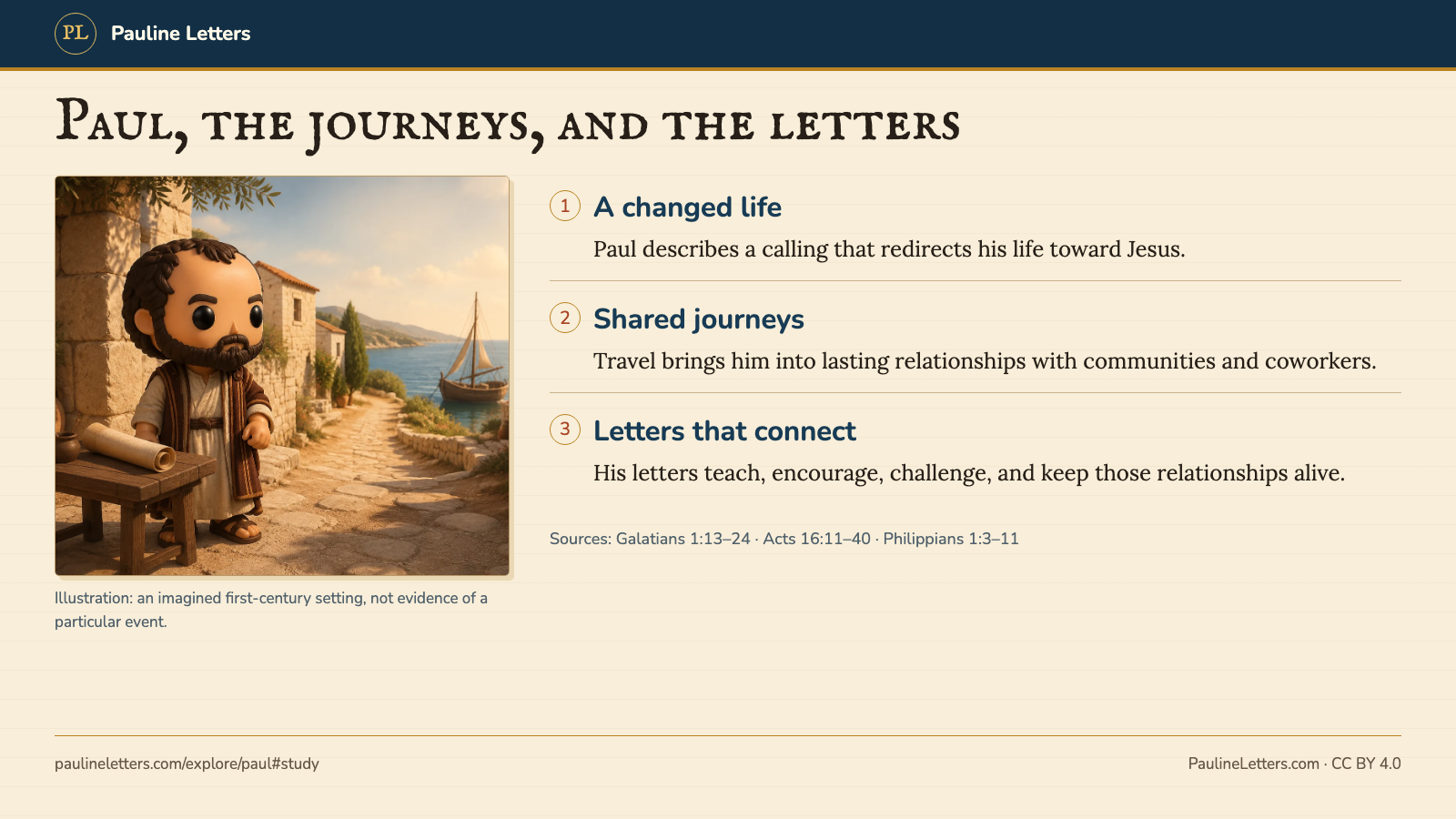
The idea in three steps
- A changed life
Paul describes a calling that redirects his life toward Jesus.
- Shared journeys
Travel brings him into lasting relationships with communities and coworkers.
- Letters that connect
His letters teach, encourage, challenge, and keep those relationships alive.
Take this with you
You may share and adapt these original study resources with credit to PaulineLetters.com (CC BY 4.0). Bible text is not included. Reuse terms
Bibliography and sources
- Acts 7–28, World English Bible (public domain). View source
- Romans through Philemon, World English Bible (public domain). View source
- The project’s 67-row chronology, cross-referencing Acts and the letters and labeling debated dates.