Philippians in seven sessions
Set aside a little time for each reading, whether you meet daily or weekly. Read the passage first, use the explanation to notice its setting, then return to the text with the question. The aim is attentive reading and a deeper life of faith, with room for honest questions.
Philippians 1:1–30 · Philippians 2:1–30 · Philippians 3:1–4:23
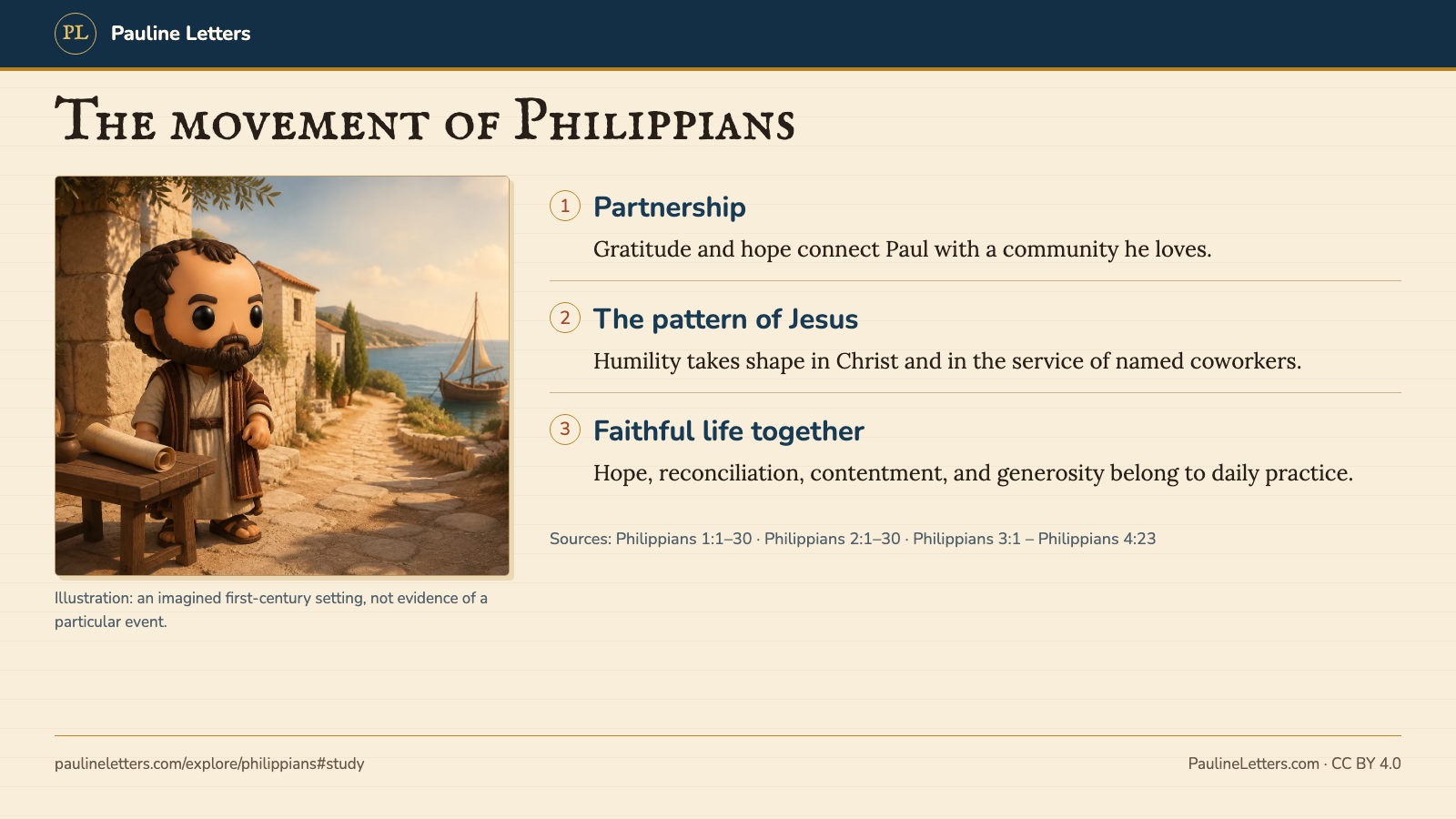
What this shows
Paul writes as a prisoner to a community that has supported his work. Rome is a common proposal for the location, while Ephesus and Caesarea are also discussed. The letter does not name the prison city, so its message need not depend on settling that question. Acts 16 provides background to Paul’s relationship with Philippi.
Philippians 1:1–30 · Philippians 2:1–30 · Philippians 3:1–4:23
Study sessions
011 · Gratitude and partnership
Philippians 1:1–11
Paul begins by remembering the Philippian community with affection. Their partnership is not just friendly feeling: it is participation in the good news over time. His prayer joins love with growing understanding and discernment—the ability to recognize what matters and choose well.
For reflection Who has helped your faith grow? How might love become more thoughtful, rather than merely more intense?
Save my place022 · Hope within hardship
Philippians 1:12–30
Imprisonment limits Paul’s movement but has not ended his witness. He weighs life and death while remaining concerned for the community’s growth. His courage does not make suffering good in itself. It shows how his hope in Christ shapes his response to circumstances he would not have chosen.
For reflection What does Paul hope will happen despite his confinement? What would standing together look like for the Philippians?
Save my place033 · The pattern of Jesus
Philippians 2:1–11
An appeal for unity leads into the letter’s account of Jesus’ humility and exaltation. Humility here is active concern for others, not the denial of their worth or our own. Paul directs the community away from rivalry and toward the self-giving pattern they recognize in Christ.
For reflection How does the account of Jesus explain the appeal at the start of the passage? Where could you practice concern for someone else?
Save my place044 · Faith with faces and names
Philippians 2:12–30
Paul’s appeal to faithful living is followed by Timothy and Epaphroditus, coworkers whose concern and service make the appeal concrete. Epaphroditus has been seriously ill. Paul’s praise of him honors costly service while also expressing relief and care for his recovery.
For reflection What qualities does Paul notice in his coworkers? Whose quiet service deserves recognition in your community?
Save my place055 · What is worth pursuing?
Philippians 3:1–21
Paul reconsiders the status and achievements that once gave him confidence. Knowing Christ has become more valuable. He describes life as an unfinished pursuit, with his hope directed toward resurrection. The passage invites commitment without pretending that spiritual growth is already complete.
For reflection What does Paul stop treating as his foundation? How does his unfinished pursuit encourage patience and perseverance?
Save my place066 · Reconciliation and peace
Philippians 4:1–9
Paul names a disagreement between Euodia and Syntyche and asks another person to help them. His teaching about prayer, thought, and practice belongs beside this practical appeal. Peace is not an instruction to ignore distress or avoid needed help; it is part of a shared life turned toward God.
For reflection How do the community’s responsibilities sit alongside the encouragement to pray? What small act could support reconciliation?
Save my place077 · Contentment and generosity
Philippians 4:10–23
The closing thanks returns to the Philippians’ material support. Paul has known both need and abundance. His confidence in Christ concerns endurance across those changing circumstances, rather than a promise that every ambition will succeed. Their gift matters because it expresses a continuing relationship.
For reflection How do receiving help, learning contentment, and giving generously belong together? What would you carry from this letter into the coming week?
Save my place1. 1 · Gratitude and partnership
Philippians 1:1–11
Paul begins by remembering the Philippian community with affection. Their partnership is not just friendly feeling: it is participation in the good news over time. His prayer joins love with growing understanding and discernment—the ability to recognize what matters and choose well.
For reflection Who has helped your faith grow? How might love become more thoughtful, rather than merely more intense?
2. 2 · Hope within hardship
Philippians 1:12–30
Imprisonment limits Paul’s movement but has not ended his witness. He weighs life and death while remaining concerned for the community’s growth. His courage does not make suffering good in itself. It shows how his hope in Christ shapes his response to circumstances he would not have chosen.
For reflection What does Paul hope will happen despite his confinement? What would standing together look like for the Philippians?
3. 3 · The pattern of Jesus
Philippians 2:1–11
An appeal for unity leads into the letter’s account of Jesus’ humility and exaltation. Humility here is active concern for others, not the denial of their worth or our own. Paul directs the community away from rivalry and toward the self-giving pattern they recognize in Christ.
For reflection How does the account of Jesus explain the appeal at the start of the passage? Where could you practice concern for someone else?
4. 4 · Faith with faces and names
Philippians 2:12–30
Paul’s appeal to faithful living is followed by Timothy and Epaphroditus, coworkers whose concern and service make the appeal concrete. Epaphroditus has been seriously ill. Paul’s praise of him honors costly service while also expressing relief and care for his recovery.
For reflection What qualities does Paul notice in his coworkers? Whose quiet service deserves recognition in your community?
5. 5 · What is worth pursuing?
Philippians 3:1–21
Paul reconsiders the status and achievements that once gave him confidence. Knowing Christ has become more valuable. He describes life as an unfinished pursuit, with his hope directed toward resurrection. The passage invites commitment without pretending that spiritual growth is already complete.
For reflection What does Paul stop treating as his foundation? How does his unfinished pursuit encourage patience and perseverance?
6. 6 · Reconciliation and peace
Philippians 4:1–9
Paul names a disagreement between Euodia and Syntyche and asks another person to help them. His teaching about prayer, thought, and practice belongs beside this practical appeal. Peace is not an instruction to ignore distress or avoid needed help; it is part of a shared life turned toward God.
For reflection How do the community’s responsibilities sit alongside the encouragement to pray? What small act could support reconciliation?
7. 7 · Contentment and generosity
Philippians 4:10–23
The closing thanks returns to the Philippians’ material support. Paul has known both need and abundance. His confidence in Christ concerns endurance across those changing circumstances, rather than a promise that every ambition will succeed. Their gift matters because it expresses a continuing relationship.
For reflection How do receiving help, learning contentment, and giving generously belong together? What would you carry from this letter into the coming week?
Sources
Philippians 1:1–30 · Philippians 2:1–30 · Philippians 3:1–4:23
Encounter Christ through Scripture, history, and thoughtful learning.
Enter the story