Letter guide · c. AD 60–62
Philippians
Philippians should be read as a letter to a particular community before it is reduced to a collection of isolated quotations.
A direct answer
Why did Paul write Philippians, and what is debated about its setting or authorship?
Philippians is a prison letter of partnership, gratitude, humility, perseverance, and joy written to a community Paul had helped found.
The letter’s exact composition history and prison location are not named in a way that settles every proposal.
- Date
- c. AD 60–62
- Place
- Traditionally Rome (location debated)
Confidence Inferred
A change of prison setting changes the date by years and affects how travel details are weighed.Confidence Inferred
A change of prison setting changes the date by years and affects how travel details are weighed.The audience is the church in Philippi, whose long partnership in Paul’s work includes named coworkers within the congregation.
Paul thanks the Philippians for their support, honors Epaphroditus, prepares for possible travel, and calls the church to a shared humility patterned on Christ.
Paul’s Voyage to Rome and Shipwreck
Acts records the founding of the Philippian church and later reaches Paul’s Roman custody, which frame the traditional reading of the letter.
Before and after
- Established
- Inferred
- Uncertain
c. AD 59/60
The storm and shipwreck; all 276 survive; the snakebite; healings on Malta.
Malta
Establishedc. AD 60
From Malta to Italy and up the Appian Way to Rome; the brothers meet him.
Malta · Syracuse · Rhegium · Puteoli · Forum Appii · Three Taverns · Rome
Establishedc. AD 60-62
Acts ends with Paul in Rome under house arrest. The prison-letter placements traditionally associated with this period are reconstructions, not claims made by Acts.
Rome
Establishedc. AD 60-62
Philemon says that Paul is sending Onesimus back to Philemon. Overlapping names with Colossians suggest a connection but do not establish a shared delivery, completed route, or prison city.
Inferredc. AD 60-62
Ephesians presents union with Christ and Jew–Gentile unity. Direct Pauline authorship, destination, and prison setting are debated.
Inferredc. AD 60-62
Philippians presents imprisonment as advancing the gospel and includes the Christ hymn. The prison city is debated.
Inferred
- Maltac. AD 59/60
- Malta · Syracuse · Rhegium · Puteoli · Forum Appii · Three Taverns · Romec. AD 60
- Romec. AD 60-62
- Philemon says that Paul is sending Onesimus back to Philemon. Overlapping names with Colossians suggest a connection but do not establish a shared delivery, completed route, or prison city.c. AD 60-62
- Ephesians presents union with Christ and Jew–Gentile unity. Direct Pauline authorship, destination, and prison setting are debated.c. AD 60-62
- Philippians presents imprisonment as advancing the gospel and includes the Christ hymn. The prison city is debated.c. AD 60-62
What the text establishes
Philippians is a prison letter of partnership, gratitude, humility, perseverance, and joy written to a community Paul had helped found.
Philippians 1:1–11; 4:10–20 · Philippians 1:12–26; 2:1–30; 4:10–20The letter’s exact composition history and prison location are not named in a way that settles every proposal.
The audience is the church in Philippi, whose long partnership in Paul’s work includes named coworkers within the congregation.
Philippians 1:1–11; 4:10–20 · Philippians 2:19–30; 4:2–3The internal house-church structure and every local tension cannot be reconstructed fully.
Paul thanks the Philippians for their support, honors Epaphroditus, prepares for possible travel, and calls the church to a shared humility patterned on Christ.
Philippians 1:12–26; 2:1–30; 4:10–20 · Philippians 1:1–11; 4:10–20The abrupt shifts in tone have led some interpreters to ask whether more than one note lies behind the canonical form.
Paul, Epaphroditus, Timothy, Euodia, and Syntyche give the letter a personal network linking Philippi with Paul’s imprisonment.
Philippians 2:19–30; 4:2–3 · Philippians 1:1–11; 4:10–20 · Philippians 1:12–14; 4:22The location of the prison must be inferred from indirect clues and travel possibilities.
Rome is a traditional rather than certain prison setting; Ephesus and Caesarea are credible alternatives.
Philippians 1:12–14; 4:22The available clues support more than one reconstruction and do not identify a prison city by name.
People and places
- Paulimprisoned writer
- Epaphroditusmessenger and coworker returning to Philippi
- Timothycoworker Paul hopes to send
- Euodianamed coworker urged toward agreement
- Syntychenamed coworker urged toward agreement
Rome · Philippi · Ephesus · Caesarea Maritima
Leading reconstruction
Rome around AD 60–62 is the traditional placement, but Ephesus and Caesarea are also proposed as the place of imprisonment.
Philippians 1:12–14; 4:22A change of prison setting changes the date by years and affects how travel details are weighed.
Other credible readings
An Ephesian or Caesarean imprisonment
Some scholars place the imprisonment at Ephesus or Caesarea rather than Rome, giving greater weight to travel distances and immediate danger.
The letter would be dated earlier and read closer to the third journey, though its partnership with Philippi remains central.
InferredWhy the readings differ Philippians is widely regarded as Pauline. The prison location is debated: Rome is traditional, while Ephesus and Caesarea have also been proposed. Pauline Letters uses the Roman setting and labels the date c. AD 60–62.
Sources
Primary texts
- Romans through Philemon, World English Bible (public domain).The Pauline letters
- Acts 7–28, World English Bible (public domain).The Acts of the Apostles
Scholarship
- Raymond E. Brown, An Introduction to the New Testament (Doubleday, 1997).
- Chapter 20, “Letter to the Philippians,” “General Analysis of the Message”Brown surveys the letter’s argument and occasion.
- Chapter 20, “Letter to the Philippians,” “From Where and When?”Brown compares Ephesus around AD 56, Caesarea around AD 58–60, and Rome around AD 61–63 as proposed imprisonment settings.
- Chapter 20, “Letter to the Philippians,” “Unity: One Letter or Two or Three?”Brown surveys proposals about the letter’s compositional unity.
- The project’s 67-row chronology, cross-referencing Acts and the letters and labeling debated dates.
- Jerome Murphy-O’Connor, Paul: A Critical Life (Oxford University Press, 1996).
- Chapter 1, “The Chronological Framework,” “The Evidence from the Pauline Letters” and “The Evidence from the Acts of the Apostles”Murphy-O’Connor explains why chronology must weigh the letters and Acts without treating either as a complete timetable.
Revision v1.2.0-evidence.20260902.4
- v1.2.0-evidence.20260902.4 ·
Teaching tools
A short, source-aware way to introduce this letter in a class, study group, or personal reading.
A ten-minute teaching plan
- Philippians is a prison letter of partnership, gratitude, humility, perseverance, and joy written to a community Paul had helped found.
- The Roman reconstruction places Philippians after Paul’s arrival in Rome alongside the prison letters; an Ephesian proposal moves it earlier in the third journey.
- Rome around AD 60–62 is the traditional placement, but Ephesus and Caesarea are also proposed as the place of imprisonment.
- Some scholars place the imprisonment at Ephesus or Caesarea rather than Rome, giving greater weight to travel distances and immediate danger.
Questions for discussion
- Why was this letter written?
- What is secure, and where do careful readers disagree?
Revision v1.2.0-evidence.20260902.4 · Reuse and attribution · PaulineLetters.com
- Date
- c. AD 60–62
- Written from
- Traditionally Rome (location debated)
- Authorship status
- Widely accepted as Pauline
- Setting confidence
- Rome, c. AD 60–62 (prison location debated)
- Key line
- Philippians 1:21 — “For to me to live is Christ, and to die is gain.”
- Earliest witness shown
- Papyrus 46, c. AD 200
Occasion and argument
A thank-you letter of joy to Philippi, written from prison.
Philippians is a prison letter sustained by partnership. The church has renewed its financial support through Epaphroditus, who became dangerously ill while serving Paul, and Paul writes with gratitude while returning him honorably. Joy in the letter is therefore neither optimism nor denial of suffering. It grows from shared work, costly friendship, and confidence that imprisonment has not stopped the proclamation of Christ.
The poetic account of Christ in chapter 2 gives the letter its moral center. Christ does not exploit status but takes the form of a servant, humbles himself, and is exalted by God. Paul places that pattern against rivalry and self-interest, then points to Timothy and Epaphroditus as embodied examples. The appeal to Euodia and Syntyche near the end makes unity concrete: two named coworkers are asked to recover agreement within a community they helped build.
The guide places Philippians alongside the travel chronology because its names, plans, conflicts, and greetings belong to a living network. Its key line, Philippians 1:21, is read in that larger movement rather than presented as a detached slogan.
Chronology and manuscript witness
Paul also writes under genuine threat. He weighs life and death, warns about opponents, and tells the Philippians that their citizenship is in heaven while they live in a Roman colony proud of its civic identity. Pressing toward the goal does not mean he has escaped weakness or already arrived. It describes a life oriented toward Christ while waiting for the transformation of mortal bodies.
Pauline authorship is widely accepted, but the prison is not named. Rome fits the traditional AD 60–62 chronology and references to the praetorium and Caesar’s household; Ephesus and Caesarea have also been proposed because of travel distances and the immediacy of danger. Abrupt changes in tone have additionally led some interpreters to suggest that more than one Pauline note was later joined. The guide uses Rome while keeping both questions visible.
Papyrus 46 (P46) is the witness pictured for this letter, dated c. AD 200 and associated with Chester Beatty Library, Dublin. Text shown. The image demonstrates textual survival in that manuscript tradition; it does not prove the proposed date or place of composition.
Common questions
When was Philippians written?
About AD 60-62 on the traditional reckoning, which places it in Roman custody. The letter names a prison but not a city, so the date depends on which imprisonment it belongs to.
Where was Philippians written from?
Rome traditionally, supported by references to the praetorium and Caesar’s household. Ephesus and Caesarea have also been proposed, largely because of the travel distances the letter’s messages imply. This project uses Rome and keeps the alternatives visible.
Who wrote Philippians?
Paul. It sits among the seven undisputed letters, though some interpreters have suggested that more than one Pauline note was later joined, on the strength of abrupt changes in tone.
What is the Christ hymn?
The poetic passage in chapter 2 describing Christ not exploiting his status, taking the form of a servant, humbling himself, and being exalted by God. Paul sets it against rivalry in the congregation, then points to Timothy and Epaphroditus as people living the same pattern.
Reading sessions
Philippians in seven sessions
A starter study in joy, humility, and life together.

Set aside a little time for each reading, whether you meet daily or weekly. Read the passage first, use the explanation to notice its setting, then return to the text with the question. The aim is attentive reading and a deeper life of faith, with room for honest questions.
Gratitude and partnership
Read: Philippians 1:1–11
Paul begins by remembering the Philippian community with affection. Their partnership is not just friendly feeling: it is participation in the good news over time. His prayer joins love with growing understanding and discernment—the ability to recognize what matters and choose well.
Consider
Who has helped your faith grow? How might love become more thoughtful, rather than merely more intense?
Hope within hardship
Read: Philippians 1:12–30
Imprisonment limits Paul’s movement but has not ended his witness. He weighs life and death while remaining concerned for the community’s growth. His courage does not make suffering good in itself. It shows how his hope in Christ shapes his response to circumstances he would not have chosen.
Consider
What does Paul hope will happen despite his confinement? What would standing together look like for the Philippians?
The pattern of Jesus
Read: Philippians 2:1–11
An appeal for unity leads into the letter’s account of Jesus’ humility and exaltation. Humility here is active concern for others, not the denial of their worth or our own. Paul directs the community away from rivalry and toward the self-giving pattern they recognize in Christ.
Consider
How does the account of Jesus explain the appeal at the start of the passage? Where could you practice concern for someone else?
Faith with faces and names
Read: Philippians 2:12–30
Paul’s appeal to faithful living is followed by Timothy and Epaphroditus, coworkers whose concern and service make the appeal concrete. Epaphroditus has been seriously ill. Paul’s praise of him honors costly service while also expressing relief and care for his recovery.
Consider
What qualities does Paul notice in his coworkers? Whose quiet service deserves recognition in your community?
What is worth pursuing?
Read: Philippians 3:1–21
Paul reconsiders the status and achievements that once gave him confidence. Knowing Christ has become more valuable. He describes life as an unfinished pursuit, with his hope directed toward resurrection. The passage invites commitment without pretending that spiritual growth is already complete.
Consider
What does Paul stop treating as his foundation? How does his unfinished pursuit encourage patience and perseverance?
Reconciliation and peace
Read: Philippians 4:1–9
Paul names a disagreement between Euodia and Syntyche and asks another person to help them. His teaching about prayer, thought, and practice belongs beside this practical appeal. Peace is not an instruction to ignore distress or avoid needed help; it is part of a shared life turned toward God.
Consider
How do the community’s responsibilities sit alongside the encouragement to pray? What small act could support reconciliation?
Contentment and generosity
Read: Philippians 4:10–23
The closing thanks returns to the Philippians’ material support. Paul has known both need and abundance. His confidence in Christ concerns endurance across those changing circumstances, rather than a promise that every ambition will succeed. Their gift matters because it expresses a continuing relationship.
Consider
How do receiving help, learning contentment, and giving generously belong together? What would you carry from this letter into the coming week?
The idea in three steps
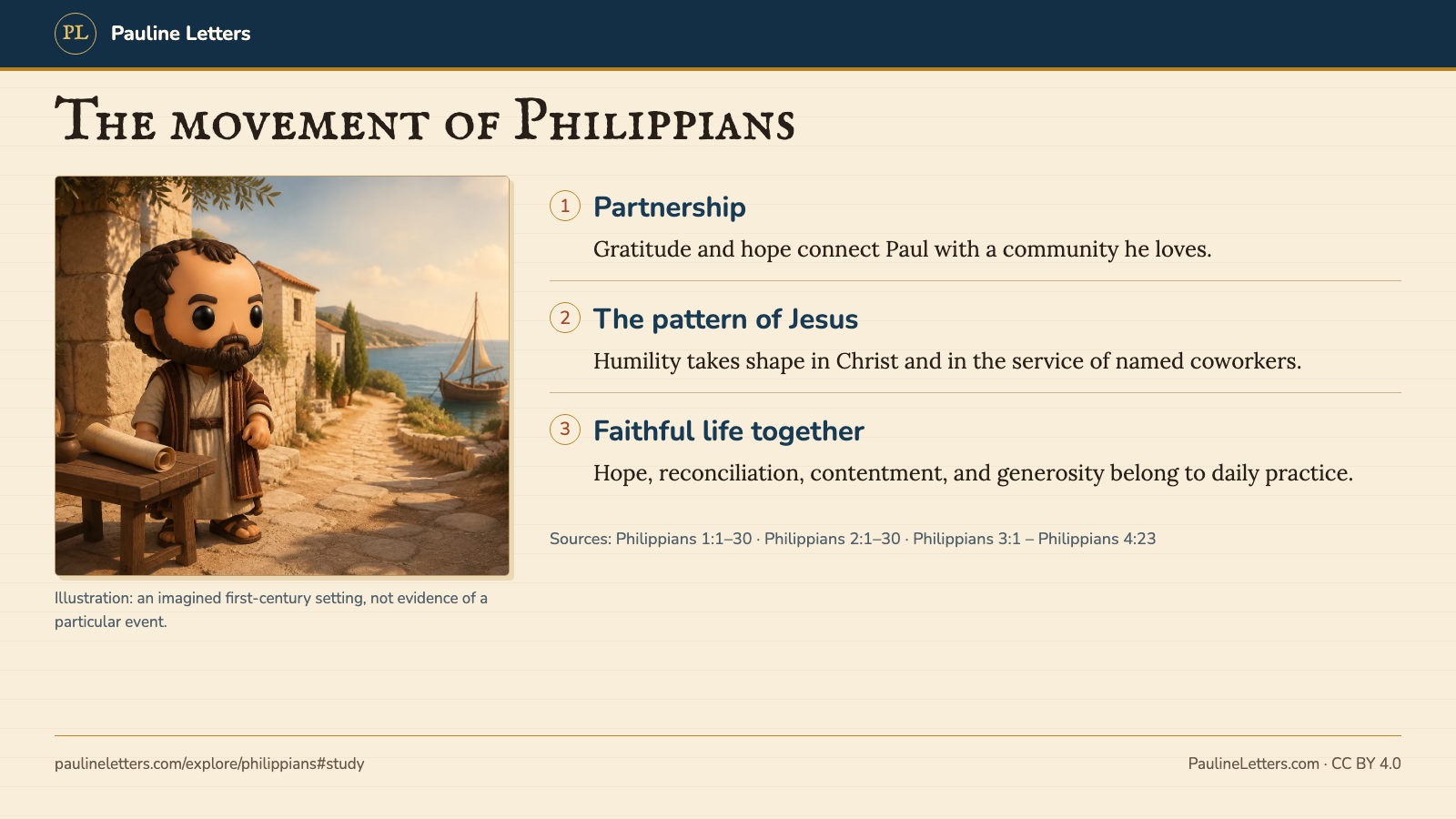
- Partnership
Gratitude and hope connect Paul with a community he loves.
- The pattern of Jesus
Humility takes shape in Christ and in the service of named coworkers.
- Faithful life together
Hope, reconciliation, contentment, and generosity belong to daily practice.
Take this with you
You may share and adapt these original study resources with credit to PaulineLetters.com (CC BY 4.0). Bible text is not included. Reuse terms
Bibliography and sources
- Romans through Philemon, World English Bible (public domain). View source
- The project’s 67-row chronology, cross-referencing Acts and the letters and labeling debated dates.
- Papyrus 46 and Codex Sinaiticus records, repositories, image sources, and rights in the Pauline Letters manuscript registry.
- Raymond E. Brown, An Introduction to the New Testament (Doubleday, 1997).
- E. P. Sanders, Paul: The Apostle’s Life, Letters, and Thought (Fortress Press, 2015).